John Bristow hires Cormoran Strike to investigate Lula Landry's death
The Cuckoo's CallingJohn Bristow’s decision to hire Cormoran Strike transforms a disputed death into an active investigation. Bristow rejects the official conclusion that his sister, Lula Landry, died by suicide and insists that someone pushed her from her balcony. Strike initially resists the commission, reasoning that the death had already received unusually intense police and media scrutiny; he accepts only after recognizing that Bristow’s demand is for justice, not another attempt to explain away his grief. The resulting inquiry reopens apparently settled evidence and ultimately makes small inconsistencies in the original account newly consequential.
The Commission and Its Turning Point
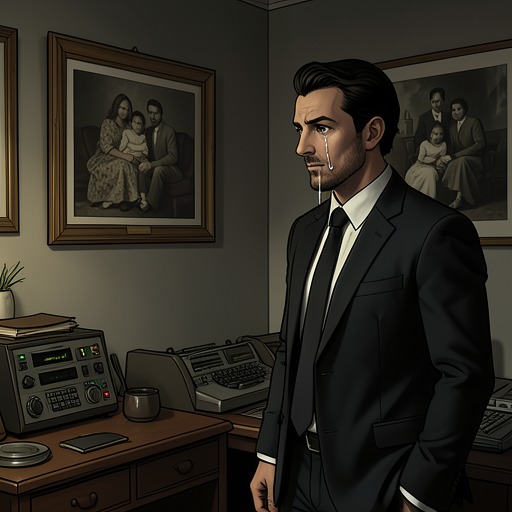
Bristow arrives with an envelope of money and a categorical belief that Lula did not kill herself. His insistence is bound up with a series of losses: he names his brother Charlie, his father, Lula, and his dying mother. Strike first tells him that he does not think it would be right to take his money. He points to the inquest and the scale of public attention, arguing that the police investigation was likely more thorough than usual and cautioning that suicide can be difficult to accept. Bristow answers that Lula was pushed from her balcony. His anger makes clear that he hears Strike’s hesitation as another effort to treat his conviction as bereavement rather than evidence.
The decisive shift comes when Bristow says that all he wants is justice. Strike responds by inviting him to sit down again and agreeing to help. The change is not simply commercial: although Strike needs money, the narrative presents Bristow’s appeal to justice as the stronger reason for setting aside his scruples. The commission thus begins with a tension between professional skepticism and an ethical willingness to investigate a claim that the official process has already closed.
Terms and Investigative Method
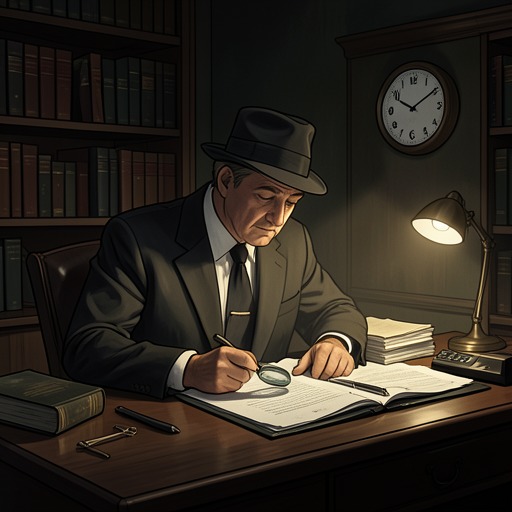
Once Bristow has outlined the case, Strike asks him to recount the day Lula died. He lets the account emerge in the client’s own order before organizing it into people, places, and property, a deliberate method intended to preserve details that might seem insignificant at first. At the end of the meeting, Strike promises to read his notes, do preliminary work, and call within a couple of days with further questions. He asks for a month’s fee in advance, names an exorbitant amount, and then requests that a quarter be paid in cash. Bristow agrees without bargaining, supplying cash alongside the cheque.
That financial arrangement establishes the practical terms of the case, but the investigation’s real structure is evidential. Strike does not assume that prior police attention guarantees that every meaningful question was asked or every discovered fact correctly interpreted. He later tells Spanner that the police may have been looking for the wrong things, or may not have understood the significance of what they found. He asks for activity on Lula’s laptop on or leading up to 8 January, including recent internet searches, rather than simply duplicating the police’s focus on her recent emails. The commission therefore develops into a re-examination of both evidence and the assumptions guiding its interpretation.
Reopening Witnesses and the Scene
Bristow’s claim also gives Strike a reason to approach people connected to Lula. When he speaks with Rochelle Onifade, he explains that John is unsure Lula committed suicide and has asked him to look again at the circumstances. The interview brings the client’s conviction into the investigation’s social world: it is no longer only a theory argued in Strike’s office, but the stated reason for questioning those who knew Lula.
Strike’s scrutiny of the case includes the Bestiguies’ accounts. In the police file, Freddie Bestigui had said that he and Lula had never visited each other’s flats and that their shared stay at Dickie Carbury’s had done little to advance their acquaintance. More important to Strike is the uncertainty surrounding the moments after Tansy Bestigui saw Lula fall. Tansy repeatedly maintained that Freddie had been in bed asleep, yet Strike regards the Bestiguies’ precise positions at the time as unproven. Her shifting stories and the gesture with which she shielded her face when he pressed the point strengthen his reservations; the presence of cocaine on the side of the bath adds another concrete detail to the account he is assessing.
The investigation also returns to Derrick Wilson’s first search of Lula’s flat. Strike asks him to demonstrate the order in which he searched the rooms, turning recollection into a practical reconstruction of movement through the building. On the stairs Wilson suddenly remembers that he slipped backwards and sat down hard on water droplets. That recollection supplies a previously overlooked physical detail, not yet an explanation by itself, but one that makes the search route and the source of the water relevant questions.
From Commission to Reconstruction
Later, Strike identifies how that minor trace fits the account he presents to Bristow: the killer took white roses from a vase in Flat Two, wiped their ends, and carried them upstairs to Lula’s flat. A few drops of water remained, and Wilson slipped on them while searching. The roses were not merely an atmospheric detail in the reconstruction. They explain why Wilson remembered water on the stairs and connect the intruder’s movements between the two flats to an accidental mark left behind.
Strike’s reconstruction continues from the roses to the encounter at Lula’s door. He says that the visitor knocked carrying them; when Lula looked through the peephole, she saw the flowers. She had been waiting for her brother to come down the street and was surprised that he seemed to have arrived without her seeing him. In that moment of excitement, she opened the door. The commission that began with Bristow’s refusal to accept suicide thus culminates in a specific account of how the killer gained entry, built from circumstances that the initial verdict had not resolved.
Significance
The hiring marks a shift from public certainty to investigative uncertainty. The death had been so widely reported that Strike already knew more about it than he had wanted to know, and he recognizes how constant coverage can leave ordinary people feeling informed and opinionated before they are fit to judge the evidence. Bristow’s commission challenges that premature closure without treating his certainty, on its own, as proof.
The investigation’s force comes instead from the discipline of reopening details: who was where, what the police looked for, how a search proceeded, and what a few drops of water could reveal about movement through the building. Bristow supplies the demand for justice; Strike’s method gives that demand a testable form. The hiring is therefore both the beginning of a detective case and the moment when an officially settled account becomes a question again.