Media frenzy surrounding Lula Landry’s death
The Cuckoo's CallingThe media frenzy surrounding Lula Landry’s death transforms a private tragedy into a national spectacle, first displaying her death as breaking news and then packaging her life, appearance, and presumed instability into competing public narratives. The coverage brings vast attention to the case but also narrows Lula into a marketable image, while the rush to explain her death encourages confident conclusions before the evidence has been fully examined.
The death becomes a public spectacle
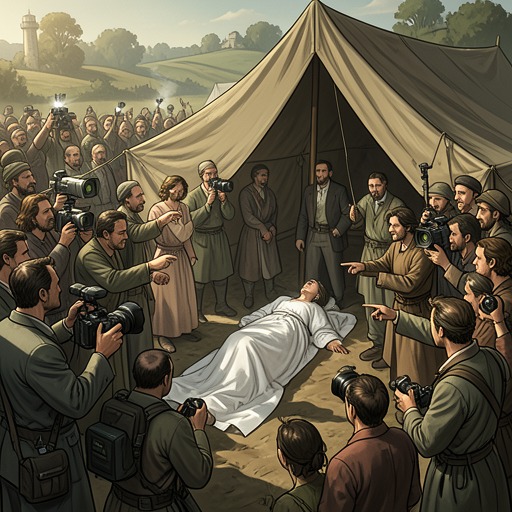
Photographers gather behind police barriers on a snowy Mayfair street, their cameras directed toward the white tent concealing Lula’s body, the entrance to 18 Kentigern Gardens, and the balcony from which she fell. Satellite-equipped television vans and reporters fill the street; members of the public raise their phones to photograph the scene, and a group of young girls bring flowers as cameras follow their movements. The street’s orderly façades and clipped shrubs become a backdrop to an event already being consumed as an image.
Twenty-four-hour news correspondents sustain speculation despite having only a few sensational facts. Reports repeat the approximate time of the fall and the security guard’s alert to police, while the delay in moving the body prompts further conjecture. The coverage does not merely relay what is known: even the gaps in knowledge become material for speculation.
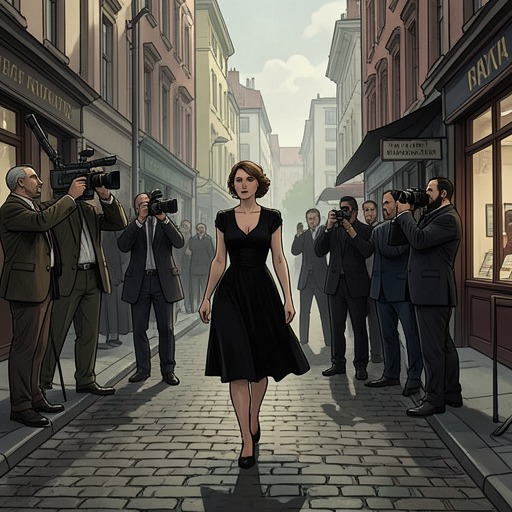
Within hours, the story has displaced politics, wars, and disasters. Reports and broadcasts circulate Lula’s face and body alongside a compact sequence of dramatic details: a public quarrel with her famous boyfriend, her journey home alone, screaming that was allegedly overheard, and the fatal fall. Her boyfriend retreats to a rehabilitation facility, people who had been with her are pursued by reporters, and the witness who claims to have heard another argument acquires a smaller form of celebrity beside the images of the dead model.
Competing explanations and the news cycle
The witness’s account initially feeds the possibility that Lula was killed. When investigators establish that the woman had lied, she withdraws to rehabilitation, and the famous boyfriend—previously treated as a prime suspect—recedes from the center of the story. The public narrative changes direction with conspicuous speed: after a brief pause of disappointment, the conclusion becomes suicide.
Coverage then recasts the death as a morality tale. Commentators describe Lula as unstable and unsuited to superstardom, attributing her fate to a supposedly corrupting wealthy world and to her own fragile personality. The repeated allusions to Icarus cast her rise and fall as a cautionary legend, replacing uncertainty about a particular death with a simplified account of excess and punishment. The same attention that had pursued a possible murderer now supplies a ready-made judgment about the dead woman.
The frenzy eventually loses its momentum. The narrative’s succession of renewed attention and fatigue shows that the public story depends less on sustained understanding than on fresh developments and striking images. Once reporters have exhausted their available material, the coverage falls quiet, with the sense that too much has already been said.
The public image and the market for attention
A later newspaper commentary asks why readers and viewers care so intensely about Lula. It questions whether her beauty and mixed-race appearance represented genuine change in the fashion industry or simply a commercially appealing look for that season. The article contrasts the extensive public attention to a famous model with the relative invisibility of other young women who die in circumstances that receive little sustained notice. In doing so, it treats fame not as proof of public grief but as a mechanism that distributes visibility unevenly.
The commentary also argues that audiences mourn an image more readily than a person. Lula’s appearance circulated through celebrity magazines and newspapers as a promise attached to clothes, handbags, and celebrity itself; after her death, the imagined promise appeared temporary and hollow. The article connects this image to the public’s appetite for the entertaining persona of a glamorous, unruly model, whose reported drug use, expensive clothes, and troubled on-and-off relationship supplied a continuing supply of stories.
That conversion of personal life into commercial material continues after death. A fashion photograph featuring Lula and Ciara Porter appears in a campaign for Guy Somé’s designs about a week after the inquest’s suicide verdict. Lula is pictured with large wings, and the composition draws attention to her face; the image attracts criticism that Guy Somé is profiting from her recent death. At the same time, an online admirer insists that Lula had loved the designer and would have wanted the photograph to serve as a tribute. The same image can therefore be read as exploitation, commemoration, and the continuation of a brand.
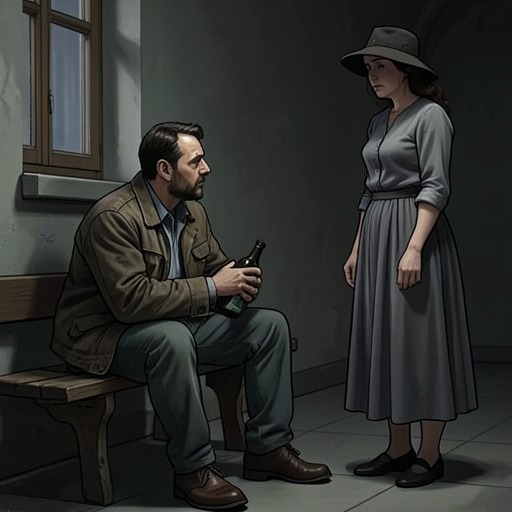
The commentary contrasts this public consumption with a quieter account of friendship. A woman who met Lula at a treatment facility attended her funeral, sat in a rear pew, and left without selling her story. Her restraint becomes evidence, within the article, of a more private relationship with the person behind the celebrity image. The contrast is pointed: the commercial story prizes access and disclosure, while this mourner’s refusal to market her connection preserves its intimacy.
Public certainty and the investigation
The media story’s early confidence contrasts with the difficulty of establishing what happened. At the inquest, the detective leading the case is said to have been convinced from the outset that Lula died by suicide because she was taking lithium. The claim that this assumption shaped the investigation raises a question about how a known medical condition can become a shortcut to a conclusion, rather than one fact to be weighed alongside others.
The treatment of Tansy Bestigui’s testimony offers another example of identity shaping credibility. She maintained that she had heard a man arguing with Lula shortly before the fall, but police discounted her account because she had taken cocaine. Investigators later tested her revised claim that she had opened the windows: after the Bestiguis left their flat to escape the press, police recreated the sound conditions with a man shouting from Lula’s balcony. They also found no fingerprints on the window latches, which had been cleaned the day before, and the windows were locked and bolted when officers arrived. The later account of a press hounding a supposed witness thus sits beside a concrete effort to test what she could have heard and done.
Digital speculation also persists after the initial news cycle. Online lists of unanswered questions ask who called off the paparazzi, why two men seen running away from Kentigern Gardens did not come forward, and why Lula was wearing a different outfit from the one in which she had returned home. These questions circulate as conjecture, but they identify details that a sensational summary cannot settle. Cormoran Strike, hired by Lula’s brother, receives a police file containing witness statements, DNA information, visitor-book pages, medication details, the autopsy report, medical and telephone records, laptop findings, and a DVD marked “CCTV 2 Runners.” The documentary record is more extensive than the public story’s handful of dramatic facts, yet it is within those records that he begins to look again at the case.
The frenzy therefore has a double effect: it makes Lula’s death impossible for the public to ignore, while encouraging a premature sense that everyone already understands it. Its images and judgments outlast the initial news event, but they cannot substitute for investigation. As Strike revisits the evidence, the contrast between the loud certainty of coverage and the patient work of examining records becomes central to the case’s continuing meaning.