Yvette Bristow’s Valium dependence
The Cuckoo's CallingYvette Bristow’s Valium dependence emerges in the course of Cormoran Strike’s interview with her, amid her recollections of Lula Landry and the losses that have marked the Bristow family. In her room, Yvette asks Strike to fetch pills from her bedside drawer; he finds enough Valium for repeated overdoses, and a nurse later confirms that Yvette has been receiving prescriptions from three doctors for years. The dependence is not incidental background: it shapes the interview’s conditions and forms part of a wider pattern in which illness and medication influence how characters interpret distress and behavior.
Identity and context
Yvette is the adoptive mother of Lula and the mother of Charlie Bristow. In recalling Lula’s search for her birth mother, she places that search against the period when she was seriously ill: she had just been diagnosed with cancer, the tumor was advanced, and she began chemotherapy. She says that John Bristow and Tony Landry were angry with Lula for pursuing her birth family while Yvette was so unwell, and remembers John taking her to hospital and staying with her during the worst of the treatment.
Her account conveys the family’s grief and competing loyalties, but it also comes from a woman whose own health is failing. Yvette attributes Lula’s perceived self-absorption to being spoiled and wonders whether that was her fault, linking her own indulgence of Lula to the earlier loss of Charlie. Her reflections therefore place the Valium dependence within a household shaped by cancer, bereavement, and strained family relationships, without establishing that any one of those circumstances caused it.
Dependence disclosed during the interview
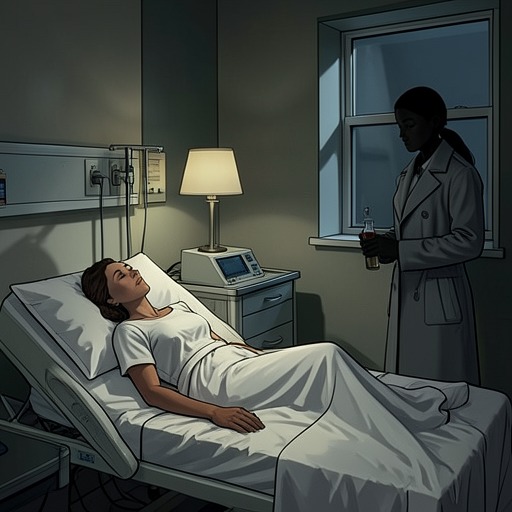
When Yvette’s eyes fill with tears as she speaks of losing Lula, she asks Strike to look in the bedside drawer and get her pills. The drawer contains many white boxes with different labels. Asked which ones she wants, Yvette says they are all the same. Strike selects a box clearly labeled Valium, and the quantity in the drawer is sufficient for her to overdose many times.
Yvette asks him to remove a couple of pills so that she can take them with tea. Her hands tremble, and Strike steadies the saucer as he gives her the pills and cup. The exchange shows her access to Valium as immediate and routine: the medicine is kept among an extensive supply within reach of her bed, and she requests it as part of the conversation rather than as an unusual intervention. The evidence establishes both her reliance on the drug and the substantial quantity available, but does not specify her prescribed dose or how much she has already taken.
As the interview continues, Yvette’s speech becomes increasingly slurred and she closes her eyes drowsily. Strike wonders how much Valium she has already taken. The scene does not establish a precise amount or prove that her tablets alone account for her condition; it does show that her medication use is relevant to his reading of the encounter and to his concern about her alertness.
Prescriptions and confirmation
After leaving Yvette’s room, Strike asks the nurse whether Yvette’s Valium addiction is still as severe as before. The nurse confirms that it is, while adding that, given Yvette’s condition, it cannot harm her now. She also says that labels on the boxes indicate three doctors have been prescribing Valium to Yvette for years, and criticizes the doctors’ practice as unprofessional.
This exchange turns what might have appeared to be a private, isolated habit into a sustained pattern supported by the medication supply and the nurse’s account of long-term prescribing. The nurse’s qualification—that it cannot harm Yvette now—places the dependence against her grave illness, but does not erase its duration or the apparent ease with which multiple prescriptions were obtained. Strike’s question and the nurse’s answer supply confirmation beyond Yvette’s request for pills.
Illness, interpretation, and narrative significance
The episode belongs to a larger investigation in which medical history repeatedly affects how evidence is judged. John Bristow argues that the police and coroner treated Lula’s bipolar disorder and lithium medication as grounds for viewing her death as suicide, overlooking other evidence. Strike, by contrast, cautions himself that a person’s apparent interest in future plans does not rule out suicide. The novel thus distinguishes diagnosis and medication from any simple conclusion about motive or state of mind.
Other testimony in the investigation is also filtered through assumptions about illness and drugs. Eric Wardle dismisses Tansy Bestigui’s account of hearing an argument as an auditory hallucination caused by cocaine use, and Rochelle Onifade describes depression as an illness that can take hold. These accounts do not make Yvette’s Valium dependence equivalent to Lula’s mental-health history or Tansy’s drug use; rather, they show how labels and medication become part of the language through which characters explain, discount, or assess testimony.
Yvette’s dependence is therefore presented through concrete circumstances rather than a medical history: the crowded drawer, the Valium box, the request for pills, her drowsiness, and the nurse’s confirmation of years of prescriptions. That sequence also marks a limit in the evidence. It establishes a serious, longstanding dependence and its presence during Strike’s visit, while leaving the precise effects of the drug on Yvette’s recollections and the exact extent of her use unresolved.