“Left, right, left, right”
The Curious Incident of the Dog in the Night-TimeThe “Left, right, left, right” chant is Christopher’s rhythmic tool for navigating fear and sensory overload. As he escapes through unfamiliar railway spaces, repeating the words gives his movement a dependable beat; paired with an imagined red line, it helps him keep going when noise, crowds, and uncertainty threaten to overwhelm him.
Origin and Use
Christopher explains that when he is frightened or angry, doing something with a rhythm, like music or drumming, can help. Siobhan taught him this strategy. The chant is therefore not simply a marching refrain: it is a learned method for regulating his response and directing his body through a difficult environment.
The First Railway Crossing
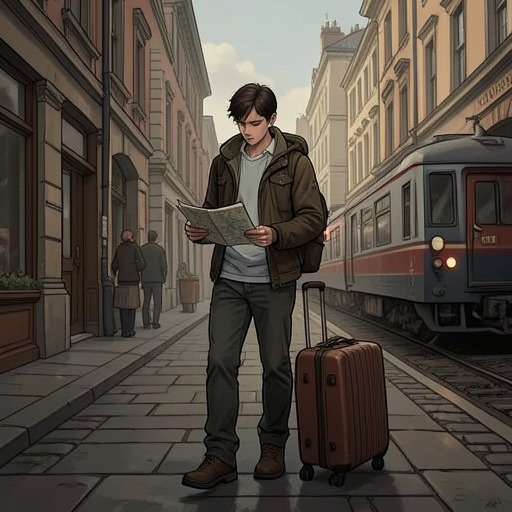
At the station, signs and the movement of strangers become overwhelming. After someone bumps into him, Christopher makes a noise like a dog barking to scare the person away. He pictures a big red line beginning at his feet and running through the underpass, then starts walking along it while repeating the chant. The imagined route and the spoken rhythm work together: one supplies direction, the other a steady pace.
Following the line, Christopher goes up the stairs toward Platform 1. Another collision, this time with someone carrying a suitcase, prompts another bark-like noise. The chant does not make the station safe or quiet, but it gives him a repeatable action amid its unpredictable interruptions. Checking his watch, he calculates that three minutes have passed since the ticket office and that the train will leave in two minutes.
Return at the Station
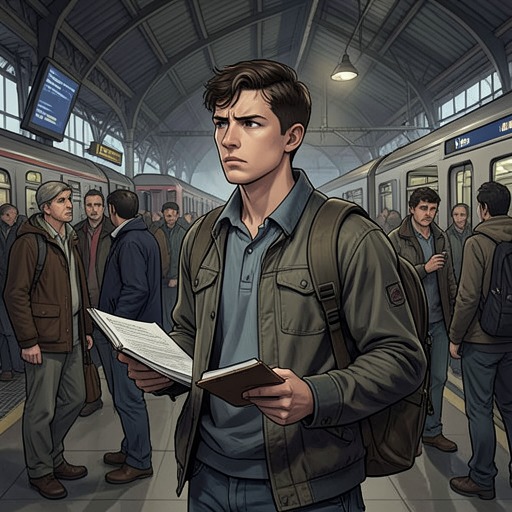
Later, after seeing a policeman searching beneath the seats in another carriage, Christopher gets off the train. The scale and echoing noise of the station room make him kneel because he thinks he may fall over. Once there, he works out which direction to take: he reasons that if this is the last stop, London lies in the direction the train had been travelling.
He then imagines another red line, this one running parallel to the train toward the gate at the far end, and walks along it repeating “Left, right, left, right . . .” The recurrence marks both the persistence of his fear and the usefulness of the routine: the surrounding situation has changed, but he can draw on the same practiced sequence. At the gate, a man tells him that someone is looking for him. Christopher asks who, thinking it might be Mother after the policeman in Swindon called her.
Form and Significance
The repeated words make an abstract coping strategy audible and concrete. Their even beat contrasts with the station’s collisions, signs, noise, and uncertain directions; the imagined red lines turn that rhythm into a route across the floor. The chant does not remove the distress or guarantee safety. Instead, it helps Christopher take the next step, first through the underpass and later toward the station gate.