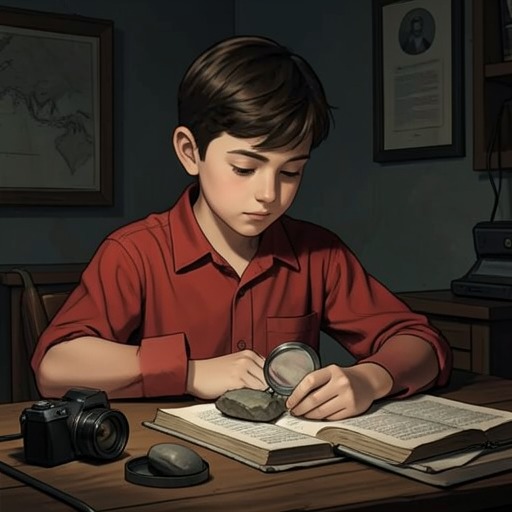
“My memory is like a film”
The Curious Incident of the Dog in the Night-Time“My memory is like a film” describes how Christopher understands and uses recollection: not as a vague impression, but as a searchable sequence of scenes that can be revisited and examined. The comparison explains both his unusual precision about remembered details and the practical method by which he makes sense of people and situations.
Recollection as Playback
Christopher says his memory is like a film because he can recall conversations, what people wore, and what they smelled like. He calls the olfactory component a “smelltrack,” extending the familiar idea of a soundtrack to a sense that is especially useful in his recollections. Memory, in this account, preserves more than the words spoken: it records a scene’s sensory particulars.
He describes controlling recall with the terms “Rewind,” “Fast Forward,” and “Pause,” like operating a video recorder, though he compares the process more closely to a DVD player because he can reach a distant memory without replaying everything that happened between. The controls are not physical buttons; the playback takes place in his head. This makes the analogy a description of a mental procedure rather than a claim that memories are literally stored as films.
Scenes and Their Limits
When asked what his mother was like, Christopher says he can rewind to different scenes and describe her as she appeared in each. The example presents memory as episodic: a person is recovered through particular moments, rather than reduced to one summary characteristic. It also shows how the film metaphor shapes the book’s narration, allowing a question about someone’s identity to open onto a sharply bounded remembered scene.
The account has a stated limit. Christopher cannot remember anything from before he was about four, because, as he explains it, he was not looking at things in the right way for them to be properly recorded. The metaphor therefore implies not only reliable access to remembered material but also a boundary where recording did not take place.
Searching Memory for Practical Guidance
Christopher also describes memory as a search system. To recognize someone whose identity he does not know, he notices identifying features such as clothing, a walking stick, unusual hair, glasses, or a characteristic way of moving the arms, then searches his memories for a match. Recognition is presented as a comparison between observed details and previously encountered people.
The same procedure helps him decide how to act when a situation is difficult or other people’s words do not make sense. He searches memory for an earlier occasion when he heard a phrase, treating past encounters as a reference library for interpreting the present. The film image thus connects recollection to action: memories are not merely replayed for their own sake but consulted to guide recognition and response.