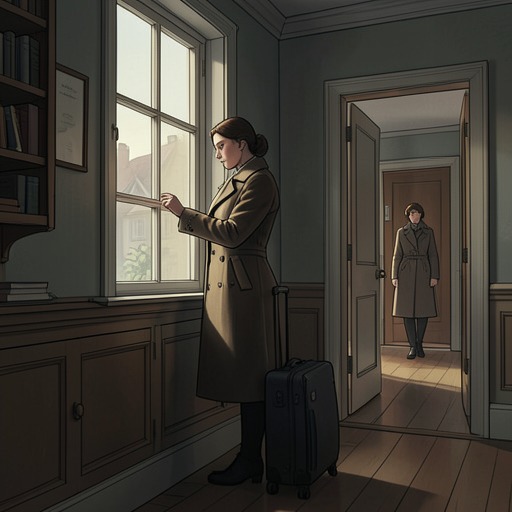
451c Chapter Road
The Curious Incident of the Dog in the Night-Time451c Chapter Road is the London address Christopher sets out to find after Father confesses to killing Wellington. First encountered as a precise destination in Mother’s postmarked letter, the address gives Christopher a route out of Swindon and toward the mother he had been told was dead; reaching it brings him to Mother and Roger Shears, and converts his journey from a plan into a family reunion.
The address and its significance
The address enters the story through a sealed envelope Christopher discovers beneath his book in the shirt box. It is addressed to him at 36 Randolph Street, but the letter’s lack of a date leaves him unsure when it was written and whether someone else might have pretended to be Mother. The postmark resolves the crucial question: it shows that Mother sent it on 16 October 1997, eighteen months after she was said to have died. The address in the letter therefore does more than identify a London residence. It establishes that Mother is alive and gives Christopher concrete evidence against the account he had trusted.
When Christopher decides that London is the only place he can go, he treats the journey as a problem to solve by eliminating options, as he might in a mathematics examination. The destination is not vague: he knows the address as 451c Chapter Road, London NW2 5NG, and can give it exactly when asked. A train timetable, station signs and a street route can turn the plan into successive tasks. The address becomes a point of certainty amid the larger uncertainty of leaving home.
The journey to Chapter Road
The route is made up of connected but demanding stages. At Swindon station, Christopher is overwhelmed by the crowds, echoing tunnel, smells and competing sounds; he holds on to a sign to steady himself, then finds a seat and tries to clear his thoughts with a maths problem. Later in London, he uses a red line imagined on the floor to guide himself through the station, keeps hold of his Swiss Army knife and Toby, and follows signs toward Willesden Junction on the Bakerloo Line. Reading the signs and choosing a direction make the transport network usable one decision at a time, even as close crowds and unfamiliar escalators make movement difficult.
After leaving Willesden Junction, Christopher studies the shape of the roads and identifies Station Approach and Oak Lane as the streets he needs. It takes him 27 minutes to reach 451c Chapter Road. When he presses the button marked Flat C, no one answers. He cannot go back to Swindon, so he waits outside, hoping Mother is not away on holiday. The address has brought him to the right place, but arriving does not yet guarantee that anyone will be there to receive him.
Arrival and reunion
Christopher waits in the small garden in front of the address, hidden behind dustbins and beneath a bush. When a woman enters with Roger Shears, Christopher recognizes Mother’s voice and stands up to tell her he had waited because she had not been in. Mother responds by saying his name; Roger’s surprised response makes clear that Christopher’s unexpected arrival is also a disruption for the adults there. The address is thus the scene of reunion, but not a smooth or uncomplicated one: Christopher has reached Mother, while her presence with Roger introduces the circumstances of her life in London.
Mother takes Christopher inside and directs him to follow Roger up the stairs to Flat C. Though Christopher is afraid of entering a place he does not know, he makes a map of the flat in his head to feel safer. Mother runs him a bath and gives Toby water and bran flakes; Christopher lets Toby explore the bathroom, then returns to the bath. These ordinary acts mark the move from waiting outside to being cared for inside the home, while Christopher’s need to map the unfamiliar rooms shows that arrival does not erase his anxiety.
Narrative role
The address is a small piece of exact information around which a major change in Christopher’s understanding is built. The letter’s postmark overturns the claim that Mother has died; the address then makes that revelation actionable. Christopher turns what he has learned into a plan, navigates a journey through stations and streets, and arrives at the home where Mother lives. In this way, 451c Chapter Road links the detective plot’s discovery of concealed truth to the physical plot of escape and reunion. It is both a destination that can be read, followed and reached, and the threshold of a family situation Christopher has not yet learned how to understand.