Astronaut dreams with outer space
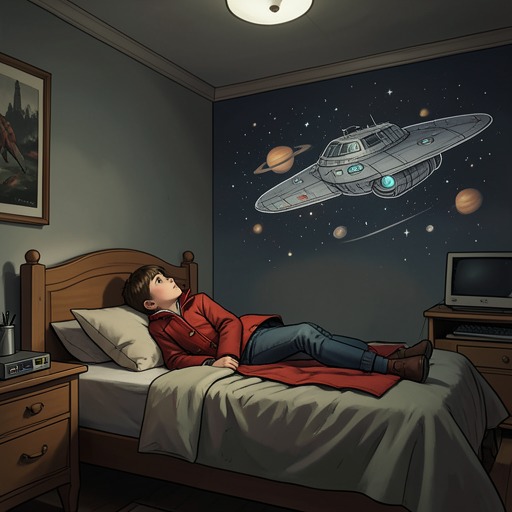
The Curious Incident of the Dog in the Night-TimeThe astronaut dream and Christopher’s fascination with outer space are intertwined: space offers an imaginable future shaped by machines, solitude, and stars, while astronomy lets him reason independently about the universe and his own small place within it. His conviction that he could be a good astronaut is not simply a fantasy of adventure. It is a carefully specified ideal of independence, and later, when he must contemplate living in London, the same vast distance that once promised freedom becomes a source of grief.
The Universe as Something to Work Out
Christopher values the expanding universe because it is an explanation he can reach by thinking through what he sees. He likes the account of why the night sky is dark: although the universe contains billions of stars, the universe is expanding, and light from the most distant stars cannot reach Earth because those stars are moving away at nearly the speed of light. The fact matters to him partly because it can be reasoned out from looking up at the night sky, without having to ask anyone.
His account extends beyond the present into an imagined ending. He supposes that when the universe has finished expanding, the stars will slow, stop, and fall back toward its center; as they move toward Earth, their light will eventually fill the sky with a brightness that signals the end of the world. The vision is immense but follows a chain of cause and effect. It also includes its own bleak qualification: people may already be extinct, and anyone left could be burned to death by the light. Outer space is not only beautiful or consoling in Christopher’s thinking; it is a system whose consequences can be followed even to a future in which no observer remains.
That habit of reasoning connects astronomy to his sense of what it means to be clever. Noticing how things are is, for Christopher, observation; cleverness means using evidence to work out something new, whether the expansion of the universe or the identity of a murderer. His interest in space therefore belongs to the same intellectual method as his investigations: inspect a fact, trace its implications, and arrive at an explanation that can stand on its own.
The Astronaut as an Achievable Ideal
When Mr. Jeavons asks whether Christopher dislikes change, Christopher distinguishes change itself from change imposed on him. He says he would not mind changing if he became an astronaut, describing it as one of the biggest changes imaginable. Asked directly whether he wants to become one, he says yes. The exchange makes the aspiration more than a passing fancy: becoming an astronaut is a future he actively wants, even though he understands it is unlikely.
Christopher knows some of the obstacles. Becoming an astronaut would require becoming an air-force officer, following many orders, and being prepared to kill other people; he cannot take orders. He also lacks the 20/20 vision required to be a pilot. These practical limits do not cancel the desire. He insists that it is possible to want something even when it is very unlikely, preserving the dream without pretending that its difficulties are unreal.
He also rejects the idea that the dream is foolish merely because others dismiss his prospects. Terry predicts that Christopher will only find work collecting supermarket trolleys or cleaning a donkey sanctuary, and says that people like him will not be allowed to pilot billion-pound rockets. Christopher recounts this judgment to Father, who answers that Terry is jealous of Christopher’s intelligence. Christopher finds that explanation stupid because he does not see himself as competing with Terry. The exchange sets the scale of Christopher’s ambition against other people’s assumptions about what he can do, while his own case rests on specific capacities rather than on a claim that success is guaranteed.
Designing a Life in Space
Christopher’s imagined astronaut life is organized around the conditions that would make an unfamiliar world manageable. He believes he has the intelligence to qualify and understands how machines work. He thinks he could tolerate a tiny spacecraft thousands of miles from Earth without panic, claustrophobia, homesickness, or madness, because he likes very small spaces when he is alone. At home, he sometimes sits for hours in the airing cupboard beside the boiler, with the door closed, and finds the solitude calming. His plan is therefore conditional: he would need to travel alone, or have a part of the spacecraft that nobody else could enter.
The imagined craft is appealing in practical as well as emotional terms. There would be no yellow or brown things inside it. Contact with Mission Control would take place through a radio link and television monitor, so the people there would not feel like strangers physically present with him; the interaction would be more like playing a computer game. Machines and computers would surround him, and the small window would look out on thousands of miles without anyone nearby. The dream turns distance into a controlled environment, with technology mediating contact and a boundary protecting solitude.
Christopher has already rehearsed that view from Earth. On summer nights he lies on the lawn and frames the sky with his hands, blocking out the fence, chimney, and washing line so that he can pretend he is in space. The gesture transforms an ordinary garden into an imagined spacecraft window. The stars beyond it are not merely decoration: he knows that the molecules from which life is made were constructed in stars, including the iron in human blood. Cosmic distance thus connects the remote universe to the material composition of the body.
He would like to take Toby with him. Since animals are sometimes sent into space for experiments, Christopher imagines finding an experiment that would not hurt the rat and using it to make the case. But he does not make the entire ambition depend on bringing Toby along: even if permission were refused, he would still go, because the journey would be a dream come true. The qualification reveals both his attachment to Toby and the force of the aspiration itself.
The Night Sky in the Garden
Looking at the sky remains part of Christopher’s ordinary life as well as his imagined future. In the garden at night, he watches the constellation Orion above the shed and the neighboring plant. He resists the familiar picture of a hunter: the stars are only points, and they could be joined into any number of patterns, including a woman with an umbrella, Mrs. Shears’s Italian coffee maker, or a dinosaur. The episode shows his preference for what can actually be observed over the story attached to it. Yet it also makes the sky a field for imagination, where alternative figures can be made without mistaking them for facts.
Christopher uses a planisphere, a pair of plastic circles joined by a pin, to find the map of the sky visible from a particular place and time of year. Its markings take account of latitude, including Swindon’s position at 51.5 degrees north. The device makes the sky legible through a procedure: turn the upper circle to align with the date and consult the opening to see the appropriate map. For Christopher, wonder and exactness are not opposites. The stars can be immense and distant while still being approached through a practical, usable instrument.
Contemplating them also changes the scale on which he measures personal trouble. Some stars are hundreds or thousands of light-years away; some may already have died or exploded and collapsed into red dwarfs, their light still traveling toward Earth. Thinking about this makes Christopher feel small, and he finds it useful to regard difficult things in his own life as negligible—so small that they need not count in a calculation. Space offers perspective, not because his difficulties disappear, but because he can place them within a much larger frame.
Distance and the Cost of Change
That perspective becomes harder to hold when Christopher has to think about going to London to live with Mother. He knows the practical sequence for a train journey from playing with his train set: check the timetable, buy a ticket, consult the departure board, find the platform, and board. But as he sits near Mrs. Shears’s house, an old rusty metal pan lid looks to him like a planet, its rust forming countries, continents, and islands. In that moment, the astronomy of imagined travel is drawn into the real problem of leaving home.
Christopher concludes that he can never become an astronaut. Space would put him hundreds of thousands of miles from home, but home is now in London, about a hundred miles away—more than a thousand times nearer than a spacecraft would be. The comparison is mathematically clear and emotionally devastating. He describes the pain as internal, like the intense hurt of a cut knee being cleaned with disinfectant, and says the thought of losing the astronaut future makes him sad.
He then thinks of Sherlock Holmes and the ability to detach his mind so that he will not notice how much the thought hurts. This response echoes his earlier confidence that he could reason about the universe from observation: calculation can give shape to distance, but it cannot prevent distance from becoming a loss. Across the book, the astronaut dream consequently holds two meanings at once. It is a genuine, detailed ambition founded on Christopher’s preferred conditions and strengths, and it is an image of remoteness whose emotional meaning changes when separation from home ceases to be imaginary.