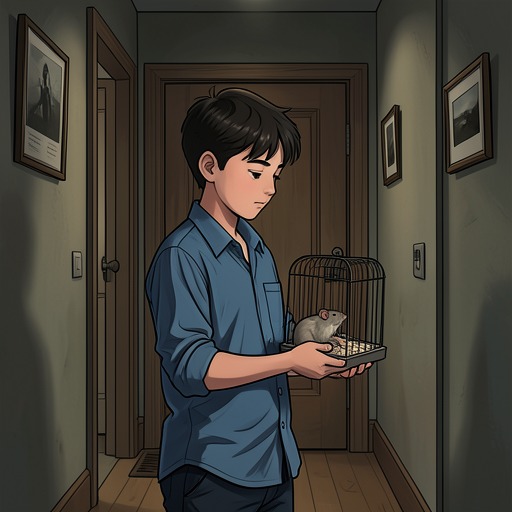
Christopher Boone and Toby’s owner–pet relationship
The Curious Incident of the Dog in the Night-TimeChristopher Boone and Toby’s owner–pet relationship is a bond of routine care that becomes a test of responsibility when Christopher leaves home. Toby is not merely a pet Christopher mentions in passing: Christopher feeds him, makes decisions around his needs, carries him during a dangerous departure, and carefully explains how another person can care for him. The relationship gives Christopher a concrete duty to preserve even as his own circumstances become uncertain.
Toby in Christopher’s Daily Life
Toby is Christopher’s pet rat, and caring for him is woven into Christopher’s domestic routine. After returning home, Christopher gets a carrot for Toby, goes upstairs, lets him out, and gives him the food. The sequence is specific and dependable: Christopher attends to Toby before turning to his own solitary activities, including playing Minesweeper. Later, after coming home from an investigation, he again goes upstairs and feeds Toby, feeling happy that he has been acting as a detective. Toby’s care thus recurs alongside the ordinary habits through which Christopher organizes his life.
Christopher also keeps three pellets of rat food among the possessions in his pockets. The detail places Toby’s needs within the material inventory Christopher carries with him, rather than leaving the relationship confined to the home. Food for Toby sits among a Swiss Army knife with thirteen attachments, a piece of string, puzzle piece, money, a red paper clip, and the front-door key. The pellets are a small but telling sign that caring for Toby is part of how Christopher prepares for and understands his surroundings.
Care as Practical Knowledge
Christopher’s concern for Toby takes the form of precise instructions. When he asks Mrs. Alexander to look after the rat, he explains that Toby eats special pellets available from a pet shop, but can also eat biscuits, carrots, bread, and chicken bones. He warns her not to give Toby chocolate because it is poisonous to rats in large quantities, and adds that Toby needs fresh water in his bottle every day. He also describes Toby’s habits: the rat likes to come out of his cage, though it is not essential that someone let him out.
This explanation is more than a request for help. Christopher gives Mrs. Alexander enough concrete information to maintain Toby’s care in his absence, including what to feed him, what to avoid, and how to handle his routine. When she asks why he needs someone to look after Toby, Christopher answers that he is going to London. His impending journey is expressed through the practical question of who will care for the animal he cannot simply leave behind.
Leaving Home with Toby
The strongest test of the relationship comes when Christopher decides to leave home at night. He takes both his coats and his scarf because the night will be cold, then returns upstairs to collect Toby’s cage. Toby is making scratching noises, so Christopher places one coat over the cage to quiet them. The quieting serves the immediate need to leave without waking his sleeping father, while the coat also provides protection for Toby during the journey out of the house.
Christopher carries the cage downstairs and leaves his other coat over it because he does not want Toby to get cold and die. He then takes his special food box, unlocks the back door, and holds the handle down as he closes it to prevent the latch from making a loud click. At the bottom of the garden, he avoids the shed because he expects his father might search there. He squeezes into the gap behind the shed, between its wall and the fence, behind a large black rainwater tub, and sits with Toby. In this hidden, exposed moment, the decision to leave does not dissolve Christopher’s responsibility for his pet; his attention remains on keeping Toby warm and with him.
Protection, Dependence, and Significance
Christopher’s appeal to Mrs. Alexander makes clear that he recognizes the limits of what he can provide while travelling. He holds up Toby’s cage to show her the animal and describes how Toby can manage in another person’s home. He even says that Toby will not mind being in someone else’s house because he is an animal. The remark is Christopher’s practical assessment of Toby’s adaptability, not a reason to neglect him: he still asks for a caretaker and supplies detailed guidance.
The relationship is marked less by declarations of affection than by repeated acts and usable knowledge: a carrot after arriving home, food pellets carried in a pocket, a coat over the cage, and a careful account of feeding and water. These details show how Christopher expresses attachment through responsibility. Toby’s presence also changes the terms of Christopher’s escape: Christopher must plan not only where he can go, but how to keep a dependent animal safe. The bond therefore makes care visible as a concrete practice that persists through upheaval.