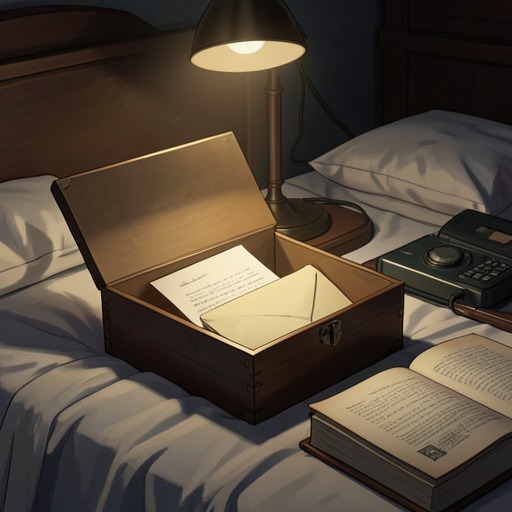
Christopher discovers his mother’s letters and learns she is alive
The Curious Incident of the Dog in the Night-TimeChristopher discovers Mother’s letters while searching Father’s room for his confiscated manuscript, and the find dismantles the family history he has been given: a letter postmarked eighteen months after Mother’s supposed death proves she is alive. The revelation makes Father’s lie as consequential as the murder Christopher has been investigating, and transforms a search through hidden belongings into a decisive breach of trust.
The search and the hidden box
Christopher enters Father’s room looking for his book. In the clothes cupboard, he first finds an upper shelf holding magazines, a broken sandwich toaster, twelve wire coat hangers, and an old hair dryer that had belonged to Mother. Below it is a transparent gray toolbox filled with do-it-yourself equipment. When he lifts the toolbox, he finds a second container underneath: an old cardboard shirt box.
Christopher opens the shirt box and sees his book inside. His relief that Father has not thrown it away immediately gives way to the problem of taking it: he has promised not to interfere with Father’s things, and expects Father would be angry if he discovered the search. Hearing Father’s van arrive, Christopher decides to leave the manuscript in place and continue writing in a secret second book instead. He reasons that Father may eventually return the original and that, even if he does not, Christopher can remember and reconstruct what he has written. The discovery of the letters begins in the same concealed space as the recovery of the manuscript, but it carries a far greater consequence.
The envelope and the postmark
Under the book, Christopher notices an envelope addressed to him among other envelopes. It has never been opened. He picks it up while Father is returning to the house. The address identifies Christopher at 36 Randolph Street, and the envelope’s postmark gives the crucial evidence: although difficult to read, its date is 16 October 1997, eighteen months after the date when Mother was said to have died.
The date contradicts Christopher’s settled understanding of his family. He believes Mother had never lived in London, had always lived with the family, and had never written to him. He also thinks her work was as a secretary for a large garage, not for a steel company, as the letter’s contents suggest. Because he cannot initially place the letter within what he knows, he considers whether someone else might have written it in Mother’s name. The postmark supplies a concrete fact that this uncertainty cannot explain away: the letter was sent after her supposed death.
Reading the letter and recognizing the lie
Christopher begins reading the correspondence but stops when he feels sick. The letter describes ordinary details of Mother’s life, including a recent dental visit and the recovery that followed it. These details establish a continuing life beyond the story Christopher has been told. He concludes that Mother did not have a heart attack and had not died; she had been alive all along, while Father had lied about her death.
The force of the revelation lies partly in its documentary form. The envelope, address, and postmark are not explanations offered by Father but physical traces Christopher can inspect and reason from. His discovery moves from a hidden object to a date, from the date to a contradiction, and from that contradiction to a revised account of his family. At the same time, the letter does not resolve every uncertainty: Christopher had initially questioned whether it was genuinely from Mother, and the available evidence establishes what its postmark proves without supplying a complete history of how or why the correspondence was kept from him.
The murder investigation reframed
Before finding the letters, Christopher has already tried to solve Wellington’s murder through physical clues and explicit reasoning. A fork with green plastic handles, found clean in Mrs. Shears’s locked shed, resembles the fork that had been used to kill Wellington. Christopher considers whether Mrs. Shears might have killed the dog, but reasons that the weapon could instead have belonged to someone with access to the shed. The fork is a clue, not a settled identification of the killer.
He later builds a chain of reasoning around possible motives for killing a dog: hatred of the dog, madness, or a wish to upset Mrs. Shears. Since he knows no one who hated Wellington or whom he considers mad, he reasons that those possibilities point toward a stranger. But he also recalls that murder is often committed by someone known to the victim. The third possibility directs him toward Mr. Shears, who had been married to Mrs. Shears and left her two years earlier. Christopher names him his prime suspect and tells Father that he thinks Mr. Shears probably killed Wellington to make Mrs. Shears sad. Father’s warning to stay out of other people’s business precedes this disclosure; at that point, Christopher does not know that the investigation reaches into his own home.
Father’s confession and the changed stakes
The later discovery of the letters changes the meaning of what Christopher has been told, and Father eventually adds a second revelation: he admits that he killed Wellington. He explains that after Mother left, Mrs. Shears helped the family and supported him through a difficult period. He had expected her to keep visiting and had imagined that they might eventually live together, either in his house or hers; he says he thought they were friends and had misjudged the relationship. This confession identifies Father, rather than Christopher’s prime suspect, as Wellington’s killer and ties the murder to Father’s expectations of Mrs. Shears.
The letters therefore do more than establish that Mother is alive. They expose the unreliability of the account on which Christopher’s understanding of his family rests, just as his investigation is moving toward a conclusion Father has concealed. The sequence sets material evidence against assurances: a dated envelope overturns the story of Mother’s death, and Father’s later words disclose his responsibility for Wellington. For Christopher, the result is not merely a corrected answer to a mystery but the collapse of trust in the person whose explanations had defined the truth of home.