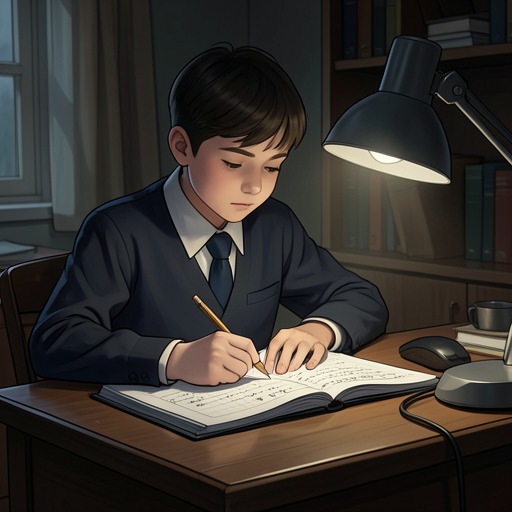
Christopher takes the mathematics A-level exam
The Curious Incident of the Dog in the Night-TimeChristopher takes the mathematics A-level after returning to school amid upheaval at home, and the exam becomes both a practical challenge and a measure of his determination to keep a promised place in his timetable. Siobhan and school staff preserve the opportunity for him to sit the papers; despite tiredness, anxiety, and difficulty recalling material, he completes the exams and earns an A.
Arrangements and the decision to sit
When Christopher returns to school, Siobhan tells him that Mrs. Gascoyne has kept his A-level papers in three sealed envelopes in her desk. The school is exploring whether he can still take the examination: Siobhan plans to contact Reverend Peters to ask him to invigilate, while Mrs. Gascoyne is to write to the examination board to request permission for Christopher to sit it after all. The outcome is not yet certain, but Siobhan tells him so he can consider the possibility.
The choice comes at a difficult moment. Christopher wants the qualification, but he is exhausted; when he tries to think about mathematics, he feels unable to work properly, and he cannot recall facts such as the logarithmic formula for the approximate number of prime numbers not greater than x. This failure of recall frightens him. Siobhan makes clear that he is not obliged to take the exam and that declining would not be wrong or foolish. Christopher chooses to proceed because he dislikes having to remove an item from his timetable: changing it makes him feel sick. His decision is therefore both a commitment to mathematics and an effort to preserve the order that his plans provide.
The three examination papers
Reverend Peters arrives at the school at 3:27 p.m. to supervise the first paper. Christopher sits Paper 1 in the Art Room. The invigilator reads The Cost of Discipleship by Dietrich Bonhoeffer and eats a sandwich; partway through, he steps outside the window to smoke while continuing to watch Christopher in case he cheats. These ordinary details frame an exam that Christopher experiences as anything but routine.
On opening the paper, Christopher finds that he cannot think how to answer any of the questions and cannot breathe properly. He feels an urge to strike or stab someone, but there is no one available to hit except Reverend Peters, whom he recognizes he must not attack if he is to keep the invigilator for the rest of the exam. Instead, he follows the coping method Siobhan has taught him for moments when he wants to hit someone at school: he takes deep breaths, counts fifty breaths, and works through cubes of the cardinal numbers as he counts. The scene shows the exam’s immediate pressure and the concrete procedure he uses to remain in the room and continue.
The next day, before Paper 2, Siobhan sends Christopher to sit alone in the toilets and practise breathing and counting. Reverend Peters again reads The Cost of Discipleship, but this time he does not smoke. For Paper 3, the following day, he reads the Daily Mail and smokes three cigarettes. The papers thus unfold across three separate sittings, with small changes in the invigilator’s routine and continued support from Siobhan helping mark the structure of the examination.
Support, strain, and family upheaval
The examination takes place against the strain of Christopher’s disrupted family life. After the first paper, Father returns to the house; Christopher screams, while Mother reassures him that she will not let anything bad happen to him. Christopher goes into the garden and lies looking at the stars. Father later comes outside, looks at him for a long time, punches a hole in the fence, and leaves. Christopher sleeps only a little, though he is able to eat spinach soup for supper. The scene makes clear that sitting the exam does not remove the fear and tension at home; the work continues alongside them.
The wider disruption also reaches the school and the exam arrangements. Siobhan explains that Christopher has been upset and has not been eating or sleeping properly, and she works with Mrs. Gascoyne to keep his papers available and seek permission for him to sit. Her role is not simply to urge him onward: she offers a real choice, explains what is known and uncertain, and prepares him with a specific breathing-and-counting routine. That clear support contrasts with situations in which Christopher is left to interpret indirect communication or unspoken expectations.
Result and significance
Christopher receives an A, the best grade, and the result gives him a distinct achievement after the uncertainty of whether he would be able to sit the examination at all. The outcome follows three papers completed under pressure, after he has confronted gaps in his recall and used counting and breathing to manage the first paper. The grade confirms not that the difficulties disappear, but that he can complete a demanding academic task while they remain.
The A-level also gives the novel a concrete measure of Christopher’s persistence. His timetable is not a casual preference: the prospect of taking an item out of it is itself distressing, and choosing to sit the exam lets him hold to a plan through disrupted sleep, family conflict, and uncertainty about the examination board’s approval. The eventual A answers the earlier fear that his tired mind may not work properly with evidence of what he has accomplished, while the three-paper structure records the sustained effort behind that result.