Christopher took the Mathematics A-level exam and obtained an A
The Curious Incident of the Dog in the Night-TimeChristopher’s mathematics A-level is both an academic achievement and a measure of his ability to keep moving toward a goal after disruption. He insists on taking the examination even when fatigue makes mathematical recall difficult and the first paper overwhelms him; later, the award of an A turns that persistence into a result he can point to. The event’s significance lies not only in the grade, but in the way a timetable, a school’s practical support, and strategies for managing distress help make the exam possible.
Opportunity Preserved
After Christopher returns to school with his mother, Siobhan tells him that his examination papers are still there, sealed in three envelopes in Mrs. Gascoyne’s desk. The papers have not been lost or discarded while his circumstances have been unsettled. Siobhan explains that the school can still arrange for him to take the examination, although the necessary arrangements have to be confirmed: she and the school will contact Reverend Peters, who can act as invigilator, and Mrs. Gascoyne will write to the examination board. The possibility is real but not yet guaranteed.
Siobhan presents the decision without making Christopher’s choice a test of obedience or worth. She tells him he does not have to sit the exam and that declining would not be wrong, illegal, or stupid. That reassurance matters because his exhaustion is substantial: he is not sleeping or eating properly, and he cannot readily recall even a mathematical formula he knows. The choice to continue therefore comes from Christopher himself, rather than from pressure to satisfy the adults around him.
Choosing to Sit the Exam
Christopher says he wants to take the A-level because removing an item from his timetable makes him feel sick. A planned event has a particular force for him: once it is entered into the sequence of things to be done, abandoning it is not a neutral adjustment. His decision connects the examination to the order and predictability he depends on, while also showing that his commitment persists despite his fear that fatigue has interfered with his ability to think.
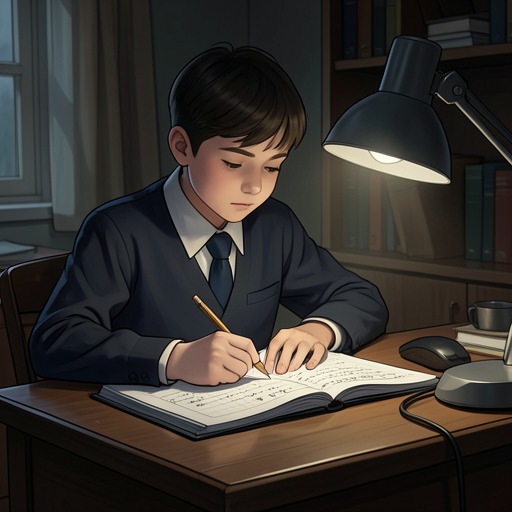
Siobhan acts on that decision by telephoning Reverend Peters. He arrives at the school at 3:27 p.m., and Christopher sits Paper 1 in the Art Room with him as invigilator. The room, time, and arrangements make the exam a specific, supervised undertaking rather than an abstract intention. Reverend Peters reads while Christopher works, and watches from outside the window when he steps out to smoke, maintaining his role as invigilator.
Managing the First Paper
When Christopher opens Paper 1, he cannot think how to answer any of the questions and has difficulty breathing. He feels an urge to lash out, but recognizes that doing so would leave him without an invigilator for the rest of the exam. Instead, he uses a strategy Siobhan has taught him: he takes deep breaths and counts fifty breaths, combining the count with cubes of cardinal numbers. The method does not erase the difficulty of the paper; it gives him a sequence of actions to follow while he remains in the exam.
The scene draws together two kinds of support. Siobhan’s earlier instruction supplies a concrete procedure, while Christopher applies it himself at the moment when his concentration and breathing fail him. The examination consequently tests more than mathematical knowledge: it also places his routines and self-management under strain. The evidence describes the distress of the first paper but does not suggest that it prevents him from continuing.
Completing the Papers and Receiving the Result
Christopher also sits Paper 3. Reverend Peters reads the Daily Mail and smokes three cigarettes while invigilating that paper. The account thus records another completed examination, not merely the crisis of the opening paper. The examination unfolds across separate papers and sessions, with Christopher returning to the task after the difficulty he experienced at the start.
The result comes later: Christopher earns an A, the best grade. The achievement resolves the uncertainty that had accompanied his decision and his fear that he could not remember what he needed. It is a concrete outcome, rather than a claim that the examination was easy or that his earlier distress vanished. His success confirms that he completed the A-level despite those obstacles.
Aftermath and Significance
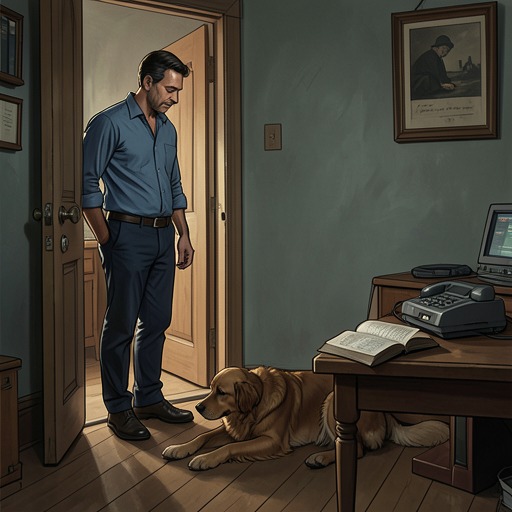
The grade is followed by further signs of change in Christopher’s everyday life. His father gives him a puppy, which Christopher names Sandy, and he is allowed to take the dog to the shop and back. When Christopher’s mother has flu and he stays at his father’s house for three days, Sandy sleeps on his bed. Christopher also helps his father plant carrots, peas, and spinach in the garden. These details do not make the exam the cause of every improvement, but they place its success within a later period in which school achievement, family contact, and ordinary responsibilities coexist.
As an event, the A-level gives Christopher a goal with a clear measure of completion: he chooses to sit, works through the papers, and receives the highest grade. Its significance is strengthened by the contrast between the unsettled circumstances surrounding the exam and the precise arrangements that preserve it—three sealed papers, a named invigilator, a particular room, and Christopher’s own counting routine. The A is an academic result, but it also records persistence without turning that persistence into effortless triumph.