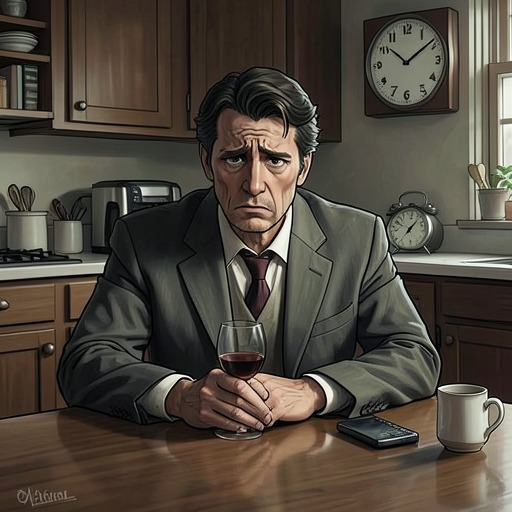
Christopher's fear of his father
The Curious Incident of the Dog in the Night-TimeChristopher's fear of his father is not a passing reaction to one frightening encounter but a lasting state formed by the collapse of trust. It first drives Christopher away from home after he learns that Father lied about Mother and killed Wellington; later, it governs his precautions in London and the guarded distance he maintains after returning to Swindon.
Origin in the Broken Trust
Christopher identifies the cause plainly: Father has killed Wellington and lied to him about Mother, whom Christopher had believed dead. Speaking to Mrs. Alexander, he says he intends to live with Mother because he is frightened of staying in the house with Father. The fear is therefore bound to a specific discovery, not simply to Christopher’s general difficulty understanding other people. Father’s deception changes the meaning of home: the person who had been his caregiver is now someone whose actions and words he cannot safely rely on.
That change affects Christopher’s decisions immediately. He leaves with the intention of reaching Mother in London, taking Toby and necessities with him. At the house, Father’s mobile phone, wallet and address book are on the kitchen surface. Christopher briefly fears that Father has returned and is inside, but checks the remembered image of the van outside and reasons that Father must have left. He takes Father’s bank card, whose PIN is 3558, as a means of getting money, then carries Toby in a coat pocket because the cage would be too heavy. The episode shows fear working together with Christopher’s careful observation and practical planning: he does not dismiss the possibility of danger, but tests it against details and acts to continue his journey.
Fear During the Journey and Reunion
When a policeman later tells Christopher that Father is at the police station looking for him, Christopher expects the possibility of being taken back to Father. The policeman is supposed to be a good person, but Christopher’s fear overrides that general rule; he runs, is briefly grabbed, screams, and continues to insist that he is going to live with Mother in London. His reaction reveals how completely the family rupture has altered his sense of safety. An official attempting to return him to a parent is, in that moment, connected to the prospect of being brought back into the feared household.
The fear remains present when Father comes to the London flat at 2:31 a.m. Christopher wakes to shouting and is frightened, with no lock on the spare-room door. When Father enters, Christopher is holding his Swiss Army knife with the saw blade out in case Father grabs him. The detail records a precaution, not an attack: Christopher prepares for possible contact because he does not feel secure, while Mother enters too and tells him she will not let Father do anything to him. The scene brings the family conflict into the room where Christopher is sleeping and makes his need for distance visible in a concrete object held ready in his hand.
A Changed Home, an Unfinished Relationship
Returning to Swindon does not end the fear. Mother has to work until 5:30 p.m., so Christopher is required to spend the interval from 3:49 to 5:30 at Father’s house because he cannot be left alone. He pushes the bed against the door in case Father tries to come in. Father sometimes speaks to him through the closed door; Christopher does not answer, and sometimes hears Father sitting quietly on the floor outside for a long time. The arrangement makes the distance between them both literal and routine: a blocked door protects Christopher, while Father’s presence on the other side shows that the relationship has not simply disappeared.
When Mother picks Christopher up after work and Father asks to talk, Christopher answers, “No.” Mother says she will stay with him, but reassurance does not yet restore trust or make conversation possible. His refusal is a boundary, and the sequence gives no evidence that the fear has been resolved. Even the quiet episodes outside the door do not prompt him to open it or respond.
The Meaning of the Fear
Christopher’s fear develops through a chain of concrete consequences: discovery of Father’s lies and violence, departure from home, flight from the possibility of being returned, guardedness during the London confrontation, and continued separation after the move back to Swindon. It is expressed less through abstract reflection than through decisions about where to go, what to carry, whether to run, and how to secure a door. The contrast between his father’s former role as the person who told him the bank-card PIN and the father he now prepares to avoid makes the rupture especially sharp: practical familiarity remains, but trust has been broken.
The lasting importance of this state is that physical proximity and reconciliation no longer mean the same thing. Christopher and Father are again in the same town and sometimes under the same roof, yet Christopher still blocks the door and declines conversation. The account leaves that relationship unresolved. Fear marks the boundary between returning to a place and feeling safe there, and between a father’s presence and the restoration of a son’s confidence in him.