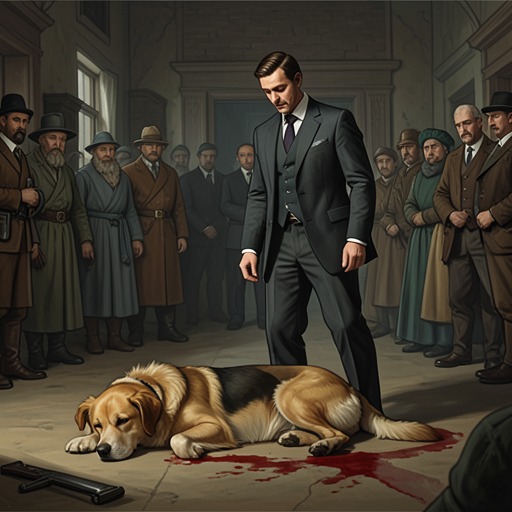
Christopher’s investigation into Wellington’s murder
The Curious Incident of the Dog in the Night-TimeChristopher’s investigation into Wellington’s murder is a self-appointed detective project that turns the search for the dog’s killer into a test of how evidence, suspicion, and trust work. Its clues lead Christopher first toward Mr. Shears, but the investigation’s decisive revelation is not merely the identity of the killer: Father confesses, and the search exposes a deeper rupture in Christopher’s family.
A project begun on a Good Day
Christopher decides to investigate because the day is a Good Day, which he regards as a suitable time for projects and planning. When he tells Siobhan what he intends to do, she suggests that he write about finding Wellington and going to the police station. Christopher identifies this conversation as the point when he started writing his account, so the investigation and the book about it begin together.
His method is personal rather than officially authorized. After Mrs. Shears tells him she does not want to see him, he decides to do detective work anyway. He treats the rejection as no reason to abandon his inquiry, setting his own course rather than accepting another person’s limits as decisive.
Inspecting the clues
At Mrs. Shears’s house, Christopher sees her watching through the frosted glass in the front door. He leaves the garden, checks that nobody is watching, climbs over the wall, and goes around to the back garden, where her gardening tools are kept. The shed is locked, so he cannot enter; instead, he looks through its side window.
On the bench he sees a fork like the one that had been found in Wellington. It has been cleaned, and its green plastic handle matches those of the other tools nearby, including a spade, a rake, and long-handled clippers. Christopher reasons that the fork belongs to Mrs. Shears, while keeping open the possibility that this apparent clue could be a red herring. The locked shed sharpens the question of access: the killer might have had a key, the shed might have been left unlocked, or the fork might have been left in the garden.
The fork does not, by itself, make Mrs. Shears the likely killer. Christopher considers that possibility, then tests it against her earlier reaction when she found Wellington. He concludes that she probably did not kill the dog, although the killer may have used her fork. The investigation proceeds through distinctions between an object’s ownership, who could reach it, and what it proves—rather than treating a striking clue as a complete answer.
The chain of reasoning and the prime suspect
After speaking with an elderly woman, Christopher leaves and has what he describes as a stroke of inspiration. He arranges his thoughts as a numbered chain: a person might kill a dog out of hatred, madness, or a desire to upset its owner. Since he knows nobody who hated Wellington and nobody he considers mad, those explanations point toward a stranger. But he also invokes the likelihood that a murderer is known to the victim, which pulls his reasoning back toward someone familiar with Wellington.
The motive of upsetting Mrs. Shears supplies the connection that identifies Christopher’s prime suspect. He knows only one person who disliked her: Mr. Shears, her former husband, who had known Wellington well. Christopher therefore calls Mr. Shears his prime suspect. His conclusion is provisional, built from what he knows about the people involved and from competing possibilities, not from proof that Mr. Shears killed the dog.
That suspicion is shaped by the history of the households. Mr. Shears left Mrs. Shears two years earlier. After Christopher’s mother was believed to have died, Mrs. Shears often came to Christopher’s home, helped with cooking, and sometimes stayed overnight. Christopher remembers her arranging the kitchen in meticulous order, a pattern of attention to objects and arrangement that resonates with his own habits of observation. The background gives the investigation a network of personal connections, but it does not establish Mr. Shears’s guilt.
From investigation to family revelation
Christopher tells Father that he thinks Mr. Shears killed Wellington, explaining that the motive might have been to make Mrs. Shears sad. Father responds by telling Christopher to keep out of other people’s business. The exchange puts the investigation into direct conflict with Father’s demand that Christopher stop asking questions, even as Christopher continues to follow his reasoning.
Later, Christopher finds an unopened envelope addressed to him beneath his book in a shirt box with other envelopes. Its postmark shows that it was posted on 16 October 1997, eighteen months after his mother was reported to have died. The date changes the meaning of the family story surrounding the investigation: Christopher’s search for Wellington’s killer now sits beside evidence that his mother was alive after the date when he had been led to believe she was dead.
When Father eventually says, “I killed Wellington, Christopher,” the suspected case against Mr. Shears gives way to the truth of Father’s responsibility. Father begins to explain that Mrs. Shears had helped him after Christopher’s mother left and that he had hoped their closeness might lead to her moving in with him, or to their moving into her home. The confession resolves the central question of who killed Wellington while changing the investigation’s stakes: the person Christopher trusted as his father is also the killer, and the inquiry has uncovered not just a crime but the collapse of that trust.
Narrative role
The investigation is presented through Christopher’s step-by-step attention to objects, access, and alternative explanations. The cleaned fork and locked shed invite inference, but Christopher himself names the possibility of a red herring and distinguishes suspicion from certainty. His reasoning makes the reader follow the same provisional path toward Mr. Shears before Father’s confession overturns it.
The book’s form ties that detective process to the act of telling: Siobhan’s suggestion that Christopher write about the search becomes the origin of the account in which the clues, the letters, and the confession appear. What begins as a project prompted by a Good Day therefore becomes a record of how evidence can answer one question while opening another. The solution identifies Wellington’s killer, but its lasting consequence is the discovery that Christopher’s family history, and his confidence in Father, cannot be taken at face value.