Christopher's Swiss Army knife
The Curious Incident of the Dog in the Night-TimeChristopher's Swiss Army knife is both a familiar possession and a measure of how he navigates risk. It travels with him through police custody, neighborhood investigation, and flight from home; its varied attachments promise practical solutions, while its saw blade gives it a defensive purpose. The knife’s significance changes with the setting: an item inventoried by the police becomes a safeguard against people Christopher fears, including his own father.
Design and Everyday Use
At the police station, Christopher is required to empty his pockets so staff can check whether he has anything that could be used to harm himself, escape, or attack a police officer. Among the contents is a Swiss Army knife with thirteen attachments, including a wire stripper, a saw, a toothpick, and tweezers. The exact inventory places the knife among ordinary personal belongings rather than presenting it as an isolated weapon: Christopher also carries string, a wooden-puzzle piece, three pellets of rat food for Toby, £1.47 in specified coins, a red paper clip, and his front-door key.
The assortment of attachments captures the object’s double character. The knife is a compact instrument for different tasks, and the saw is one component among many; in situations of fear, however, Christopher singles out that blade as a means of defense. His account makes the tool’s practical usefulness inseparable from his need to feel prepared. It is not only what the object can cut or repair, but also what carrying it allows him to anticipate.
Police Custody and Return
The police temporarily separate Christopher from the knife while he is at the station. When they release him, it is returned with his string, puzzle piece, rat food, money, paper clip, and key, all placed in a small plastic bag. The methodical return restores his belongings as a group; the knife is not treated as a separate discovery or as the reason for the caution he receives. That record concerns his having hit a police officer, which the officer describes as accidental and unintentional.
The contrast between confiscation and return establishes the knife’s place in the book’s account of police procedure. It is first considered in terms of possible misuse, then handed back as part of Christopher’s own property. Its presence does not make him immune to official scrutiny, but the careful list of items also reflects the value he places on knowing exactly what he has and retaining control over his possessions.
Investigation and Encounters with Strangers
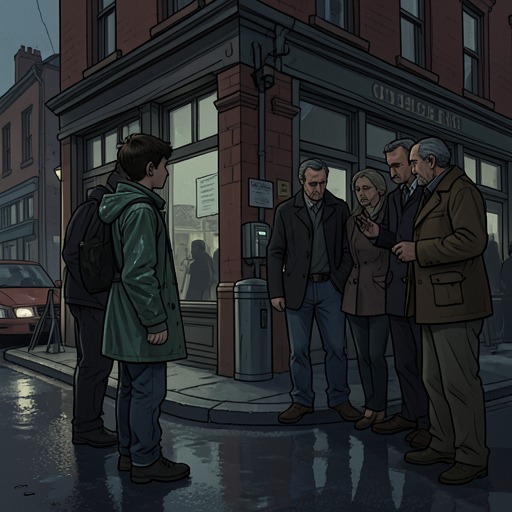
When Christopher decides to question people in his street as part of his investigation into Wellington’s killing, he acknowledges that approaching strangers is difficult for him. He distinguishes this difficulty from the particular danger taught by the school’s Stranger Danger lessons: unfamiliar people are hard to understand, and that uncertainty frightens him. Before knocking at number 40, opposite Mrs. Shears’s house, he makes a plan of the street and checks that the Swiss Army knife is in his pocket.
The preparation does not mean he regards the knife as a substitute for careful observation. He selects number 40 because its position makes its residents more likely to have seen something, and the plan helps him organize the inquiry. Carrying the knife accompanies this deliberate approach to the unfamiliar: he prepares materially for risk while using a map and a sequence of questions to make the task more predictable.
Christopher also explains that the knife’s saw blade could cut a man’s fingers off. He connects that capacity to his confidence that he could defend himself if a stranger touched him, recalling that he had hit someone hard after she pulled his hair. The account presents a stark imbalance between a compact everyday tool and the danger Christopher imagines it could answer. It also clarifies that his anxiety around strangers does not arise from a single, simple fear; he emphasizes the difficulty of understanding people he has not met and the time he needs to decide they are safe.
Fear of Father and the Saw Blade
After Christopher’s trust in Father has been shattered, the knife takes on a more immediate defensive role inside the family home. At 1:20 a.m., Christopher has not heard Father go upstairs to bed. He wonders whether Father is asleep downstairs or waiting to come into his room and kill him. He opens the knife’s saw blade so he can defend himself, then leaves his bedroom quietly to check on the house.
Christopher sees Father’s foot through the living-room door and waits four minutes to see whether it moves. Father is lying on the sofa with his eyes closed. The knife does not lead to a confrontation in this scene; instead, holding it ready accompanies Christopher’s cautious attempt to determine whether the immediate danger is real. His close attention to elapsed time and movement makes the episode an exercise in checking what he can observe while preparing for what he fears.
The next morning, Christopher hides in the garden with Toby’s cage and his special food box when Father comes looking for him. He takes the knife from his pocket and holds the saw blade in case Father finds him. Covered by an old, muddy fertilizer sack in a corner beside the shed, fence, and rainwater tub, he hears Father open the shed and search nearby. Christopher remains hidden; after Father leaves, he waits another twenty-seven minutes and listens for the van to drive away before coming out. The knife belongs to a wider strategy of concealment, timing, and listening, rather than providing a means to confront Father.
A Changing Measure of Safety
Across these episodes, the knife’s meaning follows Christopher’s changing sense of safety. At the police station it is an item officials temporarily assess and return; on the street it is something he checks before beginning an unsettling investigation; at home it is prepared as protection against Father. Those uses are connected, but not identical. The knife remains the same object while the danger around it shifts from procedural possibility, to uncertainty about strangers, to fear rooted in a broken family relationship.
Its practical design also resonates with Christopher’s preference for concrete, usable things. The list of thirteen attachments specifies what the knife contains, just as his map, watch, and carefully tracked waiting periods help him manage situations that might otherwise feel unpredictable. Yet the knife cannot settle whether another person is safe. Christopher still has to observe, interpret, wait, and decide when to move. As a recurring object, it therefore marks both the value and the limit of preparation: a tool can be carried and its blade opened, but safety depends on what Christopher can learn about the people around him.