Christopher's sensory overload
The Curious Incident of the Dog in the Night-TimeChristopher's sensory overload is the point at which a demanding environment overwhelms his capacity to process what he sees, hears, and must respond to. It shapes his movement through crowded public places and has immediate physical and practical consequences: he may cover his ears, groan, feel sick, or become unable to think clearly enough to follow a plan. The narrative describes these episodes from within his experience, making the obstacles of a crowded setting as consequential as the destination he is trying to reach.
What Overload Means
Christopher explains unfamiliar places through the image of a computer doing too many things at once: its central processing unit becomes blocked, leaving no space to think. Crowds make the problem worse because, unlike cows, flowers, and grass, people may speak to him or do something unexpected. He feels obliged to notice the surroundings and anticipate what might happen there, so the demands compete for attention rather than arriving as a manageable sequence. At the most intense point, he compares the experience to a computer crashing and describes closing his eyes, covering his ears, and groaning as if shutting down and rebooting it.
This account distinguishes simply seeing a great deal from being able to use that information. Christopher says that noticing details supports his strength in chess, mathematics, and logic; in a new place, however, the same attentiveness can leave too little capacity for planning. The resulting difficulty is not presented as a lack of observation. It follows from the effort of monitoring many details while also navigating noise, other people, and possible changes in what is happening.
Crowds and Unfamiliar Places
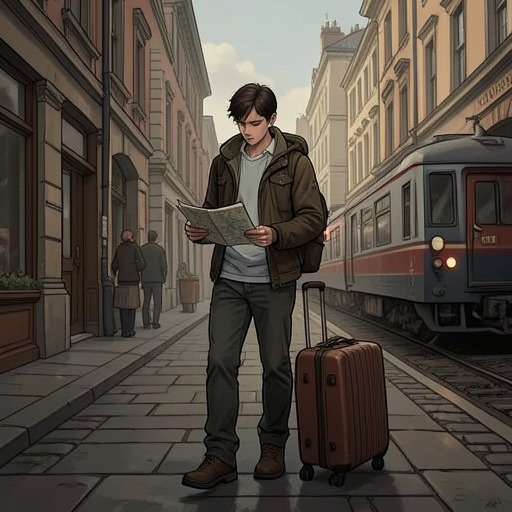
In a busy street, Christopher remembers having been there shopping with Mother, but the crowd and noise make it difficult to think. He walks at the edge of the road because he does not want people to touch him, covers his ears, and groans quietly. He normally makes a mental map and locates himself on it, but on this occasion the interference prevents him from maintaining that map. He becomes frightened when he loses sight of the sign he was following and realizes he has forgotten to keep track of its location. Rather than continue without a plan, he stops under the green-and-white awning of a greengrocer's shop and tries to decide what to do next.
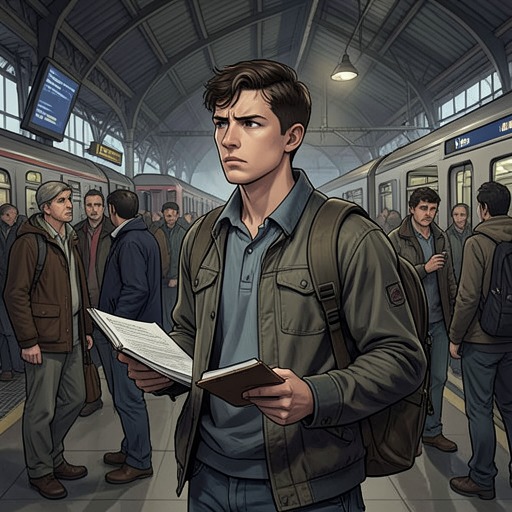
The railway station in Swindon makes the conflict between a necessary route and an unmanageable setting especially clear. Christopher is frightened and knows that his drawing of the station is only an approximation because fear has made him observe less accurately. The tunnel is echoing, busy, and unpleasant to him; people are moving in and out, and he feels giddy and sick. He holds on to the edge of a sign to steady himself and crouches rather than risk losing his balance. He wants to go home, but fear of returning makes that option feel no safer. Since he needs to travel, he sets himself the limited task of walking down the tunnel to find somewhere to sit and think, concentrating on a sign at the far end as he goes.
In another crowded underground station, the pressure builds as people fill the platform. A woman with a black briefcase, purple shoes, and a parrot-shaped brooch sits at the other end of the bench; as the station grows more crowded, Christopher can no longer see the walls and someone's jacket touches his knee. He feels sick and begins groaning loudly. When a train arrives, its sound overwhelms him despite his efforts to block it out. He closes his eyes, fears that the station may collapse or that there may be a fire, and remains distressed as the train passes and the crowd disperses. The episode recurs when the platform fills again: the incoming trains and waves of people leave him waiting in discomfort, unable to make the sensation stop or turn his attention to anything else.
Physical Responses and Coping
Across these scenes, the account links overload to specific responses rather than treating it as an abstract label. Christopher covers his ears, closes his eyes, groans, seeks a place to sit or lean, and waits for a crowd or its noise to pass. In a busy shop in Brent Cross Shopping Centre, too many people in John Lewis frighten him so badly that he lies on the floor and screams; Mother takes him home in a taxi. When she later returns to buy clothes and toiletries, he stays in the spare room because he is frightened of being in the same room as Roger Shears. These details show how overload can interrupt an ordinary practical task, and how avoiding an overwhelming space may be necessary even when the task remains unfinished.
The same bodily response does not make every episode identical. Christopher may be able to form a plan in one setting, as he does when he stops beneath the greengrocer's awning, but in another the crowd and sound leave him unable to think past the immediate distress. At the underground station, he wants the experience to stop and compares the wish to pulling the plug on a crashed computer; the image conveys his feeling that there is no room in his mind for anything except the discomfort. The episodes are not solved by deciding that a destination matters. In the station, he has to remain there and wait for the trains and crowds to pass.
Communication, Rules, and the Limits of Interpretation
The broader difficulty of processing a situation includes social information as well as noise and movement. Christopher says that people often communicate without words: a raised eyebrow can carry different meanings, as can breathing out through the nose, depending on how it is done and on the surrounding circumstances. He finds these signals difficult to interpret because their meaning depends on many details that are hard to work out quickly. His description locates some communication problems in the ambiguity of what other people express, not solely in his own ability to respond.
Siobhan's direct instructions offer a contrast. Christopher values that she specifies what he must not do and what action he can take instead: if a particular pupil hits him, for example, he is told to move away, count, and report what happened. Such directions make expectations explicit rather than leaving him to infer them from an indirect remark. This contrast matters to the portrayal of overload: clear information can make a situation more tractable, while unclear social signals add another demand to the already difficult work of noticing, interpreting, and planning. When his mother asks him to be quiet for half an hour, the request is at least specific about its duration, even though the surrounding family situation remains unsettled.
Narrative Significance
The novel makes sensory difficulty legible through Christopher's comparisons, maps, and concrete actions. The computer analogy gives a structure to an experience in which attention is overloaded and thought becomes difficult; his imperfect station map, lost landmark, and deliberate focus on a sign show how that state changes what he can do. The account does not reduce every difficulty to a single cause: noise, crowds, unexpected interactions, touch, uncertainty, and the need to make decisions can combine, while their precise effects vary from one place to another.
This perspective also complicates the ordinary assumption that a public space is neutral or that a person can simply follow a route through it. A tunnel, a crowded platform, or a department store places demands on Christopher that can overwhelm his ability to orient himself and continue. His responses—stopping, seeking the edge of a crowd, closing his eyes, or waiting—are practical efforts to manage the conditions he encounters. The episodes therefore present overload as lived experience with consequences for independence and travel, while showing that explicit communication and a less demanding environment can change what is possible.