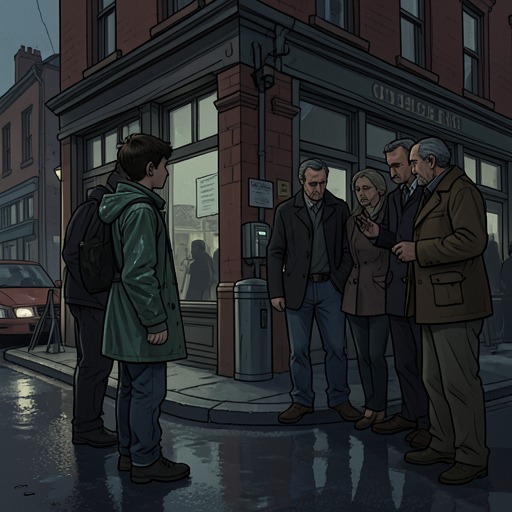
Detective Investigation and Reasoning
The Curious Incident of the Dog in the Night-TimeDetective investigation and reasoning give Christopher John Francis Boone a way to turn uncertainty into a sequence of questions, clues, and provisional conclusions. His inquiry into Wellington’s death begins as a self-chosen project and becomes the framework for his book, but the evidence he gathers points first toward Roger Shears before the eventual confession reveals Father as the killer. The method makes Christopher’s thinking legible while also showing how a sound-looking deduction can rest on incomplete information.
A Mystery as a Puzzle
Christopher prefers books about science and mathematics to conventional novels, but he likes murder mysteries because they ask a reader to work out who committed a crime and catch that person. He understands the genre as a puzzle: in a good one, the answer can sometimes be worked out before the end. This model suits his preference for explicit problems and reasoned solutions, and it shapes the book he decides to write about Wellington’s death.
The dog’s death is both the opening that catches attention and an event Christopher can write about because it happened to him. He explains that it is hard for him to imagine things that did not happen to him, so the investigation grows from an actual experience rather than an invented mystery. His choice also departs from the convention Siobhan describes: murder mysteries usually make a person, rather than a dog, the murder victim. Christopher argues that dogs matter to him because they are faithful and honest, and he regards some as more interesting than some people.
Detective work becomes possible on a Good Day, which Christopher treats as a day for projects and planning. When he tells Siobhan that he wants to find Wellington’s killer, she suggests writing about the investigation and his visit to the police station. She offers help with spelling, grammar, and footnotes. The inquiry and the act of recording it therefore begin together: the detective’s developing account is also the book the reader is reading.
Evidence, Access, and Inference
Christopher’s investigation proceeds by observing details and asking what they establish. After Mrs. Shears does not answer his question about who killed Wellington, he decides to continue investigating. At her garden shed, he cannot get in because it is locked, but he looks through a side window and sees a fork resembling the one found in Wellington. It has been cleaned; beside it are other tools with green plastic handles. The fork is a concrete clue, but Christopher does not treat its appearance as proof by itself. He considers whether it belongs to Mrs. Shears, whether it might be a red herring, and how someone could have gained access to it.
His explanation remains conditional. Mrs. Shears might have killed Wellington, but Christopher weighs that possibility against her reaction when she found her dog. He concludes that she probably did not kill him, while suspecting that her fork was used. Because the shed was locked, he identifies several possible explanations: the killer had a key, the shed had been left unlocked, or the fork had been left outside. The distinctions matter: the object suggests a connection, but the available evidence does not yet identify who used it or how.
A later chain of reasoning turns those possibilities into a suspect. Christopher considers three reasons someone might kill a dog: hatred of the dog, madness, or a wish to upset Mrs. Shears. He knows no one who hated Wellington and no one he considers mad, so those explanations point toward a stranger. But he also invokes the general claim that murder is most often committed by someone known to the victim. The third motive, making Mrs. Shears unhappy, gives him a person he knows: Roger Shears, her former husband, who had left two years earlier and knew Wellington. Christopher names Roger his prime suspect. His reasoning is orderly and transparent, but it combines a general statistical belief with limited personal knowledge; the conclusion is a working hypothesis, not a demonstrated answer.
A Book That Cannot Close the Case
Christopher’s inquiry is restricted when Father tells him to keep out of other people’s business. At dinner, Christopher states that he thinks Roger killed Wellington and explains that he sees him as a likely suspect because he might have wanted to make Mrs. Shears sad. Father gives no response in the cited exchange, but the prohibition ends Christopher’s detecting. At school the next day, Christopher tells Siobhan that he can no longer investigate and shows her what he has written, including a diagram of the universe, a street map, and prime numbers.
The interruption leaves the mystery without the ending Christopher expects. He objects that the book is not proper because the murderer remains at large and he has not discovered who killed Wellington. Siobhan answers that not every murder is solved and not every murderer is caught, invoking Jack the Ripper as an example. The unfinished investigation is thus not merely a missing final clue: it puts pressure on Christopher’s belief that a puzzle should yield a recoverable answer. His method has produced a suspect and a written record, but not the closure he associates with a successful detective story.
Reversals and the Limits of the Suspect List
The later discovery of a sealed envelope addressed to Christopher, hidden under his book in the shirt box, changes the context in which he reads his family’s history. The postmark dates the letter to 16 October 1997, eighteen months after he had been told his mother had died. That date is not evidence identifying Wellington’s killer, but it exposes how much of the investigation has taken place within a distorted account of family events. The search for a culprit and the search for trustworthy information become entangled.
Father eventually tells Christopher that he will be truthful from then on and confesses, “I killed Wellington, Christopher.” The confession overturns the prime-suspect conclusion: Roger had been selected by Christopher’s reasoning about motive and familiarity, while the killer was the person who had directed and constrained the investigation at home. Father begins to explain that after Mother left, Mrs. Shears had helped them, and that he had hoped their relationship might develop further. The revelation supplies a personal context absent from Christopher’s earlier chain of inference, although the cited account does not state every circumstance of the killing. The detective puzzle resolves not through Christopher’s access to a decisive clue but through the killer’s confession.
The confession also changes the meaning of Christopher’s investigation as a whole. His case against Roger was not simply an incorrect answer in a game: it arose within a family in which crucial facts had been withheld from him, and the person now admitting the crime had previously forbidden further inquiry. The book preserves the steps by which Christopher reached his provisional conclusion, allowing that reasoning to be understood without pretending it was sufficient to establish the truth.
Method, Safety, and the Narrative Frame
Christopher’s detective method depends on making information manageable. When a policeman’s questions arrive too quickly, Christopher describes them accumulating in his mind like loaves backing up at a bread-slicing machine. He compares his mind to a machine to explain what is happening inside it. When the policeman takes hold of his arm and lifts him to his feet, Christopher hits him; the police later give him a caution, recording that he struck an officer accidentally and did not mean to hurt him. These encounters do not advance the identification of Wellington’s killer, but they show how questioning and physical contact can overwhelm the conditions needed for orderly reasoning.
The same concern with control shapes later encounters with police. When a policeman suggests a walk to a cashpoint machine, Christopher tells him not to touch him. Later, fearing that a policeman intends to return him to Father after Christopher says he is going to live with Mother in London, he runs, is grabbed, and screams; the policeman lets go and proposes returning to the station to discuss arrangements. These episodes contrast the abstract clarity of detective rules with Christopher’s dependence on whether other people explain their intentions and respect his boundaries.
The book’s form makes the investigation available for review. Christopher records observations, separates alternatives, marks a prime suspect, and shows the work to Siobhan, who helps with its written mechanics. Because readers receive his reasoning as he constructs it, the initial case against Roger can be followed rather than merely reported. The later envelope and Father’s confession then require that earlier material to be reconsidered: the narrative first presents the limits of Christopher’s evidence and only later reveals how radically incomplete his understanding of home has been. Detective investigation is consequently both a practical pursuit of Wellington’s killer and a structure for discovering that clues alone cannot repair a world organized around concealed facts.