Dogs
The Curious Incident of the Dog in the Night-TimeDogs occupy two sharply different places in the story: Wellington’s killing sets Christopher’s investigation in motion, while Sandy, the puppy Father gives him, becomes a small but consequential part of their effort to live together again. Between the murdered dog and the new companion, the novel shows how dogs are caught up in human actions and relationships, yet also matter as individual animals to be cared for and trusted.
Wellington and the Investigation
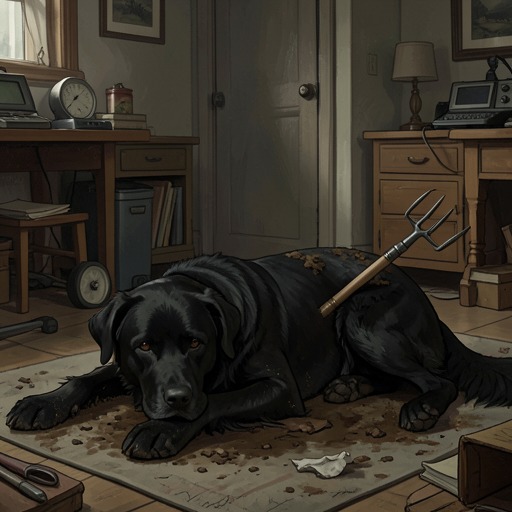
Christopher examines a garden fork that appears to match the one found in Wellington. Looking through the window of the locked shed, he sees a cleaned fork among other tools with green plastic handles. The object offers a concrete lead, but not a settled answer: Christopher considers whether it might be a misleading clue, and reasons that the killer must either have had access to the shed or encountered the fork when it had been left out.
His next deductions connect Wellington’s death to the relationships around the dog. Christopher considers hatred, madness, or a wish to upset Mrs. Shears as possible reasons for killing a dog. Because he knows of no one who hated Wellington and no one he considers mad, he weighs the general likelihood that a victim knows a murderer against the possibility of a stranger. The remaining personal motive points him to Mr. Shears, who had once been married to Mrs. Shears and had left her two years earlier. Christopher consequently names Mr. Shears his prime suspect, a conclusion that shows how he builds an investigation from visible evidence and explicit rules, even when those rules cannot establish who used the fork.
At home, Christopher tells Father that he thinks Mr. Shears killed Wellington, explaining that the crime might have been intended to make Mrs. Shears sad. Father had already told him to stay out of other people’s business; Christopher’s accusation nevertheless makes his investigation a direct point of conflict between them. The evidence he has assembled has led him to the wrong suspect, but the question he is pursuing is entangled with the family’s concealed history.
Wellington’s Death and the Truth
The investigation eventually gives way to a more devastating disclosure. Father tells Christopher that he killed Wellington. The admission overturns Christopher’s working theory: the killer was not the absent former husband he had identified, but his own father. The dog’s death therefore changes from a puzzle about a stranger or a neighbor into evidence of a betrayal inside Christopher’s home.
Father explains that after Mother left, Mrs. Shears had helped the two of them, and that he had hoped their closeness might develop into a shared life. His confession connects Wellington’s death to disappointment in that relationship, though the decisive fact Christopher has to face is simpler: Father killed the dog and had not told him the truth. Christopher reports both facts to Mrs. Alexander, saying that he is frightened to stay in Father’s house and intends to live with Mother. He also asks a policeman whether Father has been arrested, identifying Wellington as the dog Father killed with a garden fork. The crime remains, for Christopher, not merely a past act but a reason to fear the person who had been his principal caregiver.
Sandy as a New Companion
After the confession and separation, Father proposes a project whose purpose is to rebuild trust through spending more time together. As an apology and a sign that he means what he says, he brings Christopher a two-month-old golden retriever. The puppy is sandy-colored, and Christopher strokes him while he sits in Christopher’s lap. In contrast to Wellington, whose death exposed Father’s secrecy, the new dog arrives openly as a gift and an invitation to a different kind of relationship.
Christopher names the puppy Sandy. Father buys him a collar and a lead, and Christopher is allowed to walk him to the shop and back and play with him using a rubber bone. These small routines make the gift more than a moment of reconciliation: Sandy becomes part of Christopher’s everyday life and an animal for whom he can provide care. The contrast does not erase what Father did or restore trust at once; it gives their proposed project a concrete, continuing form.
When Mother has flu, Christopher spends three days at Father’s house. The stay is manageable for him because Sandy sleeps on his bed and will bark if anyone enters the room during the night. Father also makes a vegetable patch, and Christopher helps plant carrots, peas, and spinach. The dog’s presence thus accompanies a limited but meaningful return to shared domestic life: Christopher can remain in the house, and Father and son can take part in ordinary routines without the story claiming that their conflict has disappeared.
Dogs and the Story’s Contrasts
The two dogs mark opposite consequences of human conduct. Wellington is killed amid Father’s concealed disappointment and becomes the evidence through which Christopher discovers that he has been lied to. Sandy is given as an apology and becomes a living companion whose care takes the form of walks, play, and daily presence. The contrast makes the dog’s role in the plot more than a repeated symbol of family feeling: each animal has a distinct place in Christopher’s life, and their different fates expose the difference between harm done in secret and care sustained in practice.
Sandy’s later presence also accompanies Christopher’s movement toward further goals. He receives an A in his mathematics A-level, walks Sandy, and buys a book on further mathematics; Father tells Mrs. Gascoyne that Christopher plans to take the further mathematics exam the following year. These events do not make the puppy responsible for Christopher’s achievement. They place his ordinary care and companionship within a future that is beginning to open again, after Wellington’s death and Father’s confession had made home feel unsafe.