Eileen Shears
The Curious Incident of the Dog in the Night-TimeEileen Shears, known in the neighborhood as Mrs. Shears, is both Wellington’s owner and a close neighbor of Christopher and Father. Her practical support after Mother leaves draws her into the family’s daily life; later, her falling-out with Father becomes the immediate background to Wellington’s killing and Christopher’s investigation.
Identity and Introduction
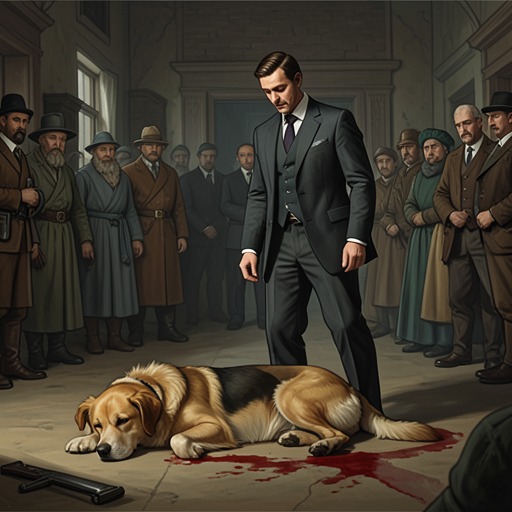
Eileen lives across the road from Christopher’s family, two houses to the left, and is described as their friend. Her dog Wellington is a large black poodle. Christopher finds him dead on her lawn with a garden fork embedded in him, then strokes him and wonders who killed him and why. The discovery establishes Eileen’s household as the starting point for Christopher’s inquiry, although she is not present in the scene.
Support After Mother’s Departure
Eileen helps Father during a difficult period after Mother leaves. Father later recalls that she came over on most days to help with cooking and cleaning and to check whether the family needed anything. In one scene, she cooks supper for Christopher and Father, making spaghetti with tomato sauce, while Father sits beside her. Her care is practical and domestic: she helps sustain the household at a time when Father says he was struggling.
Relationship with Father
Father says he thought he and Eileen were friends and hoped their closeness might develop into a shared home, either with her moving in or the family moving into her house. He also acknowledges that this expectation may have been mistaken. The evidence presents his hope as his own interpretation of their relationship, not as a plan Eileen had agreed to.
Their relationship deteriorates into repeated arguments. In Father’s account, Eileen says hurtful things and eventually throws him out of her house after a particularly severe argument. He believes she cared more about Wellington than about him and his family, a perception that helps explain his anger but does not establish Eileen’s motives. The contrast between her earlier assistance and their later conflict makes the rupture consequential: what had seemed like a possible extension of family life ends in rejection and resentment.
Wellington’s Death and Narrative Role
Father links the final argument to the circumstances of Wellington’s death. He says that after Eileen had thrown him out, the dog was in the garden, and he lost his temper when he encountered it. He confesses to killing Wellington. His account makes Eileen’s conflict with Father part of the causal background to the crime, while the dog’s death becomes the mystery that sets Christopher’s investigation in motion.
Eileen’s role is therefore shaped by absence as well as action: she is first encountered through her home and the dog found there, then through Father’s recollection of her care and their failed relationship. The novel supplies Father’s account of what happened between them, but does not give Eileen’s own explanation of the arguments or her feelings about his hopes. That limit matters: her kindness and her conflict with Father are both established, while the private meaning of their relationship remains partly beyond Christopher’s—and the reader’s—direct knowledge.