Father's bank card
The Curious Incident of the Dog in the Night-TimeFather’s bank card is the instrument that turns Christopher’s plan to reach London into a practical journey—and makes the conflict between necessity and truth-telling tangible. The card gives him access to money, but it is not his; once a policeman asks about it, Christopher must confront the fact that his attempt to leave depends on using Father’s property without permission.
The card at home
After returning to the house to collect supplies, Christopher sees Father’s mobile phone, wallet, and address book beside the kitchen sink. Their presence initially makes him fear that Father has returned and is inside the house. Christopher’s head pain worsens, and he compares the bodily coldness under his clothes to Dr. Watson’s reaction in The Sign of Four when Watson sees the tiny footprints of Tonga on the roof. He then checks the remembered image of the house and realizes that Father’s van is not outside; he concludes that Father must have left the belongings behind when he went out.
Christopher takes Father’s bank card from the wallet because he needs money for the journey. He knows how a cashpoint card works: it has a PIN, a secret number entered at a machine to withdraw cash. Father has told him the number because he believes Christopher will not forget it. Christopher recalls it as 3558 and puts the card in his pocket. The detail that Father entrusted him with the PIN makes the card more than a source of cash: it is also a piece of shared knowledge now being used in a situation Father has not authorized.
Disclosure to the policeman
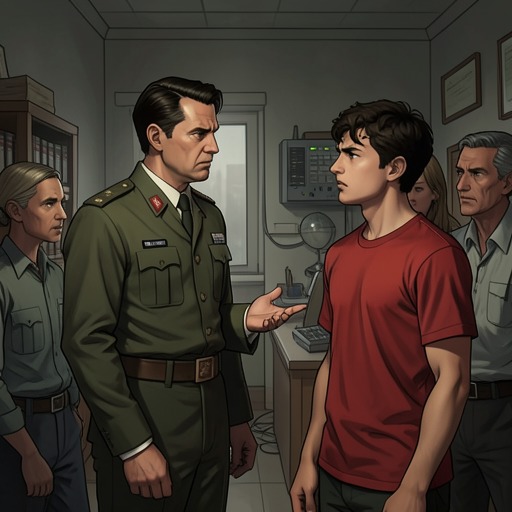
The card becomes a problem when a policeman asks how Christopher plans to get to London. Christopher does not know what to say. He understands that taking things is illegal, but also believes he must tell the truth to a policeman. He says he has a cashpoint card and shows it. When the policeman asks whether it is his, Christopher answers that it is Father’s. The narration calls his earlier answer—that he has a card—a white lie: literally accurate, but liable to leave the impression that the card belongs to him.
This exchange exposes the difference between possession and ownership at the moment Christopher most needs practical help. He has the card in his pocket and knows its PIN, yet he does not claim it as his own when directly questioned. The admission does not end his attempt to travel; instead, it makes the card’s role explicit and allows the journey to proceed in the policeman’s company.
From PIN to ticket
The policeman accompanies Christopher back through the tunnel to the cashpoint near the ticket office. The passage is less frightening to Christopher this time because the policeman is with him. At the machine, Christopher enters 3558 and is asked to specify an amount. Unsure what a London train ticket costs, he asks the policeman, who estimates about 30 pounds. Christopher first checks that “quid” means pounds; the policeman laughs, then clarifies the price, and Christopher does not laugh along.
Christopher selects £50. The machine dispenses five £10 notes and a receipt, which he puts in his pocket along with the card. The withdrawal is not the fare itself but the money that makes buying the fare possible. At the ticket counter, Christopher says he is travelling until he goes to university. The clerk sells him a single ticket for £32; Christopher gives over the £50, receives £10 in change and £8 in coins, and pockets them with his knife and the small yellow-and-orange ticket. He dislikes the ticket’s yellow half but keeps it because it is the ticket he needs.
Practical access and moral tension
The card’s importance lies in its sequence of uses: Christopher recognizes it in Father’s wallet, remembers a PIN Father has shared, reveals whose card it is, withdraws cash, and turns that cash into a single ticket. Each step narrows the gap between an intention to travel and the material means of doing so. At the same time, Christopher’s admission to the policeman preserves a distinction he cares about: although he has taken and used Father’s card, he does not tell the policeman that it belongs to him.
The object therefore carries both practical and relational weight. Father’s confidence that Christopher would remember the PIN enables him to act independently, even as the unauthorized use of the card marks a breach of ordinary permission. The narrative keeps these facts together rather than making the card simply a symbol of freedom or wrongdoing: it is a familiar tool that helps Christopher secure money, exposes him to questioning, and enables him to buy the ticket for his journey.