Good Day · Black Day system
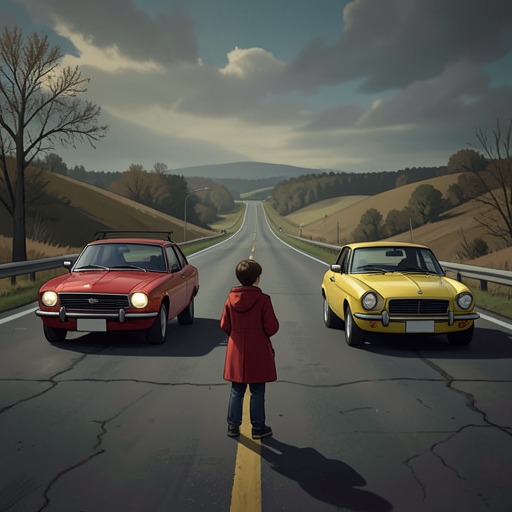
The Curious Incident of the Dog in the Night-TimeThe Good Day / Black Day system is Christopher’s car-counting rule for classifying the day ahead, and more than a private superstition, it is a practical structure through which he manages mood, risk, and uncertainty. Four red cars in a row mark a Good Day; four yellow cars in a row mark a Black Day. The same act of noticing that helps him organize experience can also determine whether he speaks, eats, or takes risks, making the system both a source of reassurance and a force that governs his choices.
Rules and Classification
The system distinguishes several categories by the color and number of consecutive cars. Four red cars mean a Good Day, three red cars a Quite Good Day, and five red cars a Super Good Day. Four yellow cars mean a Black Day. These rules are not presented as claims about what car colors objectively cause; they are Christopher’s chosen way of sorting the day into recognizable kinds. The categories give numerical pattern and color a personal significance that ordinary traffic would not otherwise possess.
The system also sits alongside Christopher’s preference for order without being identical to his idea of logic. When Mr. Jeavons asks why the car sequences determine the categories, Christopher explains that he likes things arranged nicely and that logic is only one way to achieve that order. He compares his system with office workers whose moods change with the weather, even when the weather has no bearing on their work. In that comparison, the important point is not that every source of a good or bad mood is logically connected to the day’s events, but that people use patterns to make the day feel organized.
Safety, Routine, and Conduct
When Mr. Jeavons asks whether having things always in a nice order makes him feel safe, Christopher answers that it does. The system therefore does more than label his mood after the fact: its predictability offers a form of security. The rules are stable even when the circumstances around him are not, and a color sequence supplies an answer about how to approach the day before its events unfold.
A Black Day has explicit behavioral consequences. Christopher describes it as a day when he does not speak to anyone, sits by himself reading books, does not eat lunch, and takes no risks. These actions show how the classification translates into routine: the category is not merely a name but a guide for limiting demands and exposure. The system makes a day legible by pairing a visible sequence of cars with a set of expectations for his own conduct.
Repeated Black Days
The rule becomes especially concrete after Christopher sees four yellow cars on the way to school on two consecutive mornings. On the first Black Day, he eats nothing at lunch and spends the day reading his A-level mathematics course book in a corner of the room. On the second, he again does not speak to anyone; throughout the afternoon he sits in a corner of the library, groaning with his head pressed into the join between two walls. He says that this makes him feel calm and safe, showing how withdrawal and the familiar order of the system work together as a response to distress.
After two Black Days in a row, Christopher is allowed to keep his eyes closed all the way to school until he gets off the bus. The detail turns the classification into an accumulating rule: a repeated sequence changes what he permits himself to do on the next journey. The car-counting system thus extends beyond the moment of seeing the cars. It structures later conduct through thresholds, permissions, and an effort to manage what he encounters.
Good Days and Expectation
On another journey to school, four red cars in a row make a Good Day. Christopher decides not to be sad about Wellington. The rule does not resolve what has happened to Wellington; instead, it gives Christopher a way to set aside sadness for that day. The scene shows both the reach and the limit of the system: it can organize his response to an upsetting subject without changing the facts that caused the upset.
Five days later, five red cars in a row make a Super Good Day. Christopher takes this category as a reason to expect that something special will happen. When nothing special happens at school, he concludes that the anticipated event must be after school. He then goes to the shop at the end of the road to spend his pocket money on licorice laces and a Milky Bar. The sequence does not establish that the cars cause a special event; rather, it shows Christopher using the system to form an expectation and interpret the day as it unfolds.
Narrative Significance
The system makes Christopher’s preference for predictability visible in a repeated, easily recognized form: an ordered row of cars becomes a rule for facing the hours ahead. Its effects range from small choices, such as whether to be sad about Wellington, to sustained patterns of silence, skipped meals, reading, and seeking calm in a corner. The rules are personal rather than shared, but their consequences are concrete in Christopher’s daily life.
Its repeated appearances also give the narrative a way to register changes in expectation without pretending that a favorable category controls events. A Good Day can help Christopher decide how to feel, and a Super Good Day can lead him to anticipate something special, but the category remains a framework for interpreting experience rather than proof of what will happen. That tension is central to the system: order offers Christopher safety and a means of action, even as the world outside the rule remains beyond its control.