Materialist View of Death
The Curious Incident of the Dog in the Night-TimeThe materialist view of death in Christopher John Francis Boone’s account refuses an afterlife as an explanation and instead describes death as the end of bodily function and the dispersal of matter. Its significance lies in the contrast between a precise physical account and the emotional uncertainty surrounding his mother’s absence: material continuity offers a way to imagine where her substance might be, but it does not restore her or answer every question about loss.
Rejecting Heaven as a Place
At school, Mrs. Forbes had told Christopher that Mother went to heaven when she died. He explains that Mrs. Forbes believes in heaven, then directly rejects the account: heaven does not exist, and Mother did not go there. His reasoning is not simply a statement of disbelief; it tests the claim against the physical universe and asks what such a destination would mean in practical terms.
When Christopher asks the Reverend Peters where heaven is, the vicar describes it as another kind of place, outside the universe. Christopher objects that there is nothing outside the universe, though he allows a possibility involving a black hole. A black hole, he reasons, is a singularity whose gravity prevents even light from escaping, so no information can come from beyond it. If heaven lay on the other side, the dead would have to be sent into space on rockets—and people would notice. The argument turns an abstract religious promise into a question of observable evidence, transport, and physical possibility.
The Reverend Peters later explains that calling heaven outside the universe is a manner of speaking and that the dead are with God. Christopher immediately asks where God is. The conversation ends without an answer: the Reverend Peters says they should discuss it another day when he has more time. The unresolved exchange marks a limit between Christopher’s demand for a locatable explanation and religious language that retreats from literal geography.
Why People Believe
Christopher proposes that people believe in heaven because they dislike dying and want life to continue. He connects this wish to an ordinary, material fear: other people will move into the dead person’s house and put their belongings in the rubbish. In this account, belief in an afterlife answers not only fear of nonexistence but also the prospect that a person’s home and possessions will pass into other hands.
This explanation does not treat the desire for heaven as proof that heaven exists. Instead, it distinguishes what people may need to believe from what can be established about the physical world. The contrast is characteristic of Christopher’s approach: an idea is examined by asking what it predicts and whether its claims can be observed, while emotional motives are described plainly rather than used as evidence for supernatural survival.
Decomposition and Material Continuity
To explain what happens after death, Christopher begins with a body: the brain stops working and the body rots. He recalls Rabbit, who was buried in the earth at the bottom of the garden. Rabbit’s molecules broke down into other molecules, entered the soil, were eaten by worms, and passed into plants. After ten years, Christopher imagines that only the skeleton would remain; after one thousand years, even that would be gone. Death is thus represented as a sequence of transformations rather than a journey to another realm.
The sequence does not end in simple disappearance. Rabbit has become part of the flowers, the apple tree, and the hawthorn bush. This is continuity through matter, not the survival of Rabbit as a conscious self. Christopher’s account gives the surrounding garden a specific place in the reasoning: what remains of Rabbit is distributed through the living environment where he was buried.
Christopher notes that a coffin can delay a body’s mixing with the earth until its wood rots. The detail extends his account from biological decomposition to the material conditions that affect its pace. A coffin postpones contact with the soil; it does not change the eventual physical process.
Mother’s Cremation and the Unanswered Detail
Mother was cremated. Christopher describes the process materially: she was put in a coffin, burned, ground up, and turned into ash and smoke. He does not know what happens to the ash. Because he did not attend the funeral, he could not ask at the crematorium. The account therefore combines confidence about the physical transformation with an explicit gap in what he knows; his explanation does not pretend to supply details he never learned.
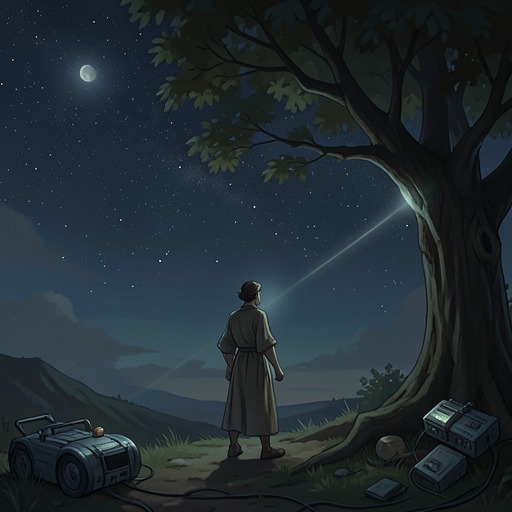
He imagines the smoke entering the air and sometimes looks up at the sky, thinking that Mother’s molecules may be there: in clouds over Africa or the Antarctic, falling as rain in the rain forests of Brazil, or coming down as snow somewhere. The imagined possibilities remain grounded in the movement of matter through the atmosphere. Unlike heaven, they require no separate universe or inaccessible destination, yet they make the vastness of that movement emotionally legible by associating it with Mother.
The materialist account holds together two different kinds of answer. It can describe bodies stopping, burning, decomposing, and entering other physical forms; it cannot establish a continued personal consciousness, and Christopher does not claim to know where the ashes went. Its force comes from keeping those limits visible while allowing the molecules of Mother, like Rabbit’s matter in the garden, to be imagined as part of the world that remains.