Math and logic as a coping mechanism
The Curious Incident of the Dog in the Night-TimeMathematics and logical reasoning are among Christopher John Francis Boone’s most dependable ways of coping with distress. When his thoughts become too crowded to organize, a problem supplies rules, steps, and a knowable limit; when pressure rises in public or during an exam, calculations give his attention somewhere precise to go. The method does not erase the circumstances that trouble him, but it helps him stay with them by narrowing the world to something he can work through.
A problem to clear the mind
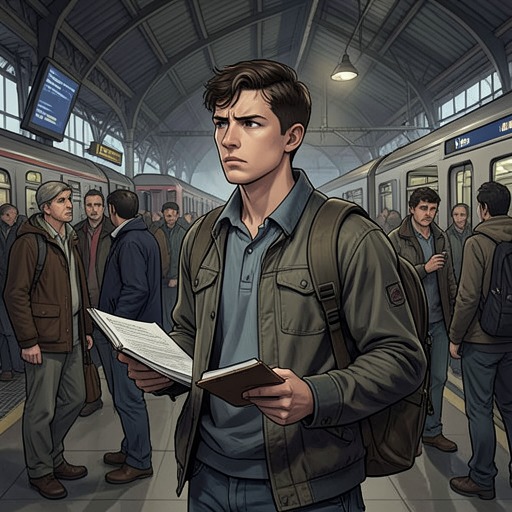
At a railway station crowded with people, Christopher sits in a corner, feeds Toby two pellets of rat food, and grips his Swiss Army knife in his other hand. He tries to decide what to do, but cannot think because there are too many other things in his head. He responds by doing a maths problem to make his head clearer: Conway’s Soldiers, a puzzle about moving tiles on an infinitely extending chessboard.
The rules are exact. A tile can jump horizontally or vertically over another tile into an empty square two squares away, and the tile jumped over must then be removed. The puzzle asks how far tiles can advance above their starting line. Christopher knows the answer: whatever sequence of moves is attempted, no tile can get more than four squares above that line. What matters to him in the station, however, is not just solving it. He can make the problem as complicated as he needs by enlarging the board and complicating the moves, filling his brain so that he does not have to think about something else. Its fixed rules turn complexity into a resource he can control.
Calculation under pressure
The same strategy returns during the journey to London. On the train, Christopher practices solving quadratic equations in his head. Later, after using the train toilet and finding a quieter hiding place among cases on shelves, he does more quadratic equations, including one written as 0 = 437x2 + 103x + 11. The calculations recur amid travel and discomfort: they occupy his attention when the surrounding situation is hard to manage, rather than changing that situation.
The train journey also shows the limits of mental calculation as a coping tool. Christopher begins to panic because he does not know how long it will take to reach London and needs to use the toilet urgently. He taps a rhythm on the glass with his knuckles and watches his watch for seventeen minutes, but leaks before he can get to a toilet. The episode places a precise, measured interval beside a bodily need that cannot be made to wait simply by counting. Mathematics can direct attention and help him endure uncertainty; it cannot always bring the uncertainty or its physical consequences under control.
Reasoning as a way through an exam
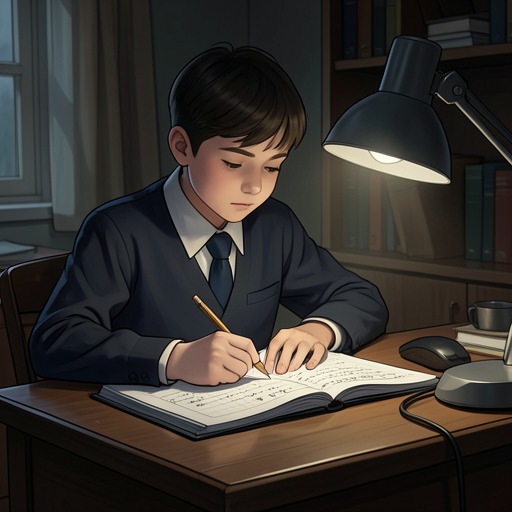
During Paper 1 of his maths A-level, Christopher initially cannot think how to answer the questions and cannot breathe properly. He feels an urge to hit or stab someone with his Swiss Army knife, but the invigilator, Reverend Peters, is the only person there; Christopher recognizes that harming him would mean he could not invigilate the rest of the exam. He follows Siobhan’s advice to take deep breaths when he wants to hit someone at school, counts fifty breaths, and works through cubes of the cardinal numbers as he counts.
Here logical thought is not only an escape into a puzzle. Christopher weighs an immediate impulse against a concrete consequence, then uses a repeated sequence to persist in the exam room. The list of cubes gives each breath a number and each number a place in an ordered progression. Together, breathing, counting, and calculation help him respond to a crisis without acting on the urge to hurt the person supervising him.
Rules, limits, and control
Across these episodes, mathematical tasks vary in scale but serve a recurring purpose. Conway’s Soldiers can expand indefinitely in Christopher’s mind, while its solution establishes a firm four-square limit. Quadratic equations offer another structured activity during the train journey, and cubes accompany counted breaths when the exam becomes difficult. In each case, a problem’s rules make attention more manageable by giving it an ordered sequence to follow.
This strategy is practical rather than magical: Christopher still experiences crowding, panic, discomfort, and trouble concentrating, and the train episode ends with a consequence that counting cannot prevent. The significance lies in the distinction between controlling an external situation and finding a way to meet it. Mathematics and logic give Christopher a form of control over what he can direct—his attention, his next step, and, at the exam, his response—without pretending that every surrounding difficulty has a solution he can calculate.