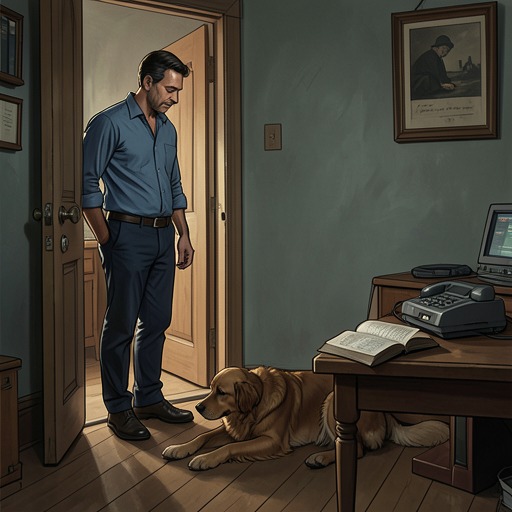
Observation and Details
The Curious Incident of the Dog in the Night-TimeObservation and detail are not incidental habits for Christopher; they shape both what he knows and what it costs him to know it. Familiar surroundings are manageable because he has already registered them and can look for what has changed. A new place demands attention to everything at once, until the abundance that makes him exceptionally observant can also leave him unable to process what is happening.
Familiar Places and Changed Details
In places he knows—home, school, the bus, a shop, or a street—Christopher has already seen almost everything. He can therefore concentrate on differences: the classroom poster for Shakespeare's Globe, for instance, had been put back slightly to the right after falling, leaving three small Blu-Tack stains down its left side. On his street, he noticed graffiti reading CROW APTOK on lamppost 437, outside number 35. The examples turn familiarity into a practical method: the known scene provides a baseline, and a displaced object or new mark becomes legible against it.
Christopher contrasts this sustained attention with what he calls glancing. Most people, he says, register a simple outline and then stop noticing, perhaps because they are thinking about beauty, an unattended gas cooker, or whether someone has given birth. His comparison between glancing at a scene and a snooker ball glancing off another gives the word a literal direction: contact without sustained engagement. The difference is not that other people see nothing, but that their attention settles for a summary where his continues into particulars.
The Field as a Test of Attention
A remembered field makes the contrast concrete. On Wednesday, 15 June 1994, while travelling with Father and Mother toward Dover to catch a ferry to France, Christopher stopped during what Father called Taking the Scenic Route. After lunch in a pub garden, he went into a field to urinate and then examined it. He counted 19 cows: 15 black and white, four brown and white. He also registered a distant village with 31 visible houses and a square-towered church, rather than a spire.
His inventory moves well beyond a conventional landscape impression. The field’s ridges suggest its medieval use as ridge-and-furrow farmland, with a ridge for each village farmer. A plastic bag from Asda lay in the hedge; a crushed Coca-Cola can had a snail on it; a long piece of orange string was also there. Carrying a compass because he wanted to know where Swindon lay while he was in France, he identified the field’s northeast corner as highest and southwest corner as lowest, and noticed that its surface folded along the diagonal between them rather than forming a simple inclined plane. He distinguished three types of grass, two flower colors, and the fact that most of the cows faced uphill.
This list is deliberately incomplete. Christopher recalls 31 additional things he noticed, but Siobhan told him he did not need to write them all down. The omitted observations matter as a limit on the written account, not as a reason to doubt the scale of his attention: the narrative gives enough exact particulars to show how much a scene can contain for him. He says that if someone later asked what the cows looked like, he might ask which cow; at home, he could draw them and describe a particular animal’s pattern. A general question about “the cows” does not match the specificity of what he remembers.
Detail, Interpretation, and Form
The account repeatedly converts an apparently ordinary view into an ordered set of distinct facts. Counting, naming, locating, and comparing give Christopher a way to make the field intelligible without reducing it to a mood such as “very beautiful.” His description holds together different kinds of observation—numbers, traces of human activity, historical inference, terrain, and animal orientation—without treating them as interchangeable. Its precision also explains the energy demanded by unfamiliar settings: registering everything is not a momentary glance but an extensive task.
That method briefly turns back on the book itself. Christopher acknowledges that he previously said he could not tell jokes, then clarifies that he knows three jokes that he can tell and understands. Siobhan says he need not revise the earlier chapter because this is a clarification, not a lie. The small correction is consistent with his larger attention to exactness: a statement can be true enough for its purpose while still needing qualification. The joke that follows depends on distinguishing what is actually observed from what a speaker claims to know, so its logic sits naturally beside Christopher’s insistence on careful evidence.
Overload in New Places
The same abundance that supports Christopher’s concentration can become disabling when the surroundings are unfamiliar. He compares the experience to a computer trying to do too many things at once: its central processing unit becomes blocked, leaving no space to think about anything else. Crowds intensify the difficulty. Unlike cows, flowers, and grass, people may speak to him or do something unexpected; he must attend both to what is present and to what might happen.
At the point of overload, the computer comparison becomes more than an explanation. Christopher describes closing his eyes, covering his ears, and groaning, as though pressing CTRL + ALT + DEL, shutting down programs, and restarting so he can remember what he is doing and where he is meant to be going. The image makes the cost of observation unmistakable: attention is not simply a gift that supplies more information, but a finite capacity that can be consumed by a crowded, unpredictable environment. His account of the Swindon train station follows this principle. Frightened, he says he did not notice its features very well, and calls his remembered map an approximation. Precision is possible, but it is not automatic when fear and unfamiliarity compete for his attention.
A Source of Skill and Strain
Christopher connects his attention to his ability in chess, mathematics, and logic. Where other people, in his view, miss much of what is around them, he notices more; the capacity that makes a new place hard to bear also gives him a store of observations to work with. The book does not present this as an uncomplicated advantage. The field can be rendered in remarkable detail, yet the same practice becomes tiring, and a crowded unfamiliar place can interrupt thought altogether.
Observation and detail therefore connect strength with vulnerability rather than resolving one into the other. Christopher’s familiar surroundings are navigable because prior knowledge lets him identify change; the field demonstrates how densely he can register a scene; the station shows how fear can diminish that capacity; and the computer-crash image describes its breaking point. Across these contrasts, attention is both his way of making the world comprehensible and the reason the world can sometimes become too much to process.