Order, rules, and predictability
The Curious Incident of the Dog in the Night-TimeOrder, rules, and predictability form a working method by which Christopher John Francis Boone makes an uncertain world navigable. Timetables give shape to time, and step-by-step rules turn a daunting journey into actions that can be followed and checked. This system does not remove fear or confusion; it gives him a way to act through them, from locating a station in Swindon to crossing London toward his mother.
Timetables as Maps of Time
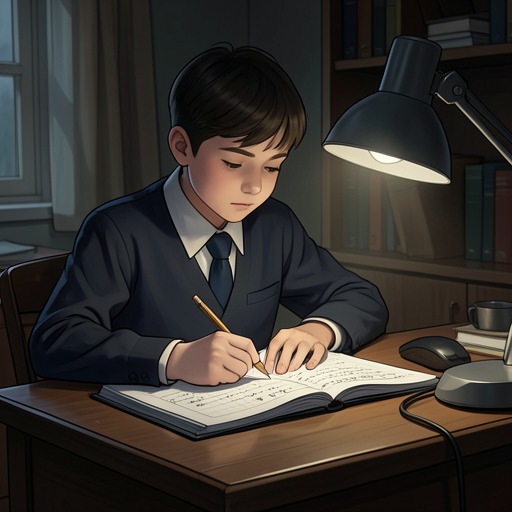
Christopher likes timetables because he wants to know when things will happen. He made one for his model railway, and, at home, wrote weekend schedules on cardboard and put them on the wall. Their entries could be as ordinary as feeding Toby, doing mathematics, or going to the shop for sweets. On holiday, when there was no timetable, he asked his parents each morning to tell him exactly what the day would involve. Routine is reassuring not because it makes every day identical, but because it makes the next step knowable.
His explanation of time clarifies why schedules matter so much. A protractor or biscuit remains in a place whether or not there is a map to find it; time, by contrast, is not a place one can return to. Christopher describes it as a relationship between changes—the Earth moving around the Sun, atoms vibrating, clocks ticking, day becoming night, and waking giving way to sleep. A timetable is therefore a map of something less tangible than physical space. It cannot make time an object, but it can keep a person from feeling lost within it.
The contrast becomes especially sharp during his journey. Christopher remembers an earlier timetable from when he lived with Father and believed Mother had died of a heart attack. The organized life represented by that schedule has since been overturned: he now needs to travel to London to live with Mother. A timetable remains useful, but the destination it helps him reach belongs to a changed family reality.
Rules for Finding a Way
When Christopher is confused in the town centre, he uses a systematic search rather than guessing. He knows the station is nearby and reasons that he can find it by walking in a spiral: keep taking right turns until reaching a road already walked, take the next left, and repeat the pattern. Following this procedure, he finds the station and builds a mental map of the town as he goes. The rules also help him attend less to the surrounding people and noise: a route that can be followed gives his attention a task.
At the station, however, the environment resists the neatness of a map. The tunnel echoes; people stream in and out; the smells of toilets and cigarettes and the crowd’s movement make Christopher feel giddy and sick. He clings to a sign to steady himself and crouches rather than risk falling. Wanting to go home does not solve the problem, because he is frightened of going home as well. In this moment, the ordinary conditions for planning—enough quiet and mental space to compare options—have disappeared.
He proceeds by breaking the task down. Christopher covers his ears, decides to walk through the tunnel to find somewhere to sit, and concentrates on a warning sign at its far end. Once upstairs, he avoids a crowded waiting room and finds an empty table in a corner. There he closes his eyes, feeds Toby two pellets of rat food, grips his Swiss Army knife, and does a mathematics problem to clear his head. The small, concrete sequence does not make the station calm; it creates a limited pocket of order within it.
From Swindon to London
Christopher’s decision to go to London follows a process of elimination: he crosses out possibilities he regards as impossible until the remaining choice is to live with Mother. He treats the train journey as a sequence whose parts can be learned and completed—consult the timetable, go to the station, buy a ticket, check the departure board, find the platform, and board. His knowledge of trains from his model railway gives the unfamiliar undertaking a structure before he begins it. He eventually enters the train and is on his way to London.
That structure cannot prevent every difficulty. Christopher dislikes being enclosed with strangers, and a moving train feels like a room from which he cannot get out. His fear of crowds is not abstract: he recalls having screamed in a car crowded with unfamiliar children, trying to escape while it was moving, and falling onto the road, where he needed stitches in his head. The train therefore combines a comprehensible route with a distressing loss of control. Knowing where it is going does not make the space inside it easy to endure.
In London, Christopher again relies on explicit cues and rules. A woman points out the Underground and advises him to take the Bakerloo Line to Willesden Junction or the Jubilee Line to Willesden Green. To cross the busy space, he tells himself that people are like cows in a field, looks straight ahead, and imagines a red line on the floor to follow. He keeps hold of the Swiss Army knife and makes sure Toby cannot escape from his pocket. The imagined line simplifies a room full of people into a route; the destination remains the purpose of his movement.
At the station, the signage does not match the instruction he first received: there is no Jubilee Line sign where he looks. Christopher makes a new plan and chooses the Bakerloo Line to Willesden Junction. He reads the signs until he finds the station name, follows the arrow through the left-hand tunnel, stays on the left side of a divided passage, and continues as the tunnel curves. Later, he chooses the Northbound route because Willesden appears in the upper half of the map and the top of maps is north. Each decision uses a rule grounded in visible information, replacing an uncertain choice with a checkable one.
After leaving Willesden Junction, he uses the shape of the roads to identify Station Approach and Oak Lane. It is dark, the bright lights make him feel sick, and he keeps his eyelids almost closed while looking for the road pattern he needs. He reaches 451c Chapter Road after a 27-minute walk, but nobody is in when he presses the button for Flat C. The method has brought him to the address; it cannot guarantee the welcome or reunion he seeks.
What the System Can—and Cannot—Do
Christopher’s rules are practical rather than abstract ideals. A spiral search finds a nearby station; signs, arrows, and the orientation of a map guide him through a transport network; a timetable renders future events more predictable. When the surroundings overwhelm him, following a rule can also narrow attention: he can focus on a sign, a route, or a mathematics problem instead of trying to process everything at once.
Yet the journey makes the limits of predictability visible. The station remains loud and crowded, the train remains difficult because it cannot be left while moving, and the London streets remain physically and sensorially demanding. Christopher’s procedures do not erase those conditions or make every outcome certain. Their significance lies in the distinction between controlling the world and finding a way to proceed within it: the timetable cannot settle the mystery of time, and the route cannot promise what waits at its end, but both turn an immense problem into a series of steps he can attempt.