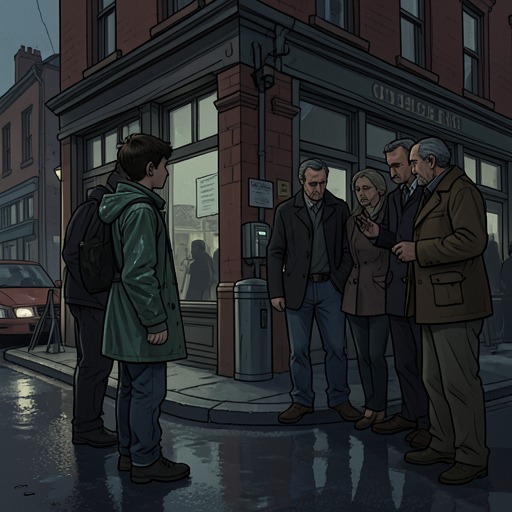
Randolph Street
The Curious Incident of the Dog in the Night-TimeRandolph Street is Christopher’s home street in Swindon, the setting where his investigation begins and the place he first turns into a map. Its ordinary houses make a difficult social task navigable: he identifies which neighbor to question, plans his approach, and treats the street as the starting point of a journey that will eventually take him away from home.
A mapped setting for investigation
Christopher makes a plan of his part of Randolph Street before going out to ask neighbors about Wellington’s murder. He carries his Swiss Army knife and knocks first at number 40, directly opposite Mrs. Shears’s house, reasoning that its residents are especially likely to have seen something. The street is therefore not just a backdrop to the investigation: its arrangement helps him decide whom to ask and in what order.
After speaking with a neighbor who warns him to be careful, Christopher thanks her and proceeds to number 43, next door to Mrs. Shears’s house. His movement from one address to another gives the inquiry a concrete, orderly shape. The questions are socially demanding, but the numbered houses and his street plan supply a sequence he can follow.
Home and the problem of strangers
The investigation requires Christopher to approach people he does not know, something he ordinarily handles by observing a newcomer for weeks before deciding they are safe. On Randolph Street, he makes an exception because he believes detective work requires bravery and that he has no choice. The familiar geography does not remove the social risk; instead, it gives him a defined task and a manageable route through it.
The street’s connection to home becomes more complicated after Christopher concludes that he must go to London to live with his mother. He plans to travel by train from Swindon station, turning the departure into a practical sequence of timetable, ticket, departure board, platform, and train. The route begins in the world of home, but the decision to leave makes that home feel as though it has shifted elsewhere.
Address, departure, and remembered geography
Randolph Street also appears as part of Christopher’s exact postal address: an envelope addressed to him gives 36 Randolph Street, Swindon, Wiltshire. The precise address fixes his place in the world in a way that contrasts with the later uncertainty of navigating unfamiliar transport spaces. It identifies a home he can locate, even as his plans take him beyond it.
During the journey toward London, Christopher recalls the street as the place from which he must travel to reach his mother. At Swindon station, fear and sensory overload make the tunnel, crowds, noise, and smells difficult to manage; later, in London, he uses a mental red line and follows signs through the Underground. The contrast gives Randolph Street a quiet structural importance: it is the known point of departure against which each unfamiliar station and route is measured. Its role in the story is both practical and emotional, joining the investigation’s first steps to the much larger challenge of leaving home.