Sensory overload
The Curious Incident of the Dog in the Night-TimeSensory overload is the breakdown that occurs when Christopher has more sights, sounds, people, and possible events to process than he can hold in mind at once. The book explains it through his computer-crash comparison, then shows its practical cost in crowded stations: planning becomes difficult, physical distress rises, and even waiting for a train requires deliberate strategies for regaining focus. It is not simply a dislike of noise; the episodes arise from the combined demand of perceiving the environment, anticipating what people may do, and deciding where to go.
Definition and the computer analogy
Christopher describes attention in a new place as a computer trying to perform too many tasks at the same time. Its central processing unit becomes blocked, leaving no space to think about anything else. A crowd makes this harder because people, unlike cows, flowers, and grass, may speak to him or act unexpectedly; he has to notice both what is present and what might happen. At the limit, the computer crashes. Closing his eyes, covering his ears, and groaning become, in his analogy, the equivalent of pressing CTRL + ALT + DEL, shutting down programs, and restarting so that he can remember what he is doing and where he is meant to go.
This account connects a distinctive strength with a vulnerability. Christopher says that his attention to detail helps him with chess, maths, and logic, because other people overlook many things. But the same expansiveness of attention becomes difficult to manage when a new setting presents too many details at once. The issue is not that the information is meaningless to him: rather, he has to register the surroundings and possible developments, leaving too little capacity for choosing and carrying out a plan.
Swindon station: overload and self-management
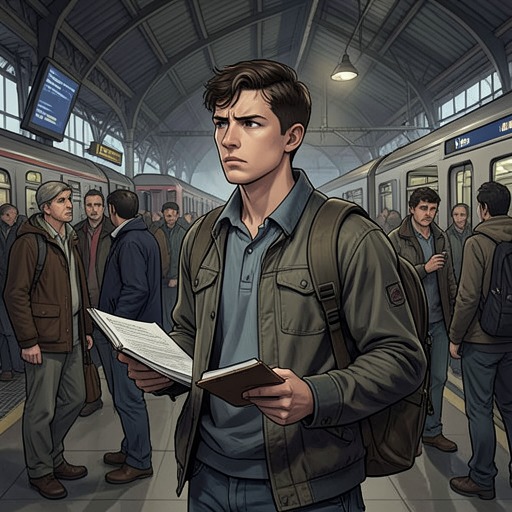
At Swindon station, Christopher is frightened and recognizes that his remembered map is only an approximation because fear has interfered with how well he notices things. The station’s tunnel, stairs, shop, café, and waiting area do not match the simple two-room station in his train set. Faced with the real place, he describes feeling giddy and sick and being unsure how to proceed. He holds the edge of a sign to steady himself and crouches, wanting to go home while also being afraid to do so.
He tries to plan, but finds there are too many things to see and hear. Covering his ears is an attempt to block noise so he can think. He reasons that he needs to stay at the station to catch a train and must find somewhere to sit, then walks through the tunnel while concentrating on a sign at its far end. The route is undertaken one manageable step at a time, not through a confident overview of the station.
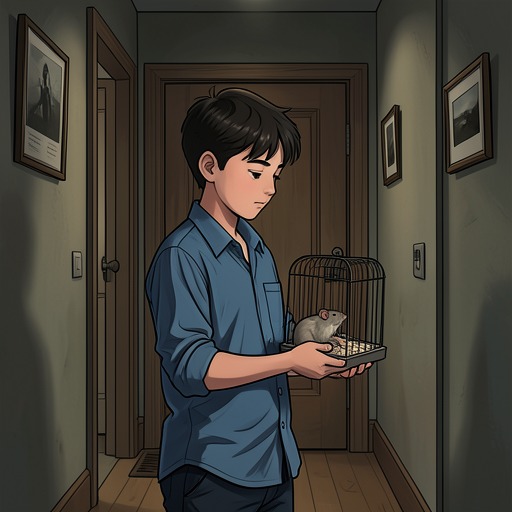
At the other end he finds a room with chairs but passes it because too many people are there. He eventually sits at an unoccupied table in a corner and closes his eyes. Toby climbs into his hand; Christopher gives him two pellets of rat food from his bag while gripping his Swiss Army knife in the other hand. He groans quietly enough, as he puts it, to cover the noise without drawing people over to speak to him. Even seated, he cannot yet organize his thoughts, so he uses a maths problem, Conway’s Soldiers, to make his mind clearer. These actions show overload shaping not only what he feels but the practical sequence by which he seeks safety and concentration.
Crowding, trains, and renewed episodes
The later underground-station episode shows that finding a seat does not make the difficulty disappear. Christopher sits at the end of a bench as people gather. A woman with a black briefcase, purple shoes, and a parrot-shaped brooch sits at the other end; the crowd continues to grow until Christopher can no longer see the walls and someone’s jacket touches his knee. He feels sick, groans loudly, and experiences the setting as so overwhelming that he cannot walk, eat, sleep, or do maths.
When a train arrives, its roar and the surrounding commotion initially seem to Christopher like signs that the station may collapse or that a fire has started. He closes his eyes and continues groaning. As the sound subsides, he gradually understands that it was a train; after its five carriages leave, the station quiets. The episode presents a gap between the sensory event and his ability to identify it while overwhelmed, without suggesting that his fear is deliberate or that the noise has actually become a catastrophe.
The cycle repeats as the station fills, trains arrive, and crowds depart. Christopher describes a balloon inside his chest becoming so large that it is hard to breathe, and compares his wish for the experience to stop to unplugging a crashed computer. He wants to sleep to escape the pain of having no room in his mind for anything else, but cannot; he can only wait. The repeated sequence matters: the station briefly empties, yet each new crowd and train brings the overload back rather than resolving it permanently.
Communication, rules, and narrative significance
The book places this difficulty alongside Christopher’s explanation that people communicate through signals that are hard to interpret. Siobhan tells him that a raised eyebrow can have very different meanings, and that even breathing out through the nose may signal relaxation, boredom, or anger depending on its force, timing, expression, posture, and context. Such cues require him to infer what others mean from details that do not have one stable interpretation. Sensory overload and social uncertainty therefore reinforce one another in crowded places: people are part of the environment he has to monitor, and their possible actions add to the work of making a plan.
Clear instructions provide a contrast. Christopher says he likes that Siobhan specifies exactly what he must or must not do. Her directions about moving away, counting to fifty, and then reporting a conflict give him a concrete procedure, unlike vague restrictions whose scope he cannot determine. When Father tells him to be quiet, Christopher asks how long; Mother also gives a specific limit of half an hour when she needs quiet. The contrast does not make explicit rules a cure for sensory overload, but it shows why precision can make an uncertain situation more manageable.
The computer analogy gives the episodes a form that Christopher can describe without reducing them to a simple dislike of crowds. Rebooting, covering his ears, seeking a corner, feeding Toby, holding a familiar object, and solving a maths problem are particular attempts to restore the capacity to think. Yet the repeated station episode also marks the limits of those strategies: they can help him wait or orient himself, but the next train and fresh crowd can overwhelm him again. The concept thus links the book’s attention to observation and logic with the environmental conditions under which those strengths become difficult to use.