Swindon
The Curious Incident of the Dog in the Night-TimeSwindon is the small town Christopher calls home, but it is more than a point on a map: it is the familiar base he must leave to reach his mother in London, and the place to which he later returns with her. Its station links those two movements. There, a journey that can be described as a train timetable and a route becomes, for Christopher, a physical trial of crowds, noise, signs, and decisions. The town’s importance lies in that contrast between knowing where one belongs and having to make one’s way through an unfamiliar world.
Home, family, and a future beyond the town
Christopher describes Swindon as a small place without a university. He plans to take A-level further maths and physics after A-level maths, then go to university; because he does not want to live alone or in a house with other students, he expects that he will have to move to a different town. His father also talks about leaving Swindon, sometimes calling it the “arsehole of the world.” The shared prospect of moving gives the town a double meaning: it is the setting of Christopher’s current life, but not the place he imagines spending his whole adult life.
His practical hopes for that future are specific. After a degree in maths, physics, or both, he expects to earn enough to pay someone to look after him, cook his meals, and wash his clothes, or to marry a woman who could provide care and company. In the same passage he recalls having once expected his parents might divorce, because they argued and sometimes hated one another. He attributes the conflict to the strain of caring for a child with behavioural problems, while also saying that he has fewer problems now that he is older and can make decisions and do things on his own, including going out and buying things at the shop at the end of the road. Swindon is thus the everyday landscape in which both dependence and growing independence are visible.
The route from Swindon to London
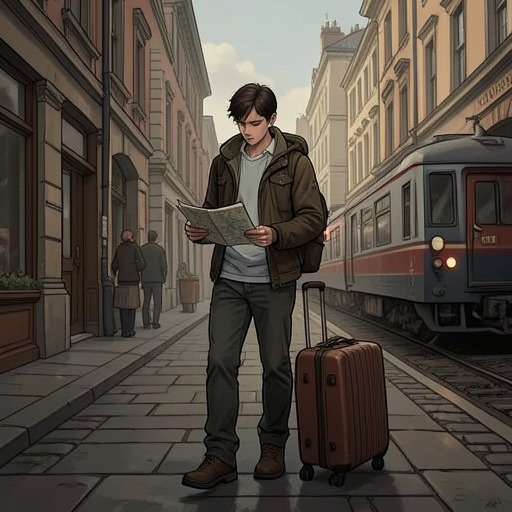
When Christopher concludes that no available option feels safe, he rules out possibilities as if eliminating questions in a maths exam. The remaining plan is to go to London to live with his mother. He knows the basic sequence of rail travel from his train set: check a timetable, go to the station, buy a ticket, consult the departure board, and board the right train. Even before he reaches the station, he connects Swindon to a fictional journey: it is where Sherlock Holmes and Doctor Watson stop for lunch on their way from Paddington to Ross in “The Boscombe Valley Mystery.” A familiar story and a model railway help turn the large decision to leave into a sequence of comprehensible steps.
Christopher leaves through the garden gate, checking that no one is watching, and walks towards his school because he knows the direction and can ask Siobhan where the station is. His fear changes as he moves: he is frightened of going somewhere unfamiliar, but also of being near his father. He describes the two fears as inversely related, so that their product remains approximately constant. The mathematical formulation does not remove the danger or uncertainty; it gives him a rule for understanding how one fear rises as the other recedes.
Once in the town centre, Christopher loses sight of a sign he had been following and realizes that he is lost. The mental map he would normally use has been disrupted by too much interference, so he stops beneath the green-and-white canvas roof of a greengrocer’s shop, among boxes of carrots, onions, parsnips, and broccoli, and makes a new plan. Because he knows the station is nearby, he searches by spiralling through the streets: moving clockwise, taking every right turn until he reaches a road already walked, then taking the next left and repeating the rule. Following this system lets him map the centre of Swindon in his head while paying less attention to the people and noise around him. The station is reached not by effortless familiarity, but by a method that converts disorientation into a repeatable procedure.
The station as an obstacle and a working map
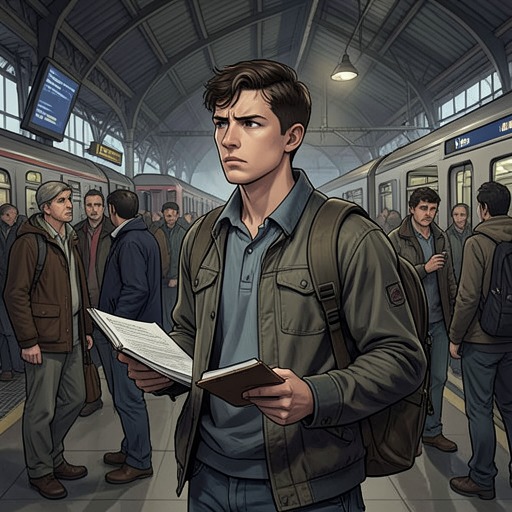
The Swindon station does not resemble the small two-room building in Christopher’s train set. It has a tunnel, stairs, a shop and café, and a waiting room; his remembered map of it is explicitly only an approximation, made while he was scared and therefore not noticing everything accurately. The difference matters: the model offers a neat arrangement of ticket office and waiting room, while the real station confronts him with a moving, crowded environment that will not hold still for orderly inspection.
Christopher compares the station to standing on a cliff in a strong wind. People pass in and out of the tunnel, sounds echo, there is only one way forward, and the place smells of toilets and cigarettes. He braces himself against a wall and grips the edge of a sign about using an assistance phone to access the car park, trying not to fall or crouch on the ground. He wants to go home but is frightened of going home; at the same time, the number of things to see and hear makes it impossible to form a plan. The station puts both his destination and his retreat within reach, while making either choice hard to act on.
He covers his ears to block the noise and decides that he must remain at the station to catch a train. With nowhere to sit by the entrance, he makes himself walk down the tunnel, focusing on a sign that reads “WARNING CCTV in operation.” At the far end, stairs lead to another crowded area. A room with chairs is too full, so he passes it and finds an unoccupied table in a corner. There he closes his eyes, holds Toby, gives him two pellets of rat food, and grips his Swiss Army knife in his other hand. He groans to cover the noise, but not loudly enough to invite other people to approach him. When he still cannot think because of the competing thoughts in his head, he works on a maths problem to make his mind clearer. The station is not simply a place to board: it is an environment that forces him to assemble a temporary refuge out of a corner, familiar objects, and mental rules.
Departure, return, and the town’s continuing tensions
The journey ultimately carries Christopher away from Swindon towards London, where he hopes to find his mother. Later, he and his mother drive back to the town; the trip takes three hours and twelve minutes, includes a stop for petrol, and is delayed by a traffic jam caused by drivers slowing to look at an accident on the opposite carriageway. Christopher tries to devise a formula connecting traffic density, speed, and how quickly drivers brake, but exhaustion defeats the calculation. He has not slept because he is worried about being unable to take his maths A-level, and he falls asleep during the drive. The same impulse to find a rule in movement that served him at the station now meets a system too complicated for him to solve while tired.
They arrive at Christopher’s home at 1:23 p.m. His mother has keys, but the house is empty. She tells him he will be safe; he goes to his room, takes Toby from his pocket, lets him run around, and plays Minesweeper, completing the Expert version in 174 seconds—75 seconds slower than his best. At 6:35 p.m., he hears his father’s van arrive and moves his bed against the door to prevent his father from entering. His parents shout at one another, and his father calls out, “How the fuck did you get in here?” The return to Swindon therefore restores Christopher to his room and familiar routines without restoring the old sense of safety. The town remains both home and the setting of an unresolved family confrontation.