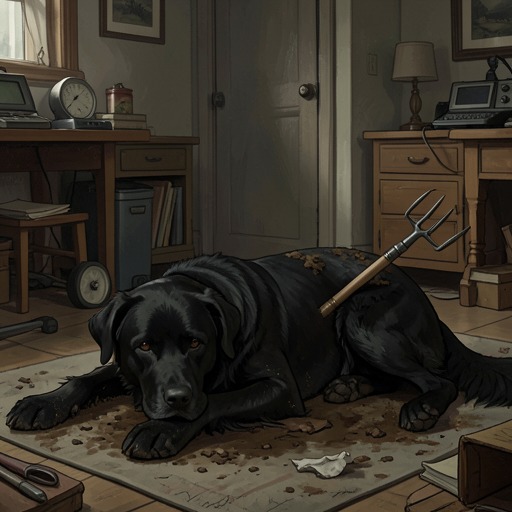
Wellington was killed
The Curious Incident of the Dog in the Night-TimeWellington’s murder turns Christopher’s investigation into a family crisis: the dog’s death first appears as a crime to solve, but Father’s later confession makes it a test of truth and trust between them. The revelation links Wellington’s killing to Father’s conflict with Mrs. Shears and to the grief and anger that followed Christopher’s mother leaving.
Discovery
At seven minutes after midnight, Christopher finds Wellington dead on the lawn in front of Mrs. Shears’s house, with a garden fork lodged in the dog. The fork’s position leads him to infer that it caused the death, though he acknowledges that he cannot be certain. He goes through the gate, kneels beside Wellington, and touches the dog’s muzzle; it is still warm. Wellington belonged to Mrs. Shears, a friend of Christopher’s family who lived across the road, two houses to the left.
The scene gives Christopher a concrete mystery to investigate. Its details matter to his reasoning: the apparent absence of other wounds supports his inference about the fork, but does not make him claim certainty. The discovery begins not with an explanation of motive but with a careful attempt to establish what happened.
Father’s Confession
Much later, Father tells Christopher that he killed Wellington. Christopher initially wonders whether the statement is a joke, because he does not understand jokes and knows that jokes do not mean what they say. Father insists that he wants to explain, making the confession a turning point not only in the investigation but in Christopher’s understanding of his father.
Father places the killing in the period after Christopher’s mother left. He says Mrs. Shears had helped him through a difficult time, regularly coming over to help with cooking and cleaning and to check whether they needed anything. He had hoped that she might eventually move into his house, or that he and Christopher might move into hers. He acknowledges that he had mistaken their closeness for a future partnership.
The Quarrel and Motive
Father says that he and Mrs. Shears argued repeatedly. In the quarrel he describes as immediately preceding the killing, she threw him out of the house. He says he believed she cared more for Wellington than for him and Christopher, and that this belief shaped his anger as he left. The dog was in the garden; Father describes an escalation in which his anger overwhelmed his judgment and he killed it.
His account connects the murder to a specific grievance rather than presenting it as an unexplained act: Father felt rejected by Mrs. Shears and interpreted her attachment to Wellington as evidence that she valued the dog more than their family. He also recognizes, in retrospect, that caring for a dog alone might have been easier for her than sharing life with other people. These explanations provide the circumstances and motive he offers, but do not undo the harm or make his act accidental.
Consequences and Significance
Father ends his account by saying he is sorry and that he never intended matters to turn out this way. His apology follows a confession that directly contradicts the trust he had sought to establish with Christopher. For Christopher, the murder is therefore both the answer to the original mystery and a decisive rupture: the person who killed Wellington is also the father who had presented himself as someone Christopher could trust.
The event’s force comes from the gap between its first presentation and its later explanation. Christopher begins with observable evidence—the fork, the dog’s condition, and the location—and cautiously reasons toward a cause. Father’s confession adds an account of adult relationships and emotional conflict, but it also reveals that the investigation has led Christopher to a truth with immediate personal consequences. Wellington’s death is no longer only a case to solve; it changes what Christopher can believe about his father.