Albert Ringier
The Dark ForestAlbert Ringier is the Hubble II astronomer whose observations give humanity its decisive visual confirmation of the Trisolaran Fleet. He is both a scientist defending the autonomy and beauty of astronomical work and a participant in a military system that appropriates that work for survival. His career therefore embodies a central tension of the Trisolar Crisis: knowledge begins as an open-ended effort to understand the universe, but under threat it becomes an instrument of planetary defense, surveillance, and command.
Identity and Scientific Position
Albert Ringier is identified as an astronomer working on the Hubble II Space Telescope. He belongs to the scientific community that designed, assembled, and operated the instrument, although the telescope is eventually requisitioned for military purposes. His professional identity is marked by an acute sense of ownership. At the launch, he calls the telescope “my Hubble,” a possessive phrase that expresses not legal ownership but the labor, pride, and emotional investment of the scientists who made its observation possible.
Ringier’s authority is observational rather than military. He is not presented as a commander or strategist; his power comes from his ability to read faint astronomical evidence and distinguish meaningful structure from visual noise. That specialized authority later places him in direct conversation with Luo Ji, who seeks him out because the astronomer was associated with the first observation of the fleet’s flight path.
Hubble II and the Launch
Ringier’s introduction occurs during the final launch required to complete Hubble II. He watches from a distant public viewing area with a crowd of astronomers and physicists. The scientists should have occupied a closer VIP platform, but a NASA official excludes them on the grounds that the object being launched does not belong to them, while admitting uniformed generals with deferential ceremony. The arrangement makes the institutional humiliation concrete: the people who built the telescope are pushed away from its launch, while military authority is granted privileged visibility.
Even from the remote site, the launch becomes a spectacle. The rocket’s flames transform the darkness into something resembling a rapid sunrise, sending golden waves across the lake and turning the sky red before the brief artificial dawn disappears into night. Ringier responds with tears in his eyes and with applause, suggesting that scientific ownership survives the political insult. His emotional reaction is not merely pride in hardware. The telescope represents a long collective effort to extend human sight, and its ascent momentarily restores the scientists’ sense that the instrument belongs to a larger intellectual project.
Hubble II is described as a second-generation space telescope whose diameter has been enlarged from its predecessor’s 4.27 meters to 21 meters, increasing its observational capability by a factor of fifty. Its compound lens is made from components manufactured on Earth and assembled in orbit. Completing the lens requires eleven launches, making the final blastoff the culmination of a technically elaborate process rather than an isolated mission. Assembly near the International Space Station is almost complete, and within two months the telescope is expected to look into the depths of the universe.
Conflict with George Fitzroy
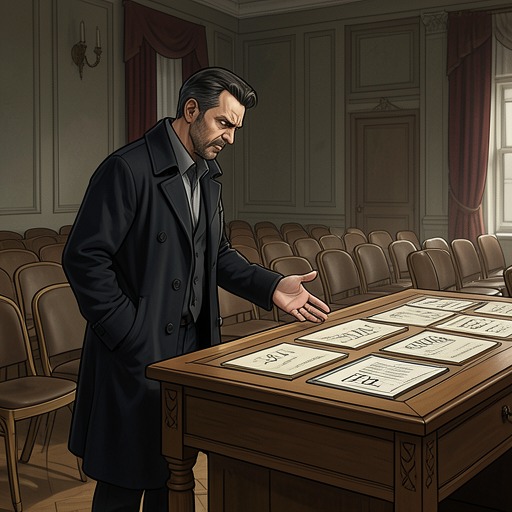
Ringier’s relationship with George Fitzroy is defined by an argument over who has the right to control scientific achievement. Fitzroy has become the military representative after Hubble II is requisitioned. He attends the launch in civilian clothes, smoking against the countdown clock, and Ringier does not know his rank or address him as “sir.” Instead, Ringier denounces him as a thief for taking what he regards as a beautiful civilian creation.
Fitzroy answers that wartime gives the military the right to requisition all civilian equipment. He further argues that the astronomers did not manufacture the lens components or design every screw, and therefore have no special claim to the telescope’s success. The exchange reduces two incompatible systems of value to a sharp confrontation. Ringier sees the telescope as an achievement whose meaning includes beauty, discovery, and the community that created it. Fitzroy sees it as strategic equipment whose ultimate value lies in what it can reveal to the defense establishment.
The dispute does not make Ringier an opponent of humanity’s defense. Rather, it shows the cost of converting scientific instruments into military assets. Ringier’s anger is directed at the loss of civilian control and at the contempt shown toward the scientists, while Fitzroy’s position reflects a wartime logic in which ownership and priority are overridden by necessity. Their antagonism becomes a recurring institutional pattern: later generations pair a lead scientist from Earth with a military head from the fleet, and their disagreements echo the original Ringier-Fitzroy division.
Discovery of the Trisolaran Fleet
During Hubble II’s observations, Ringier oversees the processing of two hundred ten images captured at multiple focal lengths. When the first image is ready, he points to the screen and identifies the enemy world that Fitzroy has been demanding to see. Fitzroy initially sees only three diffuse halos against a dark background, resembling streetlights through fog. The image does not reveal the planet directly, but the three stars will determine the fate of two civilizations.
Ringier explains that the three stars are surrounded by interstellar dust. Bodies moving at high speed had crossed the dust and left wakes through their impacts; those wakes continued expanding until they reached a diameter twice that of Jupiter. At close range the wakes were almost indistinguishable from the surrounding dust, but from four light-years away their subtle differences became observable. Ringier’s expertise lies in making this nearly invisible evidence legible.
When Fitzroy counts approximately a thousand bristles in the pattern, Ringier recognizes that the number matches intelligence reports. He then confirms that they are looking at the Trisolaran Fleet. The discovery is not a dramatic image of ships crossing open space. It is an inference built from traces, scale, distance, and corroboration. The fleet becomes visible through the physical disturbance it has left in interstellar dust, and Ringier’s achievement is to transform that disturbance into knowledge.
Consequences and Commemoration
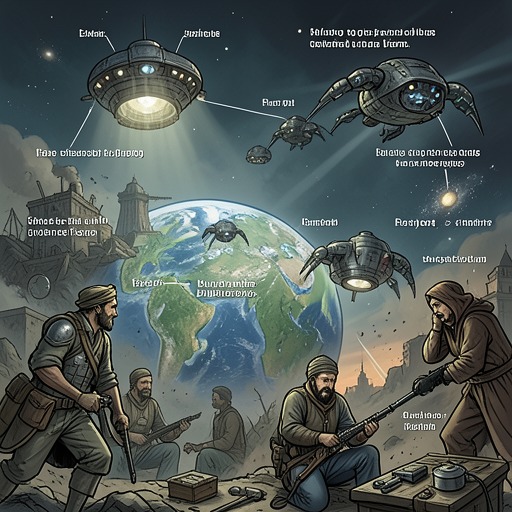
Hubble II’s discovery provides the final confirmation that the Trisolaran invasion is real. It destroys humanity’s remaining fantasies that the reports might be mistaken, exaggerated, or otherwise escapable. The result is a new descent into despair, panic, and confusion, followed by humanity’s entry into life under the Trisolar Crisis. Ringier’s work therefore has a consequence beyond astronomy: it changes the historical condition of the entire human race. Observation becomes revelation, and revelation becomes an irreversible political and psychological threshold.
Ringier’s role is later recalled when he visits Luo Ji in the tenth basement at Luo Ji’s request. Luo Ji asks whether Ringier was the first person to observe the fleet’s flight path. Ringier resists the honor, explaining that he has repeatedly issued statements correcting reporters who insist on crediting him. He says the recognition should go to General Fitzroy, because Fitzroy demanded that Hubble II observe Trisolaris during testing. Without that order, the opportunity might have been missed, since the wake in the interstellar dust would eventually have faded.
This correction complicates Ringier’s public image. He is the astronomer associated with the discovery, but he refuses to treat discovery as solitary heroism. The observation depended on a military decision, a functioning telescope, a timely test, image processing, and the physical persistence of the dust wake. His acknowledgment of Fitzroy does not erase their conflict; it shows that Ringier distinguishes between personal grievance and historical accuracy.
The commemoration of both men becomes literal in the Ringier-Fitzroy Telescope. Located five kilometers from Ringier-Fitzroy Station near the outer rim of the asteroid belt, the later instrument consists of six enormous independent lenses, the largest 1,200 meters in diameter. Ion thrusters around the rims adjust their spacing and orientation, while the station serves as the control center. The transparent lenses are nearly invisible until their protective irises reflect sunlight, revealing curved surfaces that resemble planets covered in rainbows.
The telescope breaks with the Hubble naming convention and bears the names of Ringier and Fitzroy because they discovered the tracks of the Trisolaran Fleet. The text notes that their discovery has no scholarly significance in the ordinary sense, yet the name remains fitting because the telescope’s purpose is continuous monitoring of the fleet. The original conflict between civilian science and military surveillance is thus preserved in the object’s title. Ringier’s name becomes part of a joint memorial to discovery, even as the discovery’s ultimate institutional legacy is an instrument built for vigilance and war.
Narrative Significance
Ringier functions as the human face of technologically extended perception. He does not defeat the Trisolaran Fleet, and he does not control the political consequences of what he sees. His decisive action is interpretive: he recognizes the meaning of traces that would otherwise remain meaningless halos and dust. Through him, the novel presents knowledge as both fragile and consequential. A fading wake, observed at the right distance and at the right moment, can alter the destiny of civilizations.
His repeated disputes with military representatives also give the telescope a social dimension. Hubble II is beautiful because it embodies human ingenuity, but it is vulnerable because wartime institutions can claim it. The Ringier-Fitzroy Telescope carries that contradiction into the future: an immense apparatus of sublime optical precision, jointly named for a scientist and a general, dedicated not to unrestricted wonder but to watching an approaching enemy. Ringier’s significance lies in that unresolved pairing. He represents the joy of seeing, the injury of having one’s work appropriated, and the responsibility to state what the evidence shows even when the truth ends an era of hope.