Asian Fleet
The Dark ForestThe Asian Fleet is a major suprastate organization formed from humanity’s long response to the Trisolar Crisis. Although its name preserves its regional origin, it no longer belongs to any Asian nation: it becomes an independent political and economic entity with the power of a superpower, while its territory and sovereignty exist in space. Its history therefore marks a decisive transformation of human civilization from an Earth-centered international order into a divided system of Earth International and Fleet International.
Formation and Political Status
The Asian Fleet develops out of the enormous defense mobilization prompted by the approaching Trisolaran Fleet. The Wallfacer Project had been created because the Sophons made human plans transparent, forcing humanity to preserve strategic deception alongside its openly pursued defense program. Within this wider emergency, the construction of a space force demanded new ships, weapons, ports, ecological systems, and trained personnel on a scale that leaders understood could take a century merely to establish the foundations.
The completion of the Tianti Space Elevator and the breakthrough in controlled nuclear fusion encouraged humanity, but they did not signal security. They opened the way to large-scale exploration of the Solar System, the creation of planetary bases, and a military infrastructure whose resource demands threatened to reduce living standards by a century. The Asian Fleet was thus produced by an effort that was simultaneously technological, institutional, and social: industrial expansion accelerated, environmental damage became difficult to stop, and the defense system acquired the capacity to reorganize political power.
By the time Luo Ji awakens, the Asian Fleet is no longer subordinate to any terrestrial government. The Asian, European, and North American Fleets are independent entities and members of the United Nations, each possessing political and economic strength comparable to a superpower. Together they nominally constitute the Solar Fleet. The former Planetary Defense Council has evolved into the Solar Fleet Joint Conference, but its role is largely coordinative; real authority lies with the supreme commands of the three fleets. The arrangement does not make Earth a military dictatorship, because the fleets generally avoid interference in terrestrial internal affairs, yet it establishes a second international sphere whose armed power is based beyond the planet.
Command and Organization
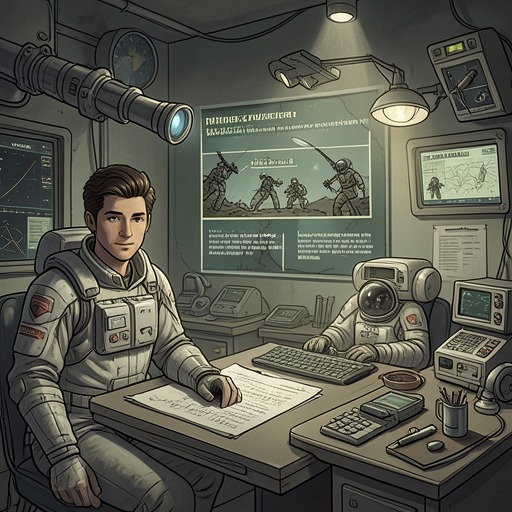
The fleet’s command structure is presented through Zhang Beihai’s encounter with the commander of the Asian Fleet. Two centuries after Zhang’s own era, the familiar space-force emblem has changed little, but the institution itself has become an independent country with a president as supreme leader. The commander who receives Zhang is responsible for the military rather than the whole political entity, a distinction that shows how thoroughly the fleet has developed state-like institutions.
The fleet also maintains a system for absorbing personnel from earlier historical periods. Zhang had originally proposed that political cadres from the space force be prepared as future reinforcements, and he was appointed commander of the Special Contingent of Future Reinforcements. He insisted that officers spend at least a year training and working in space before entering hibernation, so that future political officers would not be mere landlubbers. The request was approved, and Zhang and thirty comrades went into space one month later. His later reawakening places him inside the very institution whose long-term continuity he had helped design.
The fleet’s headquarters is shown in orbit around Jupiter, rotating to produce artificial gravity. Its dim lighting and broad windows bring the interior into close visual contact with surrounding space, making the command center feel less like a terrestrial office than a political room built into the Solar System itself. The setting expresses the fleet’s altered identity: its environment, jurisdiction, and strategic horizon are no longer terrestrial.
Technology and Strategic Reach
The Asian Fleet operates the most advanced vessels available to humanity. Natural Selection, the flagship of its third squadron, has a disc-shaped body and a separate cylindrical engine, unlike the seagoing aircraft carriers of the past. Its non-media fusion propulsion system can accelerate it to fifteen percent of the speed of light at full thrust, while its ecological systems support long-term voyages. Its four-part weapons system consists of gamma-ray lasers, railguns, high-energy particle beams, and stellar torpedoes powerful enough to obliterate the surface of an Earth-sized planet.
The strategic importance of this technology is inseparable from an earlier political dispute. Controlled fusion opened two competing research paths: media-propelled spacecraft, favored by the aerospace faction, and non-media radiation-drive spacecraft, favored by the space force. The first was regarded as safer because it resembled a larger chemical rocket powered by fusion, but it required roughly two-thirds of a vessel’s carrying capacity for propulsion media and depended on planetary bases for movement through the Solar System. The radiation-drive approach consumed major resources and carried greater risks, yet Zhang considered it the only route that could enable interstellar voyages. Natural Selection represents the victory of the more militarily ambitious direction.
The fleet’s rise also depends on planetary engineering. With the space elevator completed, humanity expanded exploration beyond Earth, establishing strategically useful footholds on Mars and the moons of Jupiter and reconsidering the importance of Venus and Mercury. The PDC narrowly approved Manuel Rey Diaz’s plan to test a stellar hydrogen bomb on Mercury, and the excavation of the test shaft became humanity’s first large-scale engineering project on another planet. The project was terminated after reaching only one-third of its intended depth because an unusually hard metal-and-rock layer made further excavation too costly and threatened to reduce the test to a compromised atmospheric-style blast.
This expansion carries an ecological price. Heavy industry driven by the space forces intensified pollution, while defeatist attitudes treated environmental protection as almost treasonous because the planet was expected to fall to the Trisolarans anyway. Greenhouse effects, climate anomalies, and patchwork desertification contributed to agricultural collapse and the exhaustion of grain reserves before the Great Ravine. The Asian Fleet’s material foundation is therefore double-edged: it creates the means of resistance while helping transform Earth into a damaged environment whose resources are being consumed for survival.
Rivalry and the Defection of Natural Selection
The Asian Fleet’s cooperation with the other fleets is undermined by competition over the interception of the Trisolaran probe. The three fleets initially competed for the mission because first contact would bring technological intelligence, honor, and political capital. Although any information gained would be shared, each fleet wanted the prestige of making contact first. The contest became sufficiently acrimonious that the Solar Fleet Joint Conference ordered all ships back to base and created a special committee to prevent unauthorized interception attempts.
The dispute was considered ridiculous precisely because it was safe. The probe could self-destruct, but the interception itself did not resemble a battle with the main Trisolaran Fleet, in which every side would preserve its strength. The episode exposes a persistent continuity between old terrestrial politics and the new fleet order: even after humanity has moved into space and faces extinction, institutions still compete for symbolic advantage and political capital.
Natural Selection breaks that temporary coordination. As the warship leaves the Asian Fleet base in Jovian orbit, its stellar-class engines drag a small artificial sun behind it, throwing enormous shadows across Jupiter and Io. The Asian Fleet High Command then confirms that Natural Selection has defected. The European and North American Fleets first assume that the ship has made an unauthorized attempt to intercept the probe, but its course quickly disproves that explanation: it is heading away from the Trisolaran invasion rather than toward the target.
The defection turns the fleet from a framework of organized defense into a participant in the fragmentation of human civilization. Its most powerful ship, designed for long-range survival and armed with weapons capable of planetary destruction, becomes an independent actor whose movement cannot be contained by the nominal joint command. The event reveals the limits of Fleet International’s unity: shared danger does not erase separate institutional interests, strategic beliefs, or competing visions of humanity’s future.
Legacy and Narrative Significance
The Asian Fleet represents the militarization and extraterrestrialization of political power. It is born as a regional defense formation, but the logic of the Trisolar Crisis transforms it into a state-like supranational entity. Its ships are not merely vehicles; they are mobile territories, economic systems, ecological enclosures, and weapons platforms. The fleet’s independence fulfills humanity’s need to operate beyond Earth while also making human authority more divided and less accountable to the planet below.
Its history also dramatizes the contradiction between rescue and sacrifice. The same program that produces fusion propulsion, planetary bases, and warships capable of interstellar acceleration consumes immense resources and accelerates environmental destruction on Earth. Later projects continue this pattern of treating the Solar System as an engineered defense environment, from the stellar hydrogen bomb test on Mercury to the Snow Project, which would use stellar hydrogen bombs and Neptune’s oil film to create dust clouds that leave tracks when the droplets pass through. Even the completed gravitational-wave system alters its surroundings by causing water vapor to collect and rain near the antenna, creating an oasis in northern China. Across these projects, civilization survives by turning planets, atmospheres, and space into strategic instruments, but every solution redistributes costs rather than escaping material limits.
The fleet’s eventual importance is therefore not confined to its battles or ships. It changes the scale at which politics operates, turns space into sovereign territory, and makes military institutions the strongest successors to the old great powers. Its ascent explains why the human world becomes divided between Earth-based society and Fleet International, while the defection of Natural Selection shows how that new order can fracture at the moment collective action is most necessary.