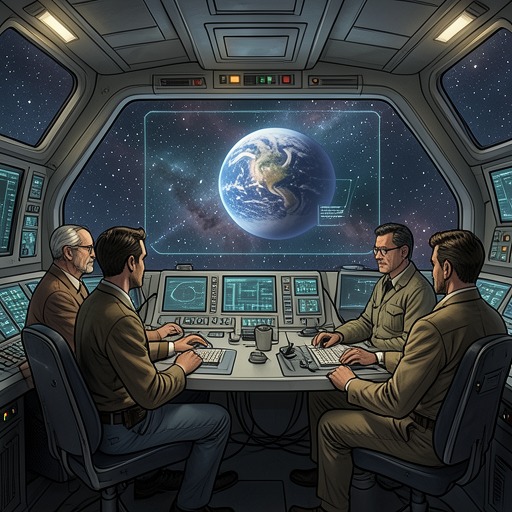
Blue Space
The Dark ForestBlue Space is an Asian Fleet warship that survives the Battle of Darkness and becomes the material and social core of Starship Earth. Its decisive significance lies not simply in escape: after the destruction of the other pursuing ships, Blue Space converts wreckage, fuel, and survivors into the infrastructure of a new civilization, carrying its dead, its resources, and its future into interstellar space.
Identity and Strategic Context
Blue Space belongs to the Asian Fleet and is one of the ships involved in the pursuit of Natural Selection. Its existence depends on the rapid expansion of humanity’s space program, a project that begins with almost nothing. The completion of the space elevator and the breakthrough in controlled fusion encourage the world, but sober leaders recognize that humanity has only reached the seashore of spacefaring: the fleet’s weapons, life-support systems, ports, and spacecraft industries still represent an unprecedented frontier. The construction of this defense system also consumes immense resources and threatens to reduce quality of life by a century, while the heavily polluting industry supporting it accelerates environmental destruction.
This strategic background gives Blue Space a double character. It is a product of planetary mobilization against the Trisolaran threat, yet its later history shows that the space fleet is not merely a shield for Earth. Once ships acquire independent mobility, fuel, weapons, and closed environments, they become potential lifeboats, rival communities, and instruments of a new political order.
Survival in the Battle of Darkness
Blue Space is exceptionally prepared for the unexpected attack that destroys much of its surrounding force. Before the assault, its crew turns the ship’s interior into a vacuum and puts all personnel in space suits. This preparation prevents the infrasonic waves from injuring anyone and limits the damage caused by the electromagnetic pulse. Survival therefore depends on a practical adaptation to the physical conditions of space rather than on superior firepower alone.
The ship responds almost immediately after the nuclear fireballs erupt. It begins its counterattack with lasers, the fastest weapon available, and directs five gamma-ray laser beams at Ultimate Law. The beams burn five enormous holes through the target’s hull; fires and secondary explosions follow, leaving Ultimate Law unable to fight. Blue Space then continues the attack with nuclear missiles and sustained railgun fire until Ultimate Law explodes, with no survivors.
The encounter reverses the expected moral and military perspective of the battle. Blue Space is first the threatened vessel, then the surviving executioner. Its victory is not clean or celebratory: the surrounding conflict has already produced catastrophic losses, and the ship’s ability to survive makes it responsible for deciding what happens to the ships and crews left behind.
From Warship to Starship Earth
After Ultimate Law disintegrates, Blue Space rendezvouses with Enterprise and Deep Space. Neither shows any sign of life. The ship collects their fusion fuel, strips their hardware, and then travels two hundred thousand kilometers to Natural Selection to perform the same operation there. The three dead ships are not merely wreckage; they become a supply of fuel, machinery, and structural material for the surviving community.
The result is an extraordinary transformation. Starship Earth becomes a construction site in space, with the massive hulls of the three dead ships surrounded by the sparks of laser welding. Blue Space takes sections of all three derelicts and arranges them in a Stonehenge-like formation, creating an outer-space tomb. The arrangement gives physical form to the transition from fleet warfare to civilization-building: the defeated ships are simultaneously dismantled for survival and preserved as a memorial.
The funeral makes the scale of the loss concrete. The 1,273 surviving crew members of Blue Space assemble in space suits within the floating tomb, while the bodies of 4,247 victims remain inside the wreckage around them. A fifty-watt votive lamp, powered by a small nuclear battery and supplied with one hundred replacement bulbs, is designed to burn for tens of thousands of years. Its light falls on a titanium bulkhead engraved with the victims’ names, but there is no epitaph. The absence of an epitaph suggests a community whose memorial is not a completed statement but a continuing voyage.
Long-Distance Voyage and Civilizational Meaning
One hour after the funeral, Blue Space accelerates away from the tomb at one percent of the speed of light. Interstellar dust will eventually slow it to three-hundredths of one percent of light speed, and it is expected to reach the NH558J2 planetary system in sixty thousand years. Yet the ship will have departed toward another star system more than fifty thousand years before that arrival. The numerical scale makes Blue Space’s journey almost impossible to measure by ordinary human time: the destination is less important than the fact of sustained movement through deep space.
Blue Space carries abundant fusion fuel and an eightfold redundant supply of critical parts. So much material must be stored externally that the additions radically alter the ship’s appearance, turning it into a huge, irregular, ungainly body. Its final form resembles a traveler burdened with provisions for an immense journey. The image joins technological survival to historical memory: Blue Space is not sleek or perfected, but assembled from ruins and equipped to endure.
The ship thus embodies an ecological and political paradox. Humanity’s defense program arose amid resource scarcity, environmental collapse, desertification, and the Great Ravine, while the industrial effort itself made pollution unstoppable. Blue Space does not escape material limits; it carries those limits outward in the form of fuel, spare parts, salvaged hulls, and a finite human population. Its survival is an act of adaptation, but also a transfer of civilization’s costs from Earth into the wider Solar System and beyond.
Narrative Role
Blue Space turns the Battle of Darkness into more than a military episode. Its preparation, counterattack, salvage operation, funeral, and departure form a sequence in which the value of survival changes repeatedly: survival first means avoiding annihilation, then defeating an enemy, then appropriating the dead ships, and finally preserving the dead while abandoning the battlefield. The ship’s actions reveal that the new space humanity is shaped by both cooperation and lethal suspicion.
Its grave of derelict vessels is especially important as an image of fragmented history. The dead ships retain their material presence even after their fuel and hardware have been absorbed into the survivor’s future. Blue Space therefore carries a broken past rather than leaving it behind. It is at once a weapon, a refuge, a workshop, a tomb, and a vehicle for a civilization whose infancy ends only after it has learned to survive among ruins.