Chinese Space Force
The Dark ForestThe Chinese Space Force is founded as the military institution responsible for preparing humanity for warfare beyond Earth. Its decisive importance lies in the fact that it must build a future it will never personally inhabit: its first officers are told that full combat capacity may take three centuries, while the fleet that finally confronts the Trisolaran invaders will carry descendants fifteen generations removed from the founders.
Founding and Institutional Identity
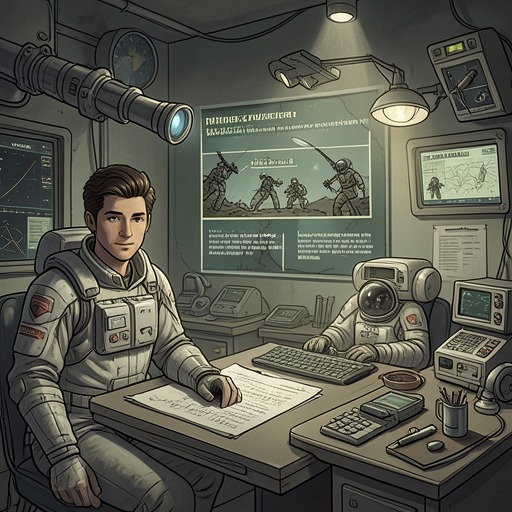
Thirty army, navy, and air force officers gather before the deep-red insignia of the new branch, a silver star emitting four sword-shaped rays. General Chang Weisi announces that the formal ceremony, uniforms, and pins will come the following morning, but that the officers already belong to the same service. The group’s composition—fifteen naval officers, nine from the air force, and six from the army—initially puzzles them, since many had assumed that space warfare would develop from aviation. Chang Weisi rejects that assumption by defining future spacecraft as large, high-endurance combat platforms more analogous to naval vessels than aircraft. Their battles will take place in three dimensions, but their operational logic will resemble naval warfare: ships, crews, endurance, and command at a distance. The Chinese Space Force is therefore based on the navy, forcing its naval members to adapt quickly while asking the other services to abandon their inherited expectations about the future battlefield.
Mission, Research, and Long-Term Planning
At its beginning, the Chinese Space Force consists of only thirty-one people, including Chang Weisi. Scientific research is being conducted elsewhere, especially on the space elevator and fusion engines for large spacecraft, but the service’s own task is to create the theoretical framework upon which a future fleet can be built. Since humanity has no experience of space warfare, the force initially functions less like an operational command than a military academy: it must organize the academy and recruit a substantial body of scholars and researchers. Chang Weisi sets the institution’s timescale in deliberately civilizational terms. Basic research across the relevant disciplines may require at least fifty years; practical technologies for large-scale space travel may take another century; and the fleet may need an additional century and a half to reach its intended scale. None of the officers present will reach space or see the fleet, and the first generation of its officers and crew will not be born for two centuries. This founding speech makes the force an institution of intergenerational responsibility rather than immediate military glory. The same long horizon shapes its strategic research. Because space-warfare theory cannot yet rest on mature technology, headquarters divides the field into low-, mid-, and high-technology strategies. The central index is the speed and range of a ten-kiloton-class spacecraft. At the low-technology level, a craft traveling roughly eight hundred kilometers per second, without life support, would be confined to the inner Solar System, within Neptune’s orbit or about thirty astronomical units from the Sun. The organization therefore plans for several possible futures instead of pretending that one technological pathway is already certain.
Strategic Doctrine and Technology Choices
The Chinese Space Force becomes an advocate for radiation-drive spacecraft in opposition to the aerospace faction’s support for media-propelled spacecraft. The disagreement is institutional as well as technical, since the two research directions require enormous resources and cannot both become the uncontested mainstream if they fail to advance on equal terms. Radiation drive is presented as the only route that can plausibly support interstellar voyages, while media-propelled craft appear safer because they are essentially fusion-powered variants of chemical rockets. The service’s objection to media propulsion is strategic. Such craft must devote roughly two-thirds of their carrying capacity to propulsion media, consume that resource quickly, and depend on planetary bases for movement through the Solar System. In a future war, that dependence would turn the Solar System into a chain of vulnerable fixed positions. The Chinese Space Force instead accepts the greater uncertainty of radiation drive because the expected war offers no genuinely safe option. This choice becomes part of the organization’s vulnerability as well as its identity. Qin Shi Huang and other figures acting under Trisolaran direction decide not to obstruct humanity’s development toward radiation-drive spacecraft, judging that sophon-imposed limits on physics will make the approach an almost unsurpassable technological peak and a bottomless sink for human time and resources. The force’s strategic conviction is thus manipulated by an enemy that understands how a plausible military pathway can become a technological trap.
Personnel, Political Work, and Future Reinforcements
The service is not only a research institution; it must also create a culture capable of sustaining a project that extends far beyond ordinary careers. During a late-night work meeting, Zhang Beihai criticizes the military leadership for neglecting political and ideological work, pointing out that the political department is the last of the six established departments to report. Chang Weisi agrees that political work has received insufficient attention because the political commissars have not yet taken up their duties, and he relies on Zhang and other officers to manage the practical burden. The organization later turns the problem of generational continuity into a formal reinforcement program. After the space elevator and controlled-fusion breakthrough encourage world opinion, sober leaders still recognize that humanity has merely reached the shore of space: the fleet’s hulls, weapons, recirculating ecosystems, and spaceports remain unprecedented projects, and even laying their foundations may take a century. The defense system will consume resources on a scale capable of lowering quality of life by a century, making social endurance as important as engineering. Zhang Beihai becomes the initial proponent and commander of the Special Contingent of Future Reinforcements, a group of political cadres intended to support the later space force. He insists that the officers spend at least a year training and working in space before entering hibernation, arguing that future political commissars cannot be landbound novices. The request is approved, and one month later Zhang and the first contingent of thirty comrades go into space. Their departure gives the Chinese Space Force a practical method for carrying institutional knowledge across the historical gulf described at its founding.
Command Security and the Trisolaran Crisis
The service’s work unfolds under an enemy that can observe nearly every external human action. The Wallfacer Project is created because sophons make Earth transparent: meetings, files, computer storage, plans, and deployments can be exposed to Trisolaris almost as soon as they are formed. The Chinese Space Force’s response belongs to a larger strategic principle: since the Trisolarans communicate through direct thoughts and are considered deficient in trickery and deception, humanity must preserve secrecy inside individual minds and construct plans whose true purposes never leave the planners’ brains. The Trisolaran threat also reaches directly into the force’s leadership. An assassination attempt against Luo Ji is orchestrated through the Earth-Trisolaris Organization, with the order conveyed to Mike Evans through sophons. It is described as the only assassination Trisolaris has ordered to that point, suggesting that Luo Ji’s importance exceeds what human institutions understand. In a separate command, Qin Shi Huang announces that the Lord has ordered the destruction of Wallfacer Luo Ji, identified as the second assassination order against him. These actions show that the strategic contest surrounding the Chinese Space Force is not limited to fleets and weapons; it includes targeted violence against individuals whose private reasoning may alter the war. The development of the mental seal introduces a further institutional danger. Researchers discover a way to bypass the ordinary process of judgment and directly make a brain accept information as genuine. The technology becomes especially threatening because many advanced warships use centralized command systems in which the captain’s orders are executed automatically by the ship’s computer. In such vessels, the captain can unilaterally control departure and return, speed, course, and much of the weapons system, making the ship an extension of the captain’s body. At the time of review, 179 of the fleet’s 695 stellar-class warships use centralized command. Their officers become the focus of scrutiny, but the ships cannot simply be docked and sealed because the three fleets are preparing to intercept the Trisolaran probe. The coming interception is the first actual engagement between the Space Fleet and the invaders, so every vessel must remain on standby. The Chinese Space Force must therefore solve a command-security crisis while preserving combat readiness: reliable authority has to replace potentially compromised authority without immobilizing the fleet at the moment of contact.
Historical and Narrative Significance
The Chinese Space Force embodies the conversion of cosmic fear into institutions, standards, personnel systems, and contested technological priorities. Its insignia and founding meeting give the future a military form, but its real substance is delayed labor: theoretical research for unknown kinds of battle, training for officers who will sleep through centuries, and decisions whose consequences will belong to descendants rather than their makers. Its significance is also marked by contradiction. The service is created to resist the Trisolaran invasion, yet its preferred technological direction can be exploited as a dead end. It seeks disciplined centralized command, yet centralized command makes a warship dangerously vulnerable to mental manipulation. It builds a transparent public organization in a world where the enemy can read every communicated plan, while the most decisive strategic work must remain private and deceptive. Through these tensions, the Chinese Space Force becomes more than a branch of the military: it is the human attempt to make long-term survival operational under conditions in which knowledge, technology, and trust are all uncertain.