Civilization immunity
The Dark ForestCivilization immunity is a historical and political concept used to explain how a civilization responds to catastrophe. Its central claim is that severe collective illness can activate an internal defensive system: after the world has suffered the early Crisis Era, it develops habits and institutions intended to prevent a recurrence. The concept gives a name to humanity’s attempt to turn trauma into a durable moral safeguard, but it also exposes the danger of confusing a temporary recovery with permanent security.
Definition and Historical Formation
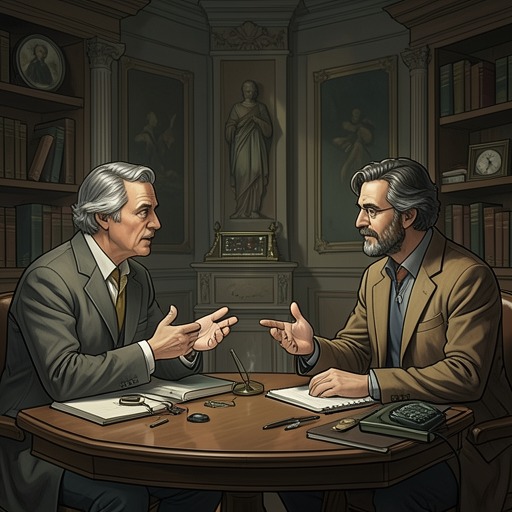
Civilization immunity is introduced during the period after the Great Ravine, when the world has endured extraordinary population loss and social disruption. An economist who had entered hibernation explains to Luo Ji that the phrase refers to a civilization’s immune response after a serious illness. In this formulation, the lesson of the catastrophe is not merely that humanity must survive, but that it must prevent a return to the political and strategic attitudes that produced the early Crisis Era.
The doctrine places humanism first and the continuation of civilization second. That ordering is presented as the foundation of the society Luo Ji encounters after awakening. It makes the protection of present human life the primary political value, while treating long-term civilizational survival as something that must be pursued through restraint rather than through the unchecked expansion of military strategy.
From Militarization to Comfort
The concept becomes visible in the world’s decision to abandon its previous space strategies. After the Second Enlightenment and Second Renaissance, new national governments terminated their space programs and redirected their attention toward improving ordinary life. Genetic engineering and fusion technology were applied to large-scale food production, ending dependence on weather and eliminating hunger. With fewer people to support, living conditions returned to pre–Great Ravine levels within two decades and eventually recovered to Golden Age standards.
This recovery gives civilization immunity its emotional force. Humanity has not simply forgotten the crisis; it has interpreted the crisis as a warning against returning to a civilization organized around fear, sacrifice, and permanent mobilization. People consequently commit themselves to comfort and resist any demand to resume the earlier path. The social order’s stability rests on the belief that historical suffering has changed humanity’s priorities for good.
Security, Secrecy, and Strategic Blindness
The concept stands in tension with the founding logic of the Wallfacer Project. At the beginning of the Trisolar Crisis, the arrival of additional sophons makes the Earth effectively transparent to the enemy. Every meeting, file, computer, plan, and deployment can be observed, leaving humanity without conventional secrecy. Yet the Trisolarans communicate through direct, open thoughts and are therefore described as deficient in trickery, camouflage, and deception. Human civilization’s advantage lies in its ability to keep intentions concealed within individual minds.
The Wallfacer Project institutionalizes that advantage by assigning selected people to devise strategies entirely in their own thoughts. Their visible actions and public explanations are deliberately false, creating a maze of misdirection for both enemy and ally. Civilization immunity, by contrast, describes the later moral consensus that regards the crisis-era mentality with suspicion. Together, the two ideas reveal a central contradiction: survival may require secrecy, deception, and military preparation, while a society shaped by catastrophe may come to regard those same practices as symptoms of the disease it believes it has overcome.
This contradiction is intensified by the repeated attempts to kill Luo Ji. The Earth–Trisolaris Organization arranges an assassination to resemble an accident, while an order from Trisolaris is conveyed to Mike Evans through the sophons. Later, a second command to destroy Luo Ji is announced inside the Three Body virtual world by Qin Shi Huang, and Luo Ji is attacked again through a genetically targeted virus. These threats demonstrate that the enemy has not adopted humanity’s post-crisis confidence in peace or welfare. They also show that the protective social consensus cannot by itself neutralize an adversary that continues to operate through surveillance, covert action, and direct violence.
The Immune System Under Stress
The novel repeatedly tests civilization immunity against technologies that transform systemic vulnerability into intimate danger. A genetic weapon is described as a guided missile: it produces mild flu symptoms in most people but recognizes the genetic characteristics of a particular target and creates deadly toxins in that person’s blood. Much later, Killer 5.2 functions as a networked murder virus, identifying its victim through multiple methods, including the universal implanted chip, and manipulating external hardware so that the world itself seems to turn against the target. These mechanisms make danger diffuse and difficult to locate, while converting the technological infrastructure of civilization into an instrument of attack.
The destruction of the combined fleet exposes an even larger failure of security. The fleet’s battle information system records a minute and eighteen seconds of battle, but its computerized decision-making system can identify only that an immensely powerful enemy force has attacked from the droplet’s position. The attacking force remains invisible to every available detection method. Fleet commanders therefore direct their attention toward distant space and even speculate about a third alien power, while the actual threat remains directly before them. Civilization’s immense informational machinery produces a complete record without producing comprehension.
The same vulnerability appears after the droplet’s attack, when the countdown predicts that it may reach Earth in four hours and fifty-four minutes. Scientific analysis correctly notes that the droplet’s energy appears limited and that its sluggish acceleration toward the Sun makes a crash into Earth seem unlikely, yet humanity still cannot determine its purpose. The episode reveals the limits of an immune system built on historical lessons: it may regulate behavior within society, but it cannot guarantee accurate judgment when an adversary possesses an overwhelming technological asymmetry.
Meaning and Limits
Civilization immunity is therefore neither a simple celebration of progress nor a permanent guarantee of safety. It explains why humanity chooses welfare, peace, and comfort after devastation, and why later society treats renewed strategic urgency as morally suspect. But the novel places that consensus beside enemies who do not share it, threats that bypass ordinary institutions, and systems whose abundance of data cannot overcome radical uncertainty.
The concept’s deepest irony is that immunity can preserve the memory of past suffering while weakening the capacity to recognize a new form of danger. A civilization that has learned to reject the habits of crisis may become healthy in social and moral terms, yet strategically vulnerable when the crisis has not actually ended. Civilization immunity thus names both humanity’s achievement and its risk: the ability to transform catastrophe into a humane order, and the possibility that the order’s very confidence will prevent it from responding to the next catastrophe.