Dark Forest Deterrence
The Dark ForestDark Forest Deterrence is Luo Ji’s ultimate use of information as a weapon. Rather than defeating the Trisolaran forces through superior technology or military strength, he makes his own death the trigger for a galactic warning that would expose both Trisolaris and the Solar System. The strategy converts humanity’s vulnerability—its transparency to the sophons and its inability to conceal conventional plans—into a threat that the enemy cannot safely ignore.
Strategic Background
The deterrence rests on the dark-forest premise that civilizations conceal themselves because revealing a location may invite destruction by a more advanced civilization. This premise gains force from the wider strategic situation. Sophons have made Earth completely transparent to the Trisolarans: additional sophons continually enter the Solar System, and every human meeting, file, computer, plan, and deployment can be observed almost as soon as it takes shape. Conventional military deception therefore cannot remain secret long enough to protect humanity.
The Wallfacer Project was created in response to this condition. Although the mainstream defense program was exposed in all its strategic and technical details, the founders of the project believed that human civilization retained one decisive advantage: the Trisolarans’ direct, open mode of thought left them deficient in tricks, camouflage, and deception. The Wallfacers were consequently empowered to develop plans whose real intentions could remain inaccessible even under constant observation. Their public status intensified this unusual arrangement. They became messiah figures surrounded by a cult, popular legends, and enormous political capital, while Luo Ji alone withdrew from public view and gave no account of his actions.
The Deterrence Mechanism
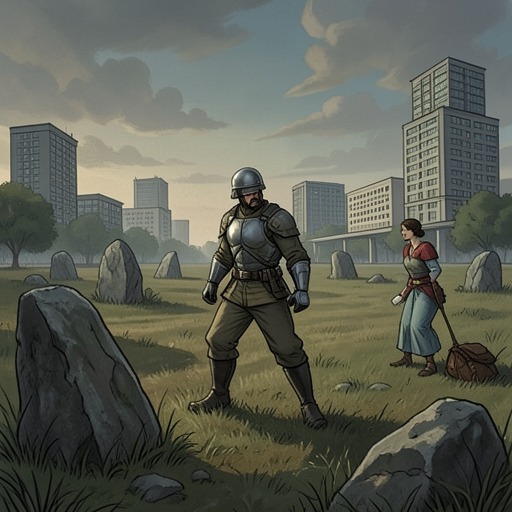
At dawn, in the cemetery beside the grave of Ye Wenjie, Luo Ji announced that he was speaking to Trisolaris. He wore a vital-signs monitor on his wrist, a device connected through a transmitter to a cradle system. The monitor sent a maintenance signal once every second to keep the Snow Project’s 3,614 bombs in orbit around the sun from detonating. His life was therefore not merely symbolically connected to the threat: the continuing beat of his heart functioned as the condition that kept the mechanism dormant.
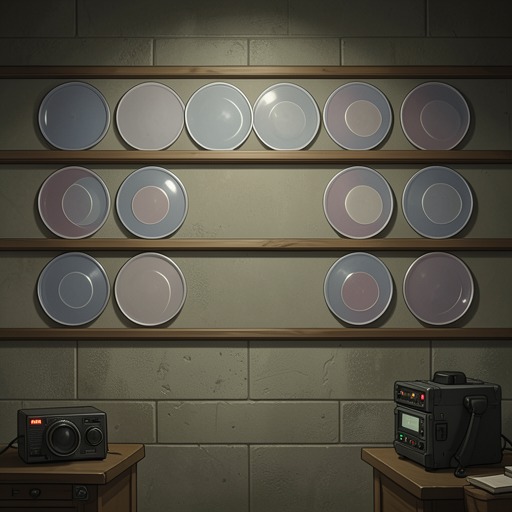
If Luo Ji died, the maintenance signal would vanish and all 3,614 bombs would explode. The oil film surrounding them would become 3,614 clouds of interstellar dust arranged in solar orbit. Seen from a distance, the dust would make the sun’s visible light and other high-frequency bands flicker. The bombs had been positioned so that this flickering would reproduce three images, each composed of thirty points, including a marked point that would allow the images to be assembled into a three-dimensional coordinate diagram.
The decisive difference from the earlier transmission was that this signal would identify Trisolaris in relation to twenty-nine surrounding stars. The sun would become a galactic lighthouse, broadcasting the location of Trisolaris while necessarily exposing the location of the sun and Earth as well. Receiving the entire transmission from a single position in the galaxy might take more than a year, but civilizations able to observe the sun from multiple vantage points might reconstruct the information in days or even hours. Luo Ji thus created a threat based not on attacking Trisolaris directly but on making its location available to unknown civilizations in a dangerous universe.
The Final Confrontation
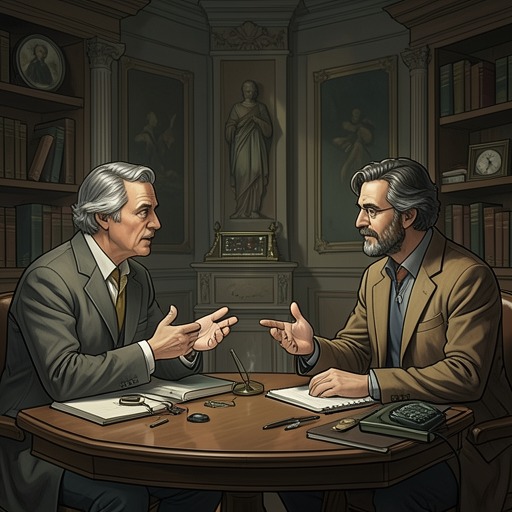
Luo Ji placed a pistol against his heart and declared that stopping his heart would constitute the greatest crime in the history of the two worlds, while also insisting that he had no regrets because it was the only option. He gave the Trisolaran side thirty seconds to respond. The delay transformed the scene into a contest between a human pulse and an interstellar system: every heartbeat preserved the possibility of negotiation, while death would activate the broadcast.
The sophons then appeared as three enormous, distorted spheres overhead and displayed the same command: “Stop!” Luo Ji asked whether he could discuss terms, but immediately rejected the idea that this was an ordinary negotiation. He presented demands that defined the conditions under which he would continue living. His first demand was that the droplet, or probe, cease transmitting toward the sun. The Trisolaran side answered that this had been done.
His second demand required the nine droplets traveling toward the Solar System to change course and fly away. The response was delayed for several seconds, then confirmed that the order had been carried out. The nine probes would emit visible light, allowing the Ringier-Fitzroy Telescope to detect them, which offered Luo Ji at least a future means of verifying compliance rather than relying solely on the enemy’s word.
The final condition concerned the Trisolaran Fleet itself. Luo Ji demanded that it not cross the Oort Cloud. The reply was that the fleet had already begun maximum deceleration and could not reduce its speed relative to the sun to zero before reaching the boundary. Luo Ji therefore required it to change course away from the Solar System. After three minutes of silence, the Trisolaran side stated that the fleet would begin changing course in ten Earth minutes and that human observation systems would be able to see the altered heading two years later.
Consequences and Verification
Once the fleet’s promised course change was accepted, Luo Ji removed the pistol from his chest and leaned against Ye Wenjie’s gravestone to keep from falling. The immediate consequence of the deterrence was not the destruction of either civilization but the suspension of an attack. The droplet stopped its solar transmission, the nine incoming probes were redirected, and the fleet began a retreat whose eventual confirmation was deferred to future observation.
The arrangement remained precarious because Luo Ji could not instantly verify every concession. He sensed that a background disturbance had disappeared after the first order, but acknowledged that this might have been an illusion, since humans could not directly sense electromagnetic radiation. He nevertheless believed the Trisolaran response, and the promised visible emissions from the nine probes offered an observational test. The deterrence therefore combined existential threat with delayed empirical confirmation: its credibility depended on a system that could activate immediately, while its success would be established through events unfolding over days, years, and potentially much longer cosmic distances.
Historical and Thematic Significance
Dark Forest Deterrence makes secrecy, communication, and visibility inseparable. The sophons’ total surveillance appears at first to give Trisolaris absolute superiority, since humanity cannot hide its military preparations. Luo Ji reverses that condition by making a single human action—the stopping of his heart—more consequential than any concealed military plan. The secret is not a weapon’s technical design but the significance of the trigger and the willingness to use it.
The strategy also exposes the cost of deterrence. Luo Ji must threaten a broadcast that could reveal Earth as well as Trisolaris, placing both civilizations on the same cosmic gambling table. He presents the threat as a crime against both worlds and apologizes for it, yet refuses to retreat from the act. Its moral force comes from this contradiction: survival requires an action that may endanger the civilization it saves.
The moment also completes a long transformation in the political order surrounding the crisis. After the combined fleet was annihilated, Escapism revived after two centuries of silence; the Battle of Darkness then made escape appear capable of producing a spiritually alienated Negacivilization rather than a continuation of human civilization. At the same time, the former great powers had declined, while the space fleet had risen as a suprastate entity. Against these large institutional failures, Luo Ji’s deterrence depends on an individual body, a monitor, a pistol, and a chain of signals. Its historical significance lies in that stark scale reversal: when states, fleets, and transparent defense programs cannot secure humanity, one person’s threatened death becomes the instrument that forces an interstellar power to answer.