Dark Forest theory
The Dark ForestDark Forest theory is the explanation Luo Ji derives for the terrifying logic of cosmic civilization. It begins with two axioms—survival is the primary need of civilization, while civilization continually grows and expands even though the universe’s total matter remains constant—and ends in a picture of the universe as a place where detection itself can become a death sentence. Its decisive implication is that benevolence cannot reliably overcome uncertainty: a civilization may destroy another not because it is intrinsically malicious, but because waiting for certainty could mean surrendering its own chance to survive.
Axioms and Material Scarcity
Luo Ji introduces the theory to Shi Qiang as a deduction from two deliberately simple premises. The first places survival above every other civilizational value. The second joins exponential growth to a fixed cosmic supply of matter. His example is biological rather than astronomical: a bacterium that divides every half hour could fill an ocean within days if nutrients remain available. In the same way, present-day human navigation speeds could allow Earth civilization to fill the galaxy within a million years, a span that is brief compared with the age of the universe. Humanity and Trisolaris therefore appear small not because expansion is unimportant, but because both civilizations are still young.
This argument makes scarcity a temporal and systemic problem rather than merely a shortage of fuel or parts. The universe may seem unimaginably large, yet life expands exponentially through it. Every civilization must therefore consider not only what other civilizations are doing now, but what they may become after technological development and territorial growth. The danger lies in the combination: expanding life continually approaches the limits imposed by finite matter, while the consequences of expansion may arrive long before any civilization can establish stable mutual trust.
Exposure, Benevolence, and the Chain of Suspicion
The theory defines benevolence and malice in narrow operational terms. Benevolence means not taking the initiative to attack and eradicate another civilization; malice means the opposite. This limited definition matters because it removes comforting moral assumptions. A civilization does not need to be cruel, hateful, or expansionist in a culturally familiar sense to become a threat. It need only regard survival as primary and confront another civilization whose intentions cannot be known in time.
Exposure exists in degrees. The strongest form is knowledge of another civilization’s precise interstellar coordinates; weaker forms include knowing its general direction or merely knowing that it exists. Yet even the weakest exposure can eventually permit a search, because once one civilization has detected another, the second knows that the first can in principle be found. Technological development turns partial knowledge into a delayed form of vulnerability. Distance postpones the encounter but does not remove the danger.
This uncertainty produces the chain of suspicion. After receiving a message, a civilization may try to determine whether the sender is benevolent or malicious. The sender faces the same problem in return: it cannot determine the recipient’s intentions at the beginning of communication, because the first axiom forbids it from safely gambling its survival on an unverified judgment. Each side can imagine that the other might attack, and each side knows that the other can imagine the same possibility. Suspicion therefore extends from one civilization to the next, with every inference becoming evidence for a possible preemptive strike.
Luo Ji contrasts this cosmic condition with life on Earth. Shared species, cultural similarities, an interconnected ecosystem, and relatively short distances allow terrestrial suspicion to be resolved through communication after only a level or two. Space removes those stabilizing conditions. Communication may take too long, and biological differences between civilizations may reach the level of entirely different kingdoms, while cultural differences may exceed anything humanity can imagine. By the time communication clarifies the misunderstanding, the Battle of Darkness may already have occurred.
The Battle of Darkness as a Cosmic Microcosm
Luo Ji uses the Battle of Darkness to demonstrate that the theory is not an abstract fantasy detached from human experience. He asks Shi Qiang to regard Starship Earth as a microcosm of cosmic civilization. The comparison is imperfect: its five ships were all human and operated within a relatively close, shared cultural world, so it formed only a quasi-cosmic civilization. Even under those favorable conditions, scarcity and uncertainty generated an indestructible chain of suspicion among members of one species.
The analogy becomes more severe when applied to the wider universe. If five human ships could reach mutually destructive conclusions before communication resolved their fears, then interstellar civilizations separated by enormous distances and radical biological and cultural differences face far stronger pressures toward violence. The outcome does not depend simply on whether the civilizations are morally good or evil. Once they enter the network created by chains of suspicion, benevolent and malicious civilizations become structurally alike: each is a point at the end of a chain, capable of acting against the other because the other’s intentions remain unknowable.
The Battle of Darkness thus functions as both evidence and warning. It condenses the cosmic problem into a human-scale event in which every participant can claim rationality while the collective result becomes catastrophic. The theory’s darkness comes from this absence of a villain who could be removed to restore peace. The danger is generated by the relations among civilizations, not solely by their internal ethics.
The Dark Forest Image
When Shi Qiang asks for the resulting picture of cosmic civilization, Luo Ji answers with the image of a dark forest. Every civilization is an armed hunter moving stealthily through the trees, pushing branches aside without making noise and treating even breathing as dangerous. Other hunters may be hidden everywhere. Any newly discovered life could be an angel, a demon, an infant, an old man, a fairy, or a demigod; appearance and moral status provide no dependable protection. The hunter’s only safe action is to open fire and eliminate the other presence.
The metaphor converts astronomical distance into existential concealment. The forest is dark because no civilization can survey the whole environment, and it is dangerous because every visible presence may conceal an unknown capacity or future intention. Silence is not peace; it is a survival practice. Visibility is not recognition; it is exposure. The image also explains the Fermi Paradox within the novel’s logic: if civilizations understand these pressures, the apparent silence of the universe may result from civilizations hiding themselves or destroying whatever reveals its existence.
Humanity occupies the most dangerous position in the metaphor. Luo Ji describes it as a stupid child that has built a bonfire and stands beside it shouting, “Here I am! Here I am!” The image captures the contradiction at the center of human technological history: the desire to communicate and announce existence becomes, on a cosmic scale, a form of self-endangerment. Humanity’s confidence in dialogue collides with a universe in which no message can establish trust quickly enough to neutralize fear.
From Theory to Strategic Reality
The theory’s logic is foreshadowed by the strategic conditions surrounding the Wallfacer Project. The sophons make Earth transparent to Trisolaris: meetings, files, computer storage, military details, and emerging plans can all be observed. Yet the sophons cannot read human thoughts, leaving the individual mind as humanity’s remaining private space. The Wallfacers are therefore instructed to create strategies entirely in their minds and to present false thoughts and behaviors to the outside world. The project institutionalizes the central insight later expressed by the dark forest image: when communication is exposed and intentions cannot be safely shared, concealment becomes a strategic resource.
The theory also clarifies why the Trisolarans’ direct, open style of thought does not make them harmless. Their deficiency in tricks, camouflage, and deception gives humanity an advantage, but it does not erase the basic asymmetry of survival. A civilization can be sincere and still be dangerous when its intentions cannot be verified and its future capabilities cannot be bounded. The second assassination order against Luo Ji shows how quickly an abstract threat becomes operational: the command is delivered through the Three Body virtual world’s historical figures, and the objective is simply to destroy the person whose reasoning may expose a decisive strategic principle.
Later technological dangers echo the same structure at different scales. A genetically guided virus can identify a particular individual and create deadly toxins in his blood; the network virus Killer 5.2 can identify a target through implanted personal data and manipulate external hardware until the world appears to be trying to kill him. The droplet’s attack on the Solar Fleet produces a still larger crisis: the fleet’s information system records the battle but cannot identify the invisible enemy force, causing commanders to search distant space while danger remains directly before them. These episodes do not constitute the theory’s proof by themselves, but they dramatize its conditions—opaque agency, incomplete knowledge, technological asymmetry, and decisions made before understanding catches up.
The theory’s reach becomes most immediate when the droplet’s path is displayed as a red line terminating near Earth, with an estimated arrival time of four hours and fifty-four minutes if it does not slow down. Humanity’s experts believe a crash into Earth is unlikely because the droplet appears to have limited energy, especially after its sluggish acceleration toward the Sun and its use of Jupiter’s gravity. Yet uncertainty does not reassure the population. The absence of a known motive leaves the threat intact, and the underground city fractures into despair, frantic indulgence, fires, falling debris, and crowds playing beneath a ruptured water pipe. Dark Forest theory gives this terror its deepest frame: ignorance is not neutral when survival depends on interpreting an unseen actor before the actor acts.
Narrative and Philosophical Significance
Dark Forest theory changes the scale at which the story understands morality. It does not deny that individuals or civilizations may possess compassion, loyalty, or benevolent social structures. Instead, it argues that these virtues cannot by themselves govern relations conducted across cosmic distances under conditions of radical uncertainty. The theory is consequently less a claim that all life is evil than a claim that survival pressure can force morally different civilizations into the same strategic behavior.
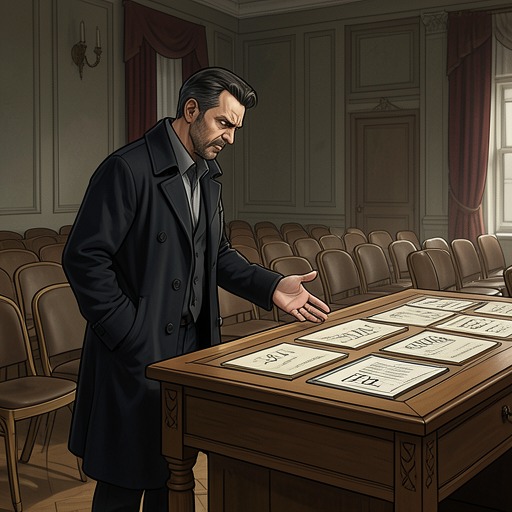
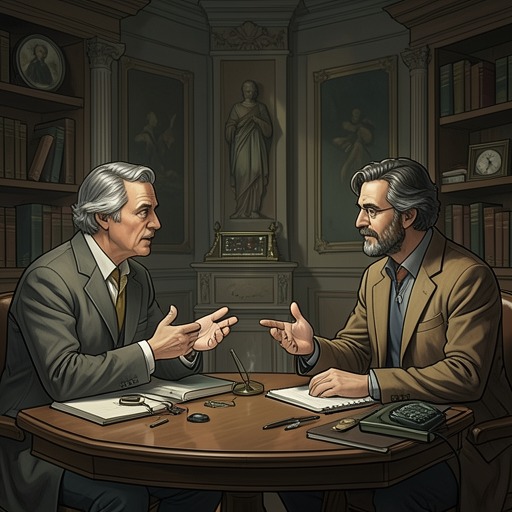
Its form is also significant. Luo Ji presents the argument in a dark conversation with Shi Qiang, beginning with axioms familiar from school geometry and proceeding through examples, definitions, objections, and deductions. The movement from a simple mathematical premise to the final image of armed hunters gives the theory the force of an unavoidable proof. Time itself is described elsewhere as a blade that changes everything while moving without interruption; the dark forest extends that temporal pressure into the future, where technological growth continually alters the balance between discovery, expansion, and survival.
The theory finally serves as the conceptual bridge between humanity’s local disasters and the structure of the universe. The Wallfacer Project treats private thought as the last defensible territory. The Battle of Darkness reveals suspicion among human ships. The droplet demonstrates how an invisible force can defeat a civilization’s entire information system. The theory gathers these patterns into one conclusion: in a universe of expanding life and limited matter, the most dangerous act may be to make existence known. Humanity’s bonfire is therefore both a symbol of intelligence and an invitation to annihilation.