Faith Center
The Dark ForestThe Faith Center is a publicly supervised facility where volunteers can use the mental seal to acquire faith in humanity’s victory in the war against Trisolaris. Its decisive significance lies in the way it converts belief into an organized technical and political service: what might ordinarily be an inward conviction becomes a proposition, a book, a scanner, a signed certificate, and a carefully regulated act of consent.
Proposal and Institutional Design
The facility was proposed by Bill Hines during a long international hearing on the mental seal. A Japanese representative equated the seal with thought control, but Hines distinguished coercive control from voluntary self-application: if a person placed a seal in their own mind by choice, he argued, there was no controller imposing a belief on a subject. On that basis, he proposed opening the mental seal “like a public facility,” with a single proposition: belief in victory in the war. Anyone willing to obtain that faith through the seal could use the facility voluntarily, under strict supervision.
The proposal did not remain unrestricted. The assembly added numerous limitations, the most important being that use of the facility would be confined to the space forces. Uniformity of thought was considered more acceptable within the military than among the population as a whole. The hearing lasted nearly eight hours, the longest ever held, and produced a motion for a vote at the next meeting, after permanent member states had taken the proposal back to their governments.
The facility’s first proposed name was the Faith Relief Center, suggested by the UK representative. The odd phrase provoked laughter, but Bill Hines rejected “relief” and insisted on the more solemn Faith Center. The naming compresses the institution’s contradiction: it offers psychological reassurance, yet presents that reassurance not as treatment or entertainment but as a public, almost sacred service.
Architecture and Public Meaning
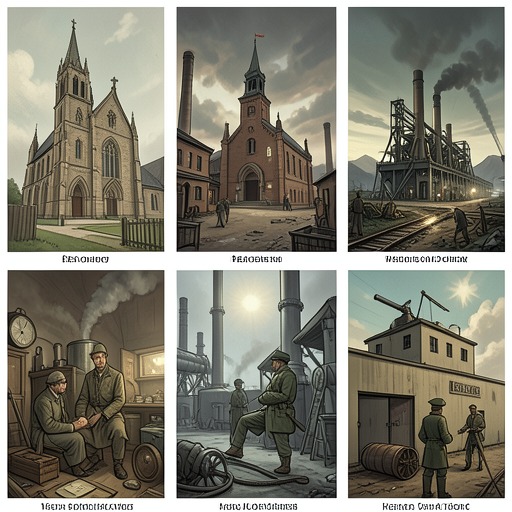
At the gate stood a reduced-scale replica of the Statue of Liberty. Its precise purpose was unknown, though it may have been intended to dilute the impression of control by placing the symbol of liberty beside a device that intervened directly in thought. The altered poem on the statue addressed hopeless souls and fearful crowds thirsting for victory, turning a familiar emblem of political freedom into an entrance sign for technologically produced conviction.
Beside the statue stood the Faith Monument, a black granite stone carrying the institution’s “golden faith” in many languages. Its declaration stated that humanity would be victorious in the war of resistance against the invasion from Trisolaris, that the enemy invading the Solar System would be destroyed, and that Earth would endure in the cosmos for ten thousand generations. The monument therefore gave the mental procedure a durable public inscription: the private belief created inside a volunteer’s mind was surrounded by a collective promise carved into stone.
The contrast between the Statue of Liberty, the altered poem, the black granite monument, and the scanner makes the Faith Center more than a neutral building. Its symbols attempt to reconcile freedom with imposed uniformity, while its monumental language elevates a military proposition into a creed about humanity’s cosmic survival.
Opening and Reception
The Faith Center was erected near the United Nations Plaza and became a tourist attraction almost immediately. For its first three days, people constantly approached to photograph the Statue of Liberty and the Faith Monument, but nobody entered. Visitors maintained a cautious distance from the facility, suggesting that its public symbolism was easier to observe than its central function was to accept.
Bill Hines and Keiko Yamasuki waited in the building’s majestic foyer during this empty period. Keiko compared their situation to running a struggling mom-and-pop store, while Hines solemnly predicted that the building would one day become a sacred place. Their exchange sets the institution’s future against its unimpressive beginning: the center has the architecture and rhetoric of a shrine, but initially lacks worshippers willing to cross its threshold.
The first volunteers arrived the following day. Four space-force officers entered in bright sunshine, three men with European faces and one woman with Asian features. They were young, tall, straight-backed, steady in their movements, and outwardly confident and mature. Yet Bill Hines and Keiko Yamasuki recognized in their eyes the same melancholy confusion that had appeared in Wu Yue’s eyes. Their decision to seek faith was therefore not presented as simple certainty; it emerged from the psychological strain of a war in which confidence and fear coexisted.
The Mental Seal Procedure
The officers placed their documents neatly on the reception desk, and their leader formally stated that they were space-force officers who had come to obtain faith in victory. The procedure was conducted under the oversight arrangements established by the assembly. The faith books were circulated among ten members of an oversight panel, each of whom checked the contents carefully before signing the notary certificate.
The first volunteer then received the faith book and sat before the mental seal scanner. A small platform stood in front of him for the book, with a red button in its lower-right corner. When he opened the book, an automated voice asked whether he was certain he wanted to obtain faith in the proposition. If so, he was instructed to press the button; otherwise, he was told to leave the scanning area.
The question was repeated three times. Each time, the button glowed red, making consent a repeated and visible threshold rather than a single hidden impulse. After the final confirmation, a positioning apparatus slowly contracted around the volunteer’s head to fix it in place. The voice instructed him to read the proposition silently and press the button.
When he pressed it, the button turned green. After approximately half a minute, the light went out and the voice announced that the mental seal procedure was complete. The apparatus separated, and the volunteer stood up and left. The speed and mechanical clarity of the process sharpen the institution’s central paradox: the decision is formally voluntary, but the resulting faith is produced through a controlled sequence of documents, surveillance, bodily positioning, silent reading, and machine confirmation.
Significance
The Faith Center embodies the wartime attempt to manage not only military capability but also the inner condition of those expected to fight. Its restriction to the space forces presents faith as a strategic resource, while its insistence on individual choice preserves the appearance of autonomy. The procedure does not erase the ethical problem raised by the Japanese representative; instead, it relocates that problem into the distinction between coercion and consent.
Its public imagery extends the contradiction into architectural form. Liberty appears at the gate, control operates inside, and a promise of ten thousand generations is fixed in black granite beside a machine that can alter a person’s mind in half a minute. The center’s movement from an empty tourist attraction toward its first solemn volunteers marks the beginning of an institution that seeks to make belief both personal and standardized, both freely requested and bureaucratically manufactured.