Future Historians
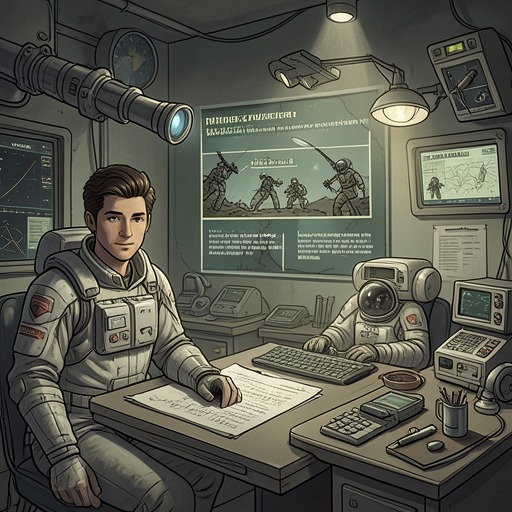
The Dark ForestThe Future Historians were a public intellectual movement formed at the beginning of the Trisolar Crisis around a group of scholars, including scientists, politicians, and military strategists. Their discussions began with the most basic questions about the war and humanity’s historical position. Rather than offering a conventional military program, they tried to understand the large-scale laws governing civilization’s development. Their work became consequential because Zhang Beihai derived from it the conviction that humanity was ultimately doomed.
Formation and Public Character
The movement emerged from discussions begun by Zhang Beihai’s father at the start of the Trisolar Crisis. A circle of deep-thinking scholars gradually gathered around him, and they called themselves the Future Historians. Their name expressed an attempt to study history from a long perspective, treating the crisis not as an isolated emergency but as part of a larger historical process.
Despite the bleak conclusions later associated with them, the Future Historians were not a secret organization. Their discussions were conducted openly, and the government and military even organized several academic conferences devoted to Future History. This public character distinguished them from covert conspiracies and from plans based on concealed operational details. Their influence came through interpretation: they supplied a framework through which individuals could understand the likely direction of civilization, rather than issuing orders or directly controlling policy.
Historical Predictions
The Future Historians predicted the Great Ravine, followed by the Second Enlightenment and Second Renaissance. They also predicted an era of prosperity corresponding so closely to the conditions of the present that Zhang Beihai regarded their forecast as virtually indistinguishable from reality. Their apparent success gave their theories an authority that survived the discovery that some of their ideas had later been judged incorrect.
Their most devastating prediction concerned the future of the human species. They foresaw humanity being completely defeated and wiped out in the Doomsday Battle. The prediction transformed their historical interpretation into an existential doctrine. Prosperity was no longer evidence that humanity was escaping danger; it could instead be one stage in a sequence whose final movement was extinction.
Influence on Zhang Beihai
Zhang Beihai insisted that his defeatist outlook did not come from a mental seal or from a weakness of personal resolve. He described himself as the master of his beliefs and attributed their firmness to the conclusions he had drawn from the Future Historians’ work. Their theories had taught him to distrust the confidence produced by contemporary technological achievement.
When a fleet commander pointed to a spaceship capable of traveling at fifteen percent of the speed of light, Zhang Beihai answered that superior speed alone did not erase a fundamental technological disparity. He compared the mounted cavalry of Genghis Khan with twentieth-century armored units and the Song Dynasty’s mounted crossbow with modern assault rifles: an ancient weapon might resemble a modern one in one measurable feature, yet the two systems could not compete because their underlying technologies differed. For Zhang Beihai, this was the lesson the Future Historians had clearly understood. Humanity’s current prosperity and technical accomplishments therefore amounted to a temporary refuge, not proof that it could withstand the ultimate contest.
The movement’s most important narrative effect is this conversion of historical study into psychological preparation. Zhang Beihai believed that other people had been blinded by the dying radiance of low-level technology and were luxuriating in the nursery of modern civilization. The Future Historians had given him a mental readiness for a war that would determine humanity’s fate, even though their conclusions made ordinary hope appear naïve.
Relation to the Crisis and Its Strategic World
The Future Historians’ reasoning belongs to the same crisis environment in which the Wallfacer Project was created. Humanity’s strategic plans were exposed to the Trisolarans through the Sophons, while human beings retained one decisive advantage: the Trisolarans could not read private thoughts. The Wallfacer Project therefore turned secrecy of mind into a strategic resource. The Future Historians operated differently, since their scholarly discussions were public, but their work helped define the historical and psychological conditions within which such strategies became necessary.
Their predictions also illuminate the contrast between visible progress and hidden vulnerability. The crisis repeatedly demonstrates that information, technology, and apparent prosperity do not guarantee security. The Trisolarans’ ability to observe human communications makes transparency dangerous, while their technological superiority makes isolated human achievements potentially misleading. Against this background, the Future Historians’ long historical view supplied a severe corrective to triumphalism: civilization could flourish and still be moving toward defeat.
Narrative Significance
The Future Historians function as an intellectual force rather than as a conventional cast of recurring characters. Their importance is measured by the beliefs they leave behind, especially Zhang Beihai’s resolute defeatism. Through them, the narrative presents history as both a record of fulfilled expectations and a source of fatalistic power. Their forecasts of the Great Ravine, the Second Enlightenment, the Second Renaissance, prosperity, and the Doomsday Battle form a disturbing sequence in which the future seems legible long before the people living in the present are willing to accept it.
Their legacy remains deliberately double-edged. The movement was not portrayed as infallible, since its theories were said to have been proven incorrect in some respects. Yet that apparent failure did not destroy its authority for Zhang Beihai, because its broader predictions had aligned so closely with historical reality. The Future Historians thus embody a dangerous kind of knowledge: not certainty, but a pattern persuasive enough to govern action. They make the possibility of humanity’s extinction intellectually imaginable before it becomes an immediate physical fact, and they explain why Zhang Beihai enters the coming struggle already convinced that survival requires more than confidence in the civilization of his own age.