Great Ravine
The Dark ForestThe Great Ravine is the defining humanitarian and ecological catastrophe of the early Trisolar Crisis: a prolonged collapse rather than a single battle, in which resource scarcity, environmental degradation, and wartime political discipline converged. Its death toll transformed the moral logic of human civilization. Afterward, the world no longer treated the preservation of civilization as sufficient justification for sacrificing the living; it developed what later generations called civilization immunity, a collective resistance to repeating the priorities that had produced the disaster.
Causes and Background
The crisis developed after Luo Ji entered hibernation. For more than a decade, life remained relatively good, but accelerating economic transformation steadily lowered living standards and narrowed the political climate until society felt as though it were already at war. Governments restricted and eventually banned Golden Age film and television because they feared that depictions of peace and comfort would weaken the fighting spirit. Accusations of collaboration with the Earth-Trisolaris Organization or betrayal of humanity made ordinary speech dangerous, while the defense effort demanded ever more heavy industry.
The mobilization of resources for the space defense system intensified the environmental damage. Leaders had understood that building a fleet would consume enormous resources and might push quality of life back by a century, yet the military program proceeded through highly polluting industrial expansion. Environmental protection was dismissed as irrelevant or even treasonous: if Earth would ultimately belong to the Trisolarans, many reasoned, preserving its natural systems seemed pointless. Environmental organizations such as Greenpeace were treated as branches of the Earth-Trisolaris Organization and suppressed. Greenhouse effects, climate anomalies, and desertification accumulated until the ecological crisis became a direct food crisis.
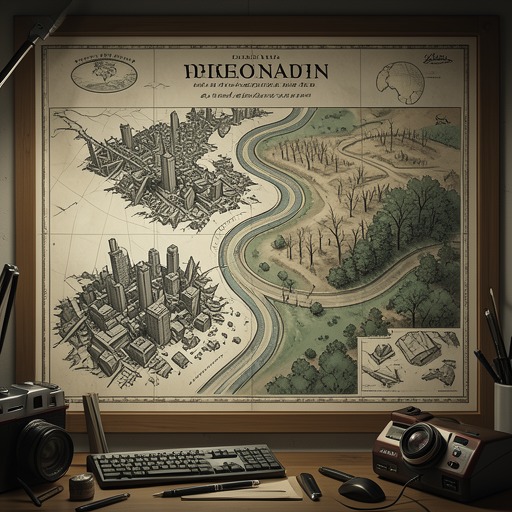
The desertification was not imagined as a single advancing front. It appeared as patchwork erosion, with intact plots of land in the interior turning into desert at the same time and the damage spreading outward like moisture leaving a cloth under the sun. Agricultural production then plunged, grain reserves were exhausted, and the Great Ravine began. The catastrophe thus embodied a slow material chain: strategic mobilization accelerated industrial pollution, pollution damaged the climate and land, and environmental decline removed the food base on which the wartime economy depended.
Course and Human Cost
The Great Ravine lasted for about half a century. During those fifty-odd years, Earth’s population fell from 8.3 billion to 3.5 billion. The scale of the loss made the earlier prediction that living standards might retreat by a century seem almost absurdly optimistic; conditions in the Great Ravine were described as far worse than the world of the 1930s and unlike the historical Great Depression, especially because the population was so much larger.
Zhang Yan, who briefly reawakened during the period, remembered the catastrophe as a grand march of hunger. Millions fled famine across the great plains through sandstorms that blocked out the sky. The description reduces the vast historical process to a sequence of exposed bodies, hot earth, and starvation, including the horrifying image of the dead being divided up where they fell. His testimony makes the Ravine more than a demographic statistic: it was a social order in which survival itself became the governing fact.
The event was also experienced unevenly across generations. When Luo Ji later asked about it, the doctor first warned that it was probably better for him not to know. The neighbors who eventually explained it spoke with visible seriousness, and Zhang Yan’s long breath after recounting it suggested that memory remained a burden. The catastrophe had become both public history and private trauma, preserved in records and videos yet still difficult to narrate directly.
Moral and Political Reversal
The Ravine forced humanity to confront a conflict between present suffering and future survival. At first, those who questioned the defense strategy were condemned as traitors. But as famine continued, more people asked whether victory in the Doomsday Battle could justify children dying of starvation. The calculation changed not because the threat from the Trisolarans had disappeared, but because the cost of pursuing victory had become intolerable to those living through it.
A popular slogan expressed the reversal: “Make time for civilization, for civilization won’t make time.” The phrase rejected the idea that individuals existed merely to be consumed by an abstract future civilization. Human beings, rather than military plans alone, became the measure of civilization’s purpose. The new political movements that followed ended national space strategies and redirected attention toward improving everyday life.
This transformation was described as a second Enlightenment, a second Renaissance, and, figuratively, a second French Revolution. The language implied a worldwide change rather than a revolution confined to France. Once the new governments abandoned the previous strategic priority, genetic engineering and fusion technology were applied to large-scale food production. Weather-dependent agriculture ended, the world ceased to be chronically hungry, and because the population was smaller, living conditions returned to pre-Ravine levels within roughly two decades before eventually recovering to Golden Age levels.
Aftermath and Civilization Immunity
The post-Ravine order developed the concept of civilization immunity. The metaphor treats the Great Ravine as a serious illness that activated a collective immune response: after suffering such a catastrophe, civilization would resist allowing the early Crisis Era’s priorities to recur. Humanism came first, while the perpetuation of civilization came second. These principles became the foundation of the society Luo Ji encountered after awakening.
The recovery did not erase the catastrophe. Older survivors repeatedly recalled the Golden Age and ended their reminiscences with regret that people had not known how to cherish it. Younger listeners heard these memories with a mixture of envy and skepticism, uncertain whether the celebrated peace, prosperity, and happiness had ever truly existed. As the elderly generation died, the Golden Age disappeared as lived experience and became history, while the Great Ravine remained the warning that gave the new civilization its moral reflexes.
The event also exposed the contradiction within humanity’s survival strategy. Space development promised protection, but its industrial foundations damaged the planet and helped produce famine. Later engineering achievements continued to carry similar tensions: the space elevator and controlled fusion encouraged humanity, while exploration of the Solar System and the testing of a stellar hydrogen bomb on Mercury treated other worlds as strategic infrastructure. Even the Snow Project proposed manufacturing clouds of space dust with stellar hydrogen bombs and Neptune’s oil film. The trajectory from the Great Ravine to such projects shows a civilization continuing to solve existential problems through planetary engineering, while repeatedly transferring environmental costs across places and generations.
Historical Significance
The Great Ravine is the decisive historical threshold between a humanity willing to sacrifice the present for a distant military future and a humanity determined to preserve lived human welfare first. Its significance lies in the way ecological decline, resource pressure, political fear, and technological ambition became one system of failure. Time did not halt the process or rescue its victims; it silently altered landscapes, institutions, populations, and moral assumptions.
For Luo Ji, the Ravine clarified the world that had grown around the consequences of his era. The desert visible beyond the protective tree line testified that recovery had not restored everything that had been lost, even after time smoothed the surface of history. The Great Ravine therefore functions both as a historical event and as a permanent argument: civilization can survive an external enemy yet destroy its own foundations if survival is defined only as victory. Its later legacy is the insistence that civilization must make time for the people who constitute it.