Hua Yuan Eden
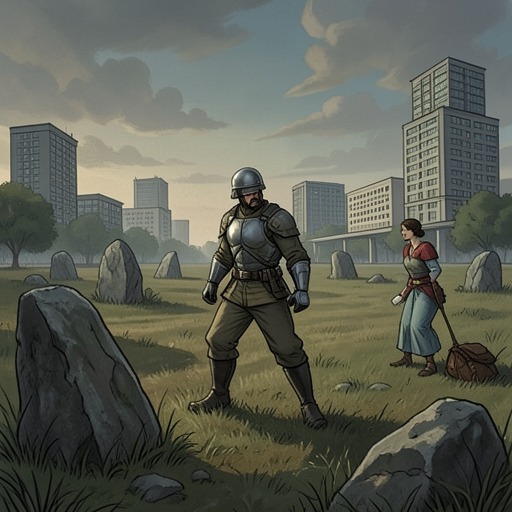
The Dark Forest“Garden of Eden” functions in the narrative as both a private refuge and a civilizational metaphor. It describes the sheltered happiness Luo Ji builds with Zhuang Yan and their child, Xia Xia, while also naming the hopeful society imagined aboard Starship Earth. In both uses, Eden offers protection from a damaged world; in both, that protection proves temporary, because knowledge of danger and the weight of history eventually enter the enclosed paradise.
Luo Ji’s Private Eden
Luo Ji’s most intimate Eden is the home in which he spends five years with Zhuang Yan and Xia Xia. He experiences the birth of Xia Xia as especially transformative: the love of wife and child blends into a happiness so complete that he forgets the outside world. The house becomes an isolated emotional universe, and Luo Ji allows himself to imagine that the external world resembles a quantum state, existing only when he observes it. This is not merely comfort but a suspension of responsibility. The Wallfacer Project and the distant future lose their power beside the immediate reality of family life.
The image is grounded in physical landscape as well as domestic feeling. At the lakeside, surrounded by sweet air and sunshine, Luo Ji gazes at snowcaps reflected in the lake and asks himself what the world four centuries in the future could matter beside life in the present. His later rejection of the Wallfacer Project is therefore expressed as a defense of the garden surrounding him: the protected present seems more real than an abstract future civilization. The manicured lawn, the pier, the lake, and the reflected mountains give his withdrawal a tangible geography, turning personal happiness into an enclosed world.
The Return of the Outside World
The Eden cannot remain sealed. After the outside world breaks into Luo Ji’s protected life, his earlier happiness becomes an illusion that can no longer endure. His thoughts return to Tyler’s challenge concerning whether a Wallfacer can escape the vicious cycle of logic and break its iron shackles. The question reactivates the duty he had tried to forget, forcing the future back into the domestic present.
The rupture is rendered through the house’s altered atmosphere. In the empty living room, fireplace embers glow hazily while rain continues outside. The same rain had accompanied Zhuang Yan’s arrival in Luo Ji’s dreams five years earlier; now she has returned to those dreams, taking their child with her. The familiar home is consequently transformed from a place of fulfillment into a site of absence and apprehension. Luo Ji reaches for the telephone, hears footsteps that do not belong to Zhuang Yan, and recognizes a slender figure standing on the porch in the rain. Eden’s defining promise—that family and present happiness can exclude history—has collapsed.
Starship Earth as the Second Eden
The phrase expands from one household to a collective experiment after the people of Starship Earth begin imagining a new world. In Citizens’ Assembly meetings, they debate a constitution and social structure, draft laws, and plan the first election. Officers and soldiers of different ranks, as well as people from different ships, exchange views about their common future. They believe Starship Earth may form a civilizational core that will grow as the fleet reaches one star system after another. Increasingly, they call it a “second Eden,” a second point of origin for human civilization.
This second Eden differs from Luo Ji’s home in scale but not in structure. Both are enclosed spaces organized around the hope that a new beginning can be protected from catastrophe. The ship’s imagined future is political rather than familial: it is built through debate, lawmaking, and the expectation that a community can reproduce civilization while moving away from its ruined origin. The optimism is therefore active and institutional, not simply sentimental. Yet it remains vulnerable to the same contradiction: a refuge created by escape cannot escape the knowledge that made escape necessary.
Knowledge, Nostalgia, and the Darkening Garden
The wonder aboard Starship Earth does not last. The ship’s chief psychologist, Lieutenant Colonel Lan Xi, and the Second Civilian Service Department prepare for the psychological dangers of an endless voyage, identifying nostalgia, or homesickness, as the greatest anticipated enemy. They establish communication channels with Earth and the fleets so that people can remain in contact with family and friends and continue receiving news and programming. Even at seventy astronomical units from the Sun, with signals delayed by nine hours, communication remains excellent. The measures reveal an attempt to keep the second Eden connected to the world it has abandoned.
The effort produces an unexpected result. Nostalgia is widespread but does not become an uncontrolled mass disaster, because Earth has lost its power to sustain longing. After the destruction of humanity’s main fleet, Earth falls into chaos and is described through news from home as full of the stench of death. Although the ultimate doomsday remains roughly two centuries away under the most optimistic estimate, there is little in Earth or the Solar System to which the travelers can return emotionally. Their distance is therefore not only spatial. The ship’s inhabitants are protected from homesickness partly because the lost home has ceased to resemble a home.
A more ominous enemy nevertheless emerges, first among the upper levels rather than among soldiers and lower-ranking officers. Lan Xi’s professional expectations are overturned: the psychological shadow does not follow the pattern he has studied. The second Eden is threatened not by simple longing for the past but by the knowledge and spiritual consequences of creating a separate human world under conditions of defeat.
Biblical Echo and Civilizational Warning
When Lan Xi consults Scott, the chaplain of Enterprise, Scott says that the Garden of Eden is growing dark and that blackness will swallow everything. He describes vipers and snakes climbing into people’s souls and invokes the eating of the fruit of knowledge. The biblical imagery makes knowledge the decisive force that corrupts innocence. In this framework, Eden is not destroyed merely by an external attack; it is changed from within when its inhabitants understand what their refuge means and what has happened beyond it.
Lan Xi’s question about whether what happened in the first Garden of Eden will be repeated in the second explicitly links Luo Ji’s domestic paradise with Starship Earth’s collective one. The recurrence turns the phrase into a structural motif. The first Eden protects love by excluding the outside world, until the future and separation return through the rain-soaked house. The second Eden protects a fledgling civilization through distance and collective planning, until the psychological crisis of the voyage reveals that escape has not removed humanity’s history. “Garden of Eden” thus names hope at the moment of its greatest beauty, while also foreshadowing the knowledge, fear, and loss that make such protection impossible to preserve.