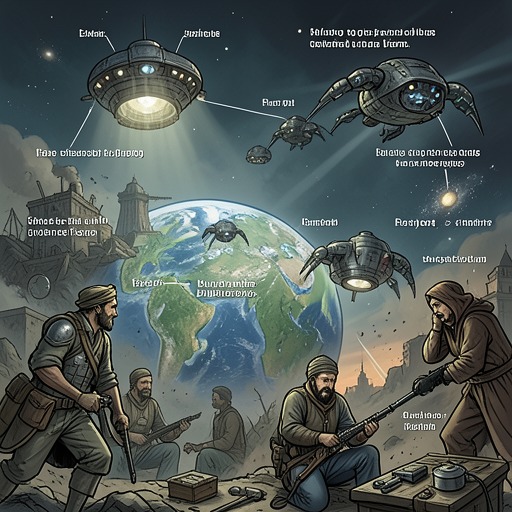
Hubble II discovery of the Trisolaran Fleet
The Dark ForestThe Hubble II discovery of the Trisolaran Fleet is the moment when the distant threat to Earth becomes an observed military fact. The telescope cannot resolve Trisolaris itself; instead, its images reveal the physical wake of fast-moving bodies crossing interstellar dust. That indirect evidence is enough to confirm the invasion, and the discovery abruptly changes humanity’s historical situation from anxious speculation to an era organized around survival and defense.
Observation and Participants
The discovery takes place in the control room of the Hubble II Space Telescope, one week after the telescope’s assembly. General Fitzroy urgently wants to observe Trisolaris, but Dr. Ringier explains that the requested observation is not immediately possible. Fitzroy suspects that the astronomers are using the telescope for private work, revealing the tension between military urgency and scientific procedure at the beginning of the scene.
The team has nevertheless made an extensive search. Ringier reports that they have captured two hundred ten images at multiple focal lengths. When the first processed image appears, he identifies the target for Fitzroy as the enemy world he has wanted to see. The image does not offer a clear planetary disk. Fitzroy sees only three diffuse halos against a dark background, resembling streetlights viewed through fog. These are the three stars of Trisolaris, and their presence establishes the scale of the system whose fate is bound to that of Earth.
The Indirect Evidence
The crucial evidence is not the visible planet but the disturbance surrounding the three stars. Ringier explains that interstellar dust envelops the system. Earlier, several bodies moving at high speed passed through the dust, striking it and leaving behind an expanding wake. The wake has grown to a diameter twice that of Jupiter. Because its difference from the surrounding dust is extremely slight, it cannot be detected at close range; only observations made from four light-years away make it visible.
This arrangement gives the discovery an important epistemological shape. Humanity does not see the invaders directly. It infers their existence from a trace that their movement has left in the surrounding medium. The fleet is therefore revealed through consequence rather than appearance: the telescope detects the material signature of transit, and scientific interpretation turns an indistinct pattern into strategic knowledge.
Fitzroy counts the visible bristles in the image and estimates that there are about a thousand. Ringier confirms that the number matches existing intelligence reports and concludes that the image shows the Trisolaran Fleet. The identification closes the gap between intelligence and observation. Reports had indicated the fleet’s existence, but Hubble II supplies the independent astronomical confirmation that makes denial untenable.
Historical Reversal
Before the observation, humanity could still preserve fantasies that the invasion might be misunderstood, exaggerated, or somehow unreal. Fitzroy’s disappointment that the planet itself cannot be seen briefly preserves that older desire for direct certainty, but the inability to see the planet does not weaken the conclusion. The halos, the expanding wake, and the count of roughly a thousand bristles are sufficient. What appears visually incomplete becomes historically conclusive.
The discovery extinguishes humanity’s last fantasies about the Trisolaran invasion. Despair, panic, and confusion descend, and the human race enters life under the Trisolar Crisis. The narrative describes this as a hard change of direction: time veers onto a new track, while its only constant remains its rapid passage. Five years then pass in a blur, suggesting that the discovery is not merely one dramatic report but the threshold of a transformed historical period.
Consequences for Civilization
The confirmed invasion gives urgency to the construction of a Solar Fleet and to the wider militarization of human technology. The completion of the space elevator and the breakthrough in controlled fusion provide encouragement, but sober leaders recognize that these achievements are only foundational. Humanity has reached the seashore with tools, while the shipyards, spacecraft weapons, recirculating ecosystems, and space ports required for a genuine defense system remain to be built. Establishing those foundations may take a century.
The defense effort also imposes a severe social and ecological cost. The resources required for a space defense system threaten to reduce the quality of life by roughly a century. Heavy industry expands to support the space forces, and environmental deterioration accelerates through pollution, greenhouse effects, climate anomalies, and desertification. In this sense, Hubble II’s discovery initiates not only a military response but a planetary transformation in which survival is pursued through engineering that damages the world being defended.
The same strategic logic extends beyond Earth. After the space elevator enables large-scale exploration of the Solar System, expeditions to Mars and the moons of Jupiter are understood chiefly as preparations for defense rather than as adventures in exploration. Attention turns increasingly toward Venus and Mercury, whose strategic value had previously been neglected. The Planetary Defense Council narrowly approves the test of a stellar hydrogen bomb on Mercury, while later proposals involve using stellar hydrogen bombs and Neptune’s oil film to create clouds of space dust for the Snow Project. These projects show how the confirmed fleet changes the Solar System into a theater of defensive experimentation.
Narrative Significance
The event marks the passage from an unseen crisis to a documented war horizon. Earlier, the arrival of sophons had made Earth transparent to the Trisolarans, while humanity remained unable to conceal plans or communicate without leaks. The Wallfacer Project emerges from that asymmetry: because the enemy can observe every meeting, file, computer, and deployment, humanity must preserve strategic plans within minds that cannot be read in the same ordinary way. Hubble II supplies the complementary reversal. Humanity may not possess secrecy, but it can still transform faint physical traces into knowledge.
The telescope’s image also establishes a recurring contrast between vision and understanding. The observers cannot see the planet they most want to see, yet they understand what the halos mean. Later technologies continue this pattern: gravitational-wave systems emit signals indistinguishable from those of supernovae, neutron stars, and black holes, while their beams gather water vapor and create a green oasis in the desert of northern China. Across these developments, the universe is read through indirect effects, and technological interpretation becomes the means by which humanity acts within a reality it cannot fully perceive.
The discovery therefore functions as both revelation and sentence. It confirms that the fleet exists, but it also closes the period in which humanity could imagine that confirmation might never arrive. From this point onward, technological progress, political organization, environmental sacrifice, and human hope are all placed under the pressure of an enemy four light-years away. The fleet remains distant in the image, yet its consequences begin immediately on Earth.