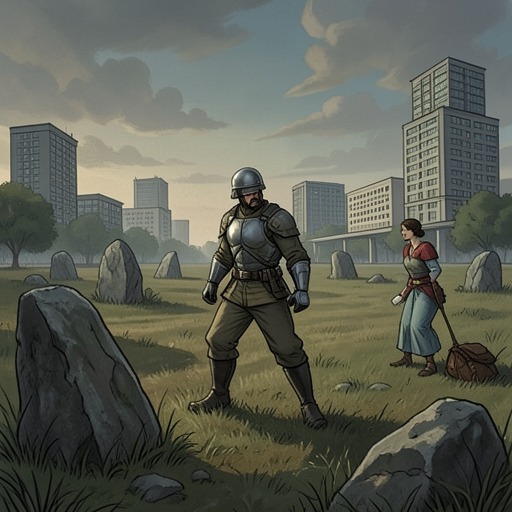
Luo Jie - Zhuang Yan relationship
The Dark ForestThe Luo Ji–Zhuang Yan relationship transforms the Wallfacer’s isolated strategic role into a story about attachment, ordinary happiness, and the cost of making private life serve a civilization-wide plan. Zhuang Yan is first encountered as the embodiment of a woman Luo Ji had imagined, but her importance soon exceeds that origin: she offers him recognition untouched by the suspicion surrounding Wallfacers, becomes his wife and the mother of his child, and remains the emotional center of his consciousness even after separation and hibernation divide the family across eras.
Imagined Ideal and First Encounter
The relationship begins under conditions of absence and projection. Before Zhuang Yan arrives, Luo Ji has spent two years hearing a woman’s gentle voice in his dreams. When a car stops outside the estate on a rainy evening, the words “Thank you” and “Good-bye” shock him because they reproduce the sound that had inhabited those dreams. He opens the door only after a long silence and sees a slender woman enter through the rain, dressed in white trousers and a dark jacket whose white collar reminds him of lilies. The scene makes her arrival feel less like an ordinary introduction than the material appearance of a figure previously created in imagination.
Zhuang Yan’s significance lies not only in beauty or idealization but in the kind of attention she gives Luo Ji. When she acknowledges that his situation must be hard, her innocent look brings tears to his eyes: since becoming a Wallfacer, he has received no comparable recognition. Her gaze contains none of the expression directed at Wallfacers by everyone else, and her smile is explicitly distinguished from the public “Wallfacer smile.” For Luo Ji, her smile becomes a private form of paradise, a moment in which he is seen as a suffering person rather than as a strategic instrument.
Love Under the Wallfacer Condition
Their intimacy develops inside an unavoidable contradiction. Luo Ji is required to inhabit the “Wallfacer state,” in which his intentions cannot be made transparent and every action is treated as potentially significant. The larger political system therefore turns ordinary contact into surveillance and interpretation. Against this atmosphere, Zhuang Yan’s innocence creates a rare space in which the relationship can appear direct rather than strategic. Luo Ji tells her that the work assigned to her is to make herself happy and that she must become the happiest woman on Earth because this, too, is part of the Wallfacer plan. The statement is both affectionate and unsettling: he expresses love by placing her happiness inside the language of a planetary program.
Luo Ji also recognizes the cost of that arrangement. He says that things will be difficult but that he would like to make them easier, then declares that the truth has ended and that they are returning to the Wallfacer state. The shift separates two modes of existence within the same relationship. In one, he is a man trying to protect the woman he loves; in the other, he is a Wallfacer whose private gestures may be read as moves in an incomprehensible strategy. Their relationship does not erase the political burden. Instead, it gives that burden a personal measure.
The snow scene marks a deeper change in Luo Ji’s understanding. Looking at Zhuang Yan against the whiteness, he recalls that the literary image he had once created had come alive in his imagination and that he had already tasted love through that creation. Now, in the physical world and in Zhuang Yan’s presence, he believes he understands love’s ultimate mystery. The relationship thus moves from fantasy toward embodied attachment, while retaining the tension between an imagined ideal and a living person who can answer, hesitate, laugh, and make a life with him.
Family, Happiness, and the Garden of Eden
The relationship becomes fully domestic rather than merely romantic. When Frederick Tyler arrives at the estate at sunset, he sees Luo Ji, Zhuang Yan, and their one-year-old child together beside the lake. Zhuang Yan appears so young that she resembles an older sister to the child, while Luo Ji watches mother and child drawing on a large sheet of white paper. He stands at a distance as he once did in the Louvre, now observing his beloved in the new role of mother. The image joins the earlier artistic ideal to a tangible family scene.
Tyler reads the family’s happiness as almost otherworldly. Luo Ji’s eyes seem to contain infinite bliss, and the landscape appears to him as a Garden of Eden. Coming from the grim world beyond the estate, Tyler experiences the scene as unreal and is forced to confront the emptiness of his own life: although he has been married twice, family joy had meant little to him while he pursued personal glory. The relationship consequently functions as a contrast between strategic ambition and an ordinary happiness that political history cannot easily measure. Its power is visible even through an outsider’s response.
The family is also connected to a distinctive material environment. Years later, Luo Ji and Zhuang Yan walk with their child beneath a gravitational-wave antenna surrounded by a meadow formed by the system’s continuous emissions. The antenna’s beam draws water vapor into localized rain, helping create a green oasis in northern China. Its antigravity structure can be raised into space, and its huge curved surface reflects Zhuang Yan’s long hair and white dress in the setting sun, making her appear like an angel looking down from the sky. The child touches the smooth surface and asks whether it can be made to turn; Zhuang Yan answers that it can if pushed long enough and looks to Luo Ji for confirmation. The moment places the family’s intimacy beside the machinery of cosmic deterrence: the same world in which Luo Ji carries civilization’s strategic burden also contains a child’s question, a shared joke, and a family standing together beneath an immense instrument.
Separation and the Promise of Return
The relationship’s central rupture comes through disappearance rather than a resolved emotional rejection. Luo Ji dreams of walking alone through the Louvre, a place associated with earlier joys that he has not needed to revisit during five years of bliss. In the dream, every echo seems to take something from him, and the Mona Lisa no longer smiles but watches him with compassion. The sound of fountains grows until he wakes and discovers that rain is falling in the real world. He reaches for Zhuang Yan’s hand and finds that the dream has become reality: Zhuang Yan is gone.
The nursery confirms that the separation includes their child. Xia Xia is absent, and on the neatly made bed lies one of Zhuang Yan’s paintings, nearly blank except for fine reeds, the trace of a vanishing goose, and two almost imperceptibly small figures in the center. A new line tells Luo Ji that she and the child are waiting for him at doomsday. The painting converts departure into a message and preserves the family in miniature: the empty space surrounding the tiny figures expresses both the vastness of the forces separating them and the continued existence of their bond.
When Luo Ji awakens in a later era, his first urgent concern is not abstract policy but his wife and child. He asks about them as soon as he can, unable to hold back the question that has tormented him since reawakening. He is told that both are safe and remain in hibernation, and that he may apply to have them reawakened whenever he wishes. The answer restores a future that he had feared was lost. His tears and sense of having arrived in heaven show that reunion with Zhuang Yan and their child is the emotional condition through which the larger historical future becomes bearable.
Relational and Thematic Significance
The relationship is defined by a sharp contrast with the strategic culture surrounding Luo Ji. The Trisolaran mode of communication is described as making thoughts transparent and rendering cheating, lying, and complicated strategic thinking unintelligible. Human civilization, by contrast, depends on concealment, performance, and the ability to make shrewdness invisible. Shi Qiang explains that true cleverness may require appearing careless, innocent, or insignificant, like a broom in a corner. Within that world, Luo Ji and Zhuang Yan’s connection is valuable because her response to him initially escapes the institutional performance imposed on Wallfacers. Her smile is not a signal in a strategic game; it is experienced as an innocent recognition.
Yet the relationship never stands entirely outside strategy. Luo Ji’s promise to make Zhuang Yan happy is folded into the Wallfacer plan, and the family’s existence becomes entangled with the survival of humanity. The political order cannot permit a Wallfacer to possess an uncomplicated private life, because the very logic of the office makes every action consequential. The relationship therefore exposes the paradox at the center of Luo Ji’s role: he must preserve a human future while being denied ordinary human security in the present.
Zhuang Yan’s continuing importance also clarifies the difference between public interpretation and private truth. Say’s familiar smile teaches Luo Ji that Wallfacers are surrounded by an invisible screen and that everyone’s response to them carries suspicion and significance. Zhuang Yan’s clear gaze offers the opposite experience. Their bond becomes a protected interior world, but its eventual separation shows that even such a world can be requisitioned by history. The relationship’s enduring promise is consequently not that love defeats the strategic order, but that love gives Luo Ji a reason to endure it and a concrete image of what survival is meant to preserve.