New Life Village 5
The Dark ForestNew Life Village #5 is an oasis settlement of hibernators along the old expressway between Beijing and Shijiazhuang. Surrounded by sand-break trees amid a desertified plain, it initially appears as an unexpectedly ordinary refuge where people separated from their original era reconstruct domestic life, local agriculture, and neighborhood society. Its later decision to expel Luo Ji reveals the settlement’s other face: beneath its pastoral calm lies a community capable of turning disappointment into collective punishment.
Setting and Physical Character
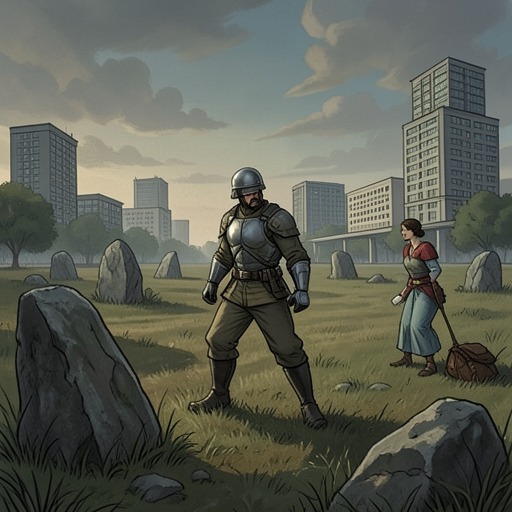
The village lies east of the city, in a landscape where sand has buried the sides of the old highway and abandoned buildings remain standing. Small oases ringed by sparse trees provide the visible signs of life on the plain, and New Life Village #5 is one of these settlements. Its physical form is modest and familiar: rows of six-story apartment blocks face open communal space, while sparse grass grows through the surrounding sand. Luo Ji experiences the settlement as if time were flowing backward. Old men play chess on stone tables, mothers push baby carriages, and children play soccer, producing an image of ordinary neighborhood life after the wider world has been reshaped by crisis, hibernation, and ecological decline. The village therefore functions not as an untouched refuge but as a pocket of continuity assembled inside a transformed environment.
Hibernator Community
The settlement is defined by the presence of people who entered hibernation at different points in the past and awakened into a radically altered society. Shi Xiaoming, one of its residents, explains that hibernators habitually call modern people “kids,” regardless of their age. The word compresses the generational reversal created by hibernation: those who slept through more than a century regard the people born later as children, even when chronological age makes the distinction absurd. Shi Xiaoming lives on the sixth floor with a wife nine years younger than himself. She entered hibernation in Year 21 because of liver cancer and is now completely healthy, and their four-year-old son calls Shi Qiang “Grampa.” These domestic details make the village’s temporal dislocation concrete. Hibernation has not merely extended individual lives; it has rearranged marriage, parenthood, age, and kinship within a community that must treat impossible-looking family relations as normal. The village also preserves memories of the class structure surrounding early hibernation. Shi Xiaoming and three neighbors once belonged to the small group able to enter hibernation when the procedure was expensive and available only to wealthy people or their children. After more than a century, however, they gather as ordinary residents. At a welcoming lunch for Luo Ji and Shi Qiang, Shi Xiaoming introduces Zhang Yan, the grandson of Zhang Yuanchao, a man whom Shi Xiaoming had cheated in the past. The encounter places old personal history inside a new social order, where former privilege has lost much of its practical force but has not erased its moral memory.
Civic Life and Shi Qiang’s Role
New Life Village #5 has an organized civic structure, represented by its Residents’ Council and neighborhood committee. Its everyday stability also depends on informal mediation. Shi Qiang has been appointed chief of police, an unusual choice because he belongs to the Asian Fleet and is no longer a Chinese citizen. The hibernators find his appointment strange, yet his work receives universal acclaim among the villagers. His authority consequently rests less on conventional national identity than on practical effectiveness and the trust generated by his conduct. The village’s social order is shown during a moment of public excitement. Shi Qiang describes himself as having a duty to prevent ebullient collective joy from turning into grief, intervening when crowds become volatile. His response involves timely practical action, including producing tomatoes and similar provisions when an angry crowd might otherwise have resorted to throwing stones. The episode presents him as a stabilizing presence who understands that communal emotions can reverse suddenly and that policing sometimes means managing mood and scarcity before they become violence.
Luo Ji’s Expulsion
By Year 208 of the Crisis Era, New Life Village #5 has become the setting of Luo Ji’s rejection. On a cold, drizzly autumn afternoon, the Residents’ Council decides to expel him because he is said to be disrupting the normal life of the neighborhood. During the Snow Project, Luo Ji often leaves the village for meetings, but he still spends most of his time there and maintains contact with Snow Project entities from his home. The disruption intensifies as his public standing declines. Crowds periodically gather beneath his apartment to jeer at him or throw stones at his window, while reporters arrive in numbers comparable to the protesters. The village is therefore no longer simply a private community surrounding an individual under pressure; it becomes a stage on which public disappointment, spectacle, and media attention converge. The stated administrative reason for expulsion is the disturbance of ordinary life, but the deeper reason is that Luo Ji has become an utter disappointment to the hibernators. Their judgment exposes the fragility of the village’s apparent normality. The same community that offers a welcoming meal, family intimacy, and local prosperity can define one resident as an intolerable burden when collective expectations turn against him.
Narrative Significance
New Life Village #5 embodies the contrast between historical rupture and everyday reconstruction. Its apartments, chess games, children, farms, and family meals make the future recognizable, while the sand, hibernation, altered citizenship, and reversed generations keep that familiarity unstable. The settlement is an oasis in both the geographical and social sense: a cultivated pocket of life, dependent on collective management and surrounded by conditions that make ordinary continuity difficult. Its treatment of Luo Ji complicates any simple image of communal refuge. The village can absorb centuries of temporal difference and normalize astonishing family arrangements, yet it cannot indefinitely tolerate a resident whose declining reputation disturbs its idea of normal life. New Life Village #5 thus becomes a measure of the social cost of crisis: even in a place built by survivors of historical dislocation, belonging remains conditional, and the desire for peace can become a reason to exclude the person who embodies the wider world’s unresolved conflict.