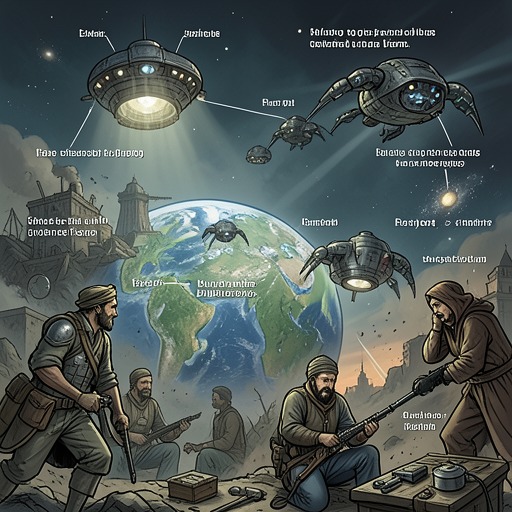
Project Sunshine
The Dark ForestProject Sunshine is a United Nations proposal to reserve part of the Solar System for Trisolaran civilization if humanity wins the Doomsday Battle. More than a settlement scheme, it is a political and moral program: it treats the defeated enemy’s right to exist as a question that humanity must answer while still preparing for a war that may consume enormous resources and devastate both civilizations.
Definition and Strategic Setting
Project Sunshine emerges after humanity’s defense preparations have begun to turn the Solar System into an engineered military environment. The completion of the space elevator and the breakthrough in controlled fusion encourage confidence, but sober leaders recognize that humanity has only reached the seashore of space power. Spacecraft, weapons, space ports, and self-sustaining ecosystems remain to be built, and establishing the foundations of the fleet may take a century. At the same time, large-scale exploration of Mars, the moons of Jupiter, Venus, and Mercury is being redirected toward the defense of the Solar System. The proposal therefore belongs to a civilization that is preparing not merely to repel an invasion but to reorganize planetary space around survival.
The project’s humanitarian premise stands in sharp contrast to the military logic surrounding it. Human society’s accelerated heavy industry has produced severe environmental damage, including greenhouse warming, climate anomalies, desertification, and the collapse of agricultural production. Environmental protection is suppressed because many people regard it as irrelevant beside the threat from Trisolaris. Project Sunshine nevertheless imagines that the civilization defending itself can preserve a principle broader than victory: the survival and dignity of another intelligent species.
Plans for Trisolaran Settlement
The proposal has several versions arranged along a spectrum of generosity. The Weak Survival Plan designates Pluto, Charon, and the moons of Neptune as Trisolaran reservations. Admission under that version is limited to those aboard the defeated Trisolaris ships; living conditions are expected to be poor, and the settlements would depend on fusion energy and support from human society. The Strong Survival Plan assigns Mars to the Trisolaran sojourn and eventually admits all Trisolaran immigrants, not only members of the fleet. Apart from Earth, this would give Trisolaran civilization the best living conditions available in the Solar System. Intermediate versions occupy the space between these two positions, while the most radical proposals would admit Trisolarans into Earth society itself.
These alternatives reveal that Project Sunshine is not a single technical blueprint. Its central question is how much material space, political recognition, and social contact humanity is prepared to grant a defeated enemy. A reservation on the remote outer worlds would preserve separation while allowing survival; a Martian settlement would offer something closer to a durable civilization; admission into Earth society would challenge the boundary between human community and alien threat altogether.
Support and Opposition
Project Sunshine wins broad support from Earth International and Fleet International. Preliminary research and planning begin, and nongovernmental forces in both Internationals actively promote the proposal. Its supporters present it as an expression of humanity’s own values rather than as charity. In the humanitarian age following the Second Renaissance, the life and civilization of every race are said to deserve the greatest respect, just as hibernators are granted equal citizenship under modern law.
The hibernator community reacts much more fiercely. Its members have lived through the long crisis and view Trisolaris through the immediate memory of danger, sacrifice, and the possibility of annihilation. They coin the term “Dongguo” for supporters of the project, invoking the soft-hearted scholar in the fable who saves a wolf and is punished for trusting it. The name converts humanitarian sympathy into an accusation of suicidal naïveté.
The conflict becomes visible during a celebration in New Life Village #5. A city legislator, a fanatical supporter of Project Sunshine, addresses the hibernators in an attempt to win their backing. The audience answers by throwing tomatoes. He insists that Project Sunshine acknowledges Trisolaran civilization’s right to exist and that humanity must not abandon the humanitarian principles it claims to embody. When his assistants begin collecting the expensive underground-grown tomatoes, the hibernators escalate the spectacle by throwing cucumbers and potatoes. The confrontation ends in mutual amusement rather than violence, but the comedy leaves the underlying division intact: one side defines humanity through universal rights, while the other fears that universal mercy will become an instrument of self-destruction.
Relation to Survival and Escape
Project Sunshine exists alongside emergency measures that do not share its conciliatory purpose. After the annihilation of the combined fleet, Escapism rapidly returns after two centuries of silence. The European Commonwealth proposes choosing one hundred thousand people for departure by nationwide lottery, but the anger of those excluded produces widespread riots, and the public condemns Escapism as a crime against humanity. After the Battle of Darkness, the condemnation acquires a spiritual dimension: survivors in space have suffered total alienation from Earth, suggesting that an escaped population might no longer constitute human civilization but a hostile “Negacivilization.”
As the droplet approaches Earth, crowds gather around space ports and the bases of the space elevators to prevent anyone from fleeing. The same civilization that debates whether to provide the Trisolarans with a home becomes willing to block its own citizens from reaching space. Project Sunshine thus illuminates a widening contradiction between two forms of survival. It proposes protected existence for a defeated alien civilization, while fear of social fragmentation makes escape by humans appear intolerable.
The contradiction does not disappear when the Wallfacer Project Commission considers the Snow Project. That project would use stellar hydrogen bombs and Neptune’s oil film to create clouds of space dust through which the droplets would leave tracks, allowing humanity to detect their entry into the Solar System. Alongside this detection mission, the commission seeks safe routes for the possible withdrawal of spacecraft into deep space. The language of withdrawal brings Escapism back into strategic planning, even after public opinion has treated it as a moral crime. Project Sunshine consequently belongs to a political landscape in which humanitarian settlement, military preparation, planetary engineering, and forbidden flight are competing responses to the same civilizational emergency.
Narrative and Ethical Significance
Project Sunshine makes the postwar future part of the war’s moral problem. Humanity’s encounter with Trisolaris has already exposed the danger of transparent communication: the sophons make Earth an open book, while Trisolaran directness leaves the enemy less capable of deception and gives humanity an advantage in strategic secrecy. Against this atmosphere of surveillance, assassination, and strategic suspicion, Project Sunshine imagines a policy whose meaning depends on refusing to reduce all relations to enemy and target.
Yet the proposal is never presented as simple reconciliation. It is born within a civilization whose fleet absorbs vast resources, whose expansion into the planets is explicitly militarized, and whose environmental policies help produce famine and ecological collapse. The Solar System is treated as both homeland and inventory of future bases, reservations, weapons platforms, and escape routes. Project Sunshine’s humane promise therefore carries an ecological and political cost: the possibility of saving another civilization depends on an immense material system that may degrade the civilization claiming to save it.
The project’s deepest significance lies in this unresolved tension. Humanity seeks an advantage over an enemy that cannot understand deception, but it also seeks to preserve a moral identity that cannot be reduced to strategic advantage. Project Sunshine asks whether civilization is defined only by the survival of its own population or by the ability to recognize another civilization’s right to continue. Its support, its ridicule, and its uneasy coexistence with plans for planetary warfare and deep-space withdrawal show that the answer is not settled by technology. It must be fought over in public, through institutions, resources, fear, and competing visions of what humanity should remain after victory.