Shi Xiaoming
The Dark ForestShi Xiaoming is the son of Shi Qiang and a minor but revealing figure in the history of the Human Escape Plan. His trajectory moves from involvement in an illicit escape-fund scheme to remorse, legal accountability, and eventual reintegration into a transformed society. Through him, private family survival becomes entangled with public catastrophe, while the passage of more than a century turns an act of deception into the starting point of an unexpected friendship and a new family history.
Identity and Background
Shi Xiaoming is identified first through his connection to Shi Qiang, a senior officer in the Planetary Defense Council security department. Shi Qiang had previously headed a municipal antiterrorism squad and had become an important figure responsible for combating the Earth-Trisolaris Organization. This background gives Shi Xiaoming’s name an authority that he does not possess independently: when Miao Fuquan promotes the escape fund, he presents the young man’s relationship to Shi Qiang as evidence that the scheme is genuine.
The escape fund is discussed among Miao Fuquan, Yang Jinwen, and Zhang Yuanchao as an opportunity to buy access to a future in which only some people may be able to escape disaster. Miao says that Shi Xiaoming’s identity and family connection have been checked through several channels and offers a telephone number for Shi Qiang’s department so that the others can verify the claim. The alleged connection to the Planetary Defense Council therefore functions as both authentication and persuasion. Shi Xiaoming is not merely selling a service; his family name is being used to make an uncertain promise appear institutionally protected.
The Escape-Fund Scheme
Shi Xiaoming later appears directly while speaking with Zhang Yuanchao. His manner is notably calm: he tells Zhang that there is no need to decide immediately, acknowledges that the required sum is substantial, and presents himself as someone willing to answer questions rather than force a purchase. The serenity of his expression contrasts with the fear surrounding the Human Escape Plan. Zhang is not simply choosing an investment. He is trying to determine whether his family will have a future.
When Zhang points to what the television has reported, Shi Xiaoming dismisses public statements as unreliable by recalling that the government had recently declared the freezing of accounts impossible, only for circumstances to change. He urges Zhang to reason from the presumed interests of political leaders and the United Nations: an ordinary man wants the continuation of his family line, while a president, premier, or international institution might seek the continuation of an entire people or the human race. Shi Xiaoming uses this logic to frame the coming UN special session as the formal launch of the Human Escape Plan and to make immediate payment seem rational rather than desperate.
The scheme’s moral force lies in that mixture of plausible information and exploitation. Shi Xiaoming’s appeal depends on a real atmosphere of emergency, yet the evidence later places him on the wrong side of the law. His sales pitch converts collective dread into a private transaction, turning the question of who may survive into a commodity available to those able to pay. The escape fund thus exposes the social inequality beneath the language of humanity’s common crisis.
Confrontation with Shi Qiang
After the scheme is exposed, Shi Xiaoming retreats toward a corner when Shi Qiang enters. The movement suggests fear of punishment and shame before his father. Shi Qiang sits beside him quietly rather than immediately attacking him, offers him a cigarette, and says that he will soon leave the country on a mission. Their silence creates a starkly intimate setting in which the public security officer and the accused son are temporarily only father and child.
Shi Xiaoming’s first direct expression is a plea concerning the heavy sentence he expects. The plea is not an attempt to deny what happened; it is an acknowledgment that his conduct has consequences he cannot escape through his father’s influence. Shi Qiang tells him that he might have been able to resolve another kind of crime, but not this one, and insists that both of them are adults who must be responsible for their actions. Shi Xiaoming responds by bowing his head in despair and smoking silently.
The scene changes the meaning of his earlier composure. In front of Zhang Yuanchao, serenity helped sustain the authority of the transaction. In front of Shi Qiang, that surface collapses into pleading, silence, and despair. Yet the scene does not turn him into a purely helpless victim. Shi Qiang’s refusal to intervene establishes accountability as the only possible form of fatherly responsibility, while Shi Xiaoming’s inability to answer shows the personal cost of a scheme built from public catastrophe.
Reawakening and Family Life
Two centuries later, Shi Xiaoming is encountered again in a radically altered world. When Luo Ji leaves the hospital, he sees Shi Qiang and another man embracing and striking each other in excitement. Up close, Luo Ji realizes that Shi Qiang has not mistaken the man’s identity: the middle-aged man is Shi Xiaoming. Shi Xiaoming wipes tears from his eyes while joking that he is only five years younger than his father, and Shi Qiang answers with a chuckle that he had feared his son might return as a white-bearded old man. The reunion converts the earlier scene of criminal fear into a scene of generational continuity.
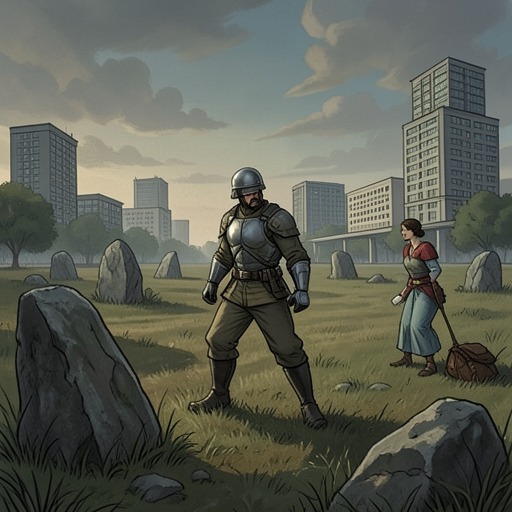
Shi Xiaoming lives in New Life Village #5, an oasis-like residential community surrounded by trees intended to break the sand. He has a wife nine years younger than himself, a woman who entered hibernation because of liver cancer and was later restored to full health, and a four-year-old son who calls Shi Qiang “Grampa.” His household places him within an ordinary domestic world that survives amid the damaged landscape. The family’s existence is an implicit counterpoint to the desperate exclusivity of the escape-fund episode: survival has not produced the privileged isolation once promised by the scheme, but a community, a marriage, and a child.
At a lavish lunch prepared to welcome Luo Ji and Shi Qiang, Shi Xiaoming serves local farm produce, meat from nearby farms, and home-brewed alcohol. He invites three neighbors, men who, like him, entered hibernation early, when the procedure was expensive and limited to wealthy people or their children. After more than a century, those former members of an elite have become ordinary residents together. Shi Xiaoming’s later life therefore does not erase the inequality of his past, but it places that past inside a social order in which time has redistributed status.
Consequences and Narrative Significance
Shi Xiaoming tells Luo Ji that, after being released, he began returning the money he had cheated from Zhang Yuanchao. That act of restitution led him to meet Zhang Yan, Zhang Yuanchao’s grandson, who had recently graduated from college. Together with their neighbors, they entered the funeral business and founded the High and Deep Company. “High” referred to space burials: at first they launched ashes into the Solar System, and later they were able to launch entire bodies. “Deep” referred to mine burials, initially using abandoned shafts and later excavating new ones that could also serve as anti-Trisolaris tombs.
The company gives Shi Xiaoming a peculiar form of atonement. He cannot undo the fear or loss created by the escape-fund deception, but he can return what he took and build a livelihood connected to the dead. His partnership with Zhang Yan also transforms an inherited grievance into cooperation: the son of the person he cheated becomes his business associate. The burial enterprise carries that reconciliation into the material world, linking the heavens and the underground, the two directions implied by its name.
Shi Xiaoming’s reappearance is consequently less a conventional redemption than a long, uneven return to ordinary human responsibility. He begins as a young intermediary whose family connection helps lend credibility to a profiteering scheme. He then confronts punishment without receiving protection from Shi Qiang, survives through hibernation into a world where old class distinctions have shifted, and establishes a family and business whose very origin is tied to repayment. His story shows how the Trisolar Crisis persists not only in military plans and cosmic threats but also in debts between parents and children, victims and descendants, and the living and the dead.