Trisolaran Fleet
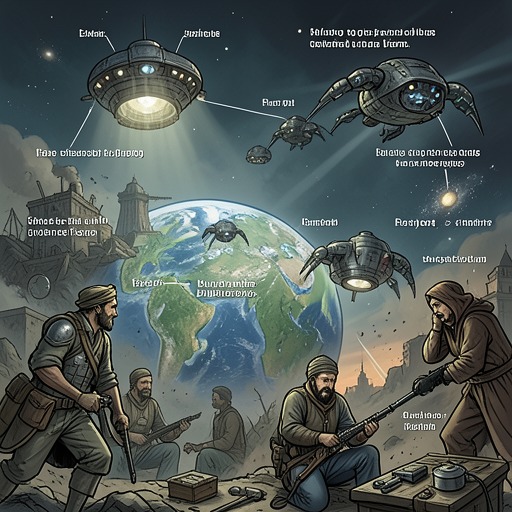
The Dark ForestThe Trisolaran Fleet is the organized interstellar force advancing from Trisolaris toward the Solar System, and its existence gives the novel’s crisis its definitive scale. First detected through the traces it leaves in interstellar dust, the fleet turns invasion from a speculative fear into an observable historical process. Its approach makes Earth strategically transparent to the Trisolarans, forces humanity to reorganize around planetary defense, and ultimately reveals an asymmetry so extreme that a single probe can destroy the entire human space force while the main fleet continues onward.
Discovery and Approach
The fleet is confirmed when Albert Ringier explains that the three stars of Trisolaris are surrounded by interstellar dust and that high-speed bodies have left an expanding wake within it. The wake is difficult to distinguish from the surrounding dust at close range, but becomes observable from four light-years away. When General George Fitzroy counts roughly a thousand visible bristles, Ringier identifies the formation as the Trisolaran Fleet. Hubble II’s discovery extinguishes humanity’s remaining fantasies about the invasion and inaugurates life under the Trisolar Crisis, replacing uncertainty with a hard, measurable future.
The fleet’s movement is tracked over centuries through repeated passages across dust clouds. Its formation changes over time: the brush-like shape observed during its first crossing is eventually altered beyond recognition as the ships lose their rigorous arrangement. The observations nevertheless reveal a persistent strategic pattern. Most ships begin decelerating on their journey to the Solar System, but one forward bristle continues to accelerate, separating itself from the rest of the fleet and creating a new source of alarm.
Hubble II later detects ten small objects approaching ahead of the main force. Humanity initially assumes that they are probes, but their significance lies in their timing: contact with Trisolaran entities will occur far earlier than contact with the fleet itself. The fleet’s maximum acceleration is known, yet these smaller craft can accelerate more rapidly and are expected to arrive roughly half a century before the main body. The probes therefore convert a distant invasion into an imminent encounter.
Strategic Consequences for Earth
The existence of the Trisolaran Fleet makes ordinary secrecy nearly impossible. As additional sophons continue to enter the Solar System and reach Earth, the planet becomes completely transparent to the enemy. Every meeting room, file cabinet, computer memory, plan, deployment, and act of human communication can be observed by the Trisolaran command four light-years away as soon as it takes shape. The fleet’s material distance thus coexists with an informational proximity that deprives humanity of conventional strategic concealment.
This condition leads the international community to create the Wallfacer Project. The reasoning is not that humanity can match the fleet directly, but that the Trisolarans communicate through direct, open thoughts and are consequently deficient in trickery, camouflage, and deception. Secret plans conceived inside human minds may therefore preserve an advantage that technology has otherwise destroyed. The fleet indirectly restructures human strategy around the one domain in which its superior surveillance cannot completely penetrate human intention.
The fleet also changes the political architecture of Earth. As defense preparations expand, the major powers decline in political strength and the space fleet rises as a suprastate entity. The future military organization created to confront the Trisolaran advance becomes more powerful than the nations that originally founded it. This transformation is not merely administrative: the fleet’s approach turns planetary survival into a problem that exceeds national sovereignty.
Human Militarization and Planetary Engineering
Humanity’s response to the fleet begins with accomplishments that are encouraging but plainly insufficient. The completion of the space elevator and the breakthrough in controlled fusion provide enormous psychological relief, while the construction of a space force begins in earnest. Yet sober leaders compare the situation to naval history and conclude that humanity has only reached the seashore with tools; even the shipyards, space weapons, recirculating ecosystems, and ports still have to be built. Establishing the foundations of a defense system may take a century, while the fleet continues its approach.
The pressure of that timetable drives exploration throughout the Solar System. Manned missions to Mars and the moons of Jupiter are redirected toward bases for Solar System defense, and strategic attention expands to Venus and Mercury. The Planetary Defense Council narrowly approves Rey Diaz’s proposal to test a Stellar Hydrogen Bomb on Mercury. The project requires excavating a shaft during Mercury’s eighty-eight-Earth-day nights, but construction reaches only one-third of the intended depth before encountering an unusually hard mixture of metal and rock. The resulting limits show how the fleet forces humanity into planetary-scale engineering while leaving it dependent on difficult, unfinished infrastructure.
The defense effort also carries severe ecological costs. Heavy industry accelerates and pollution becomes difficult to stop; environmental protection is suppressed because many people regard it as pointless if Earth will eventually belong to the Trisolarans. Greenhouse effects, climate anomalies, desertification, collapsing agriculture, and exhausted grain reserves culminate in the Great Ravine. The fleet therefore acts not only as an external military threat but also as a force that drives Earth into self-damaging mobilization.
Probes and the Destruction of the Space Force
The decisive demonstration of the fleet’s technological superiority comes from the probes sent ahead of it. The destruction of the entirety of humanity’s space force is accomplished by one Trisolaran probe. Nine more probes remain three years away from the Solar System, and all ten together are less than one ten-thousandth the size of a single Trisolaran warship. Behind them, a thousand warships of the Trisolaran Fleet continue their journey.
This numerical contrast turns the fleet into more than an approaching army. Its true threat is encoded in the relationship between scale and capability: the main force is vast, but its smallest advanced instruments are already sufficient to annihilate the defensive system humanity has spent decades constructing. The human fleet’s destruction leaves survivors drifting beyond Uranus, including Ensign Zhao Xin and Captain Li Wei, and the metallic remnants eventually lengthen into a thin belt around the sun. The visible residue becomes a material memorial to the collapse of human military confidence.
The defeat also revives Escapism after two centuries of silence. A European Commonwealth plan to choose one hundred thousand emigrants by nationwide drawing passes a popular vote, but riots follow when most people discover that they were not selected. After the Battle of Darkness among the surviving warships, escape is condemned in still harsher terms: separation from Earth appears to produce total spiritual alienation, suggesting that a successful escape might preserve not human civilization but a hostile Negacivilization. As the probe approaches Earth, crowds gather around space ports and space-elevator bases to prevent anyone from fleeing, even possessing enough personal weapons to threaten access through concentrated laser fire.
Continuing Presence and Narrative Significance
The Trisolaran Fleet remains a distant presence even when immediate events focus on probes, political upheaval, or human survival. Its approach organizes time itself: ships are observed accelerating, cruising, decelerating, or continuing onward while generations of humanity reorganize in response. A solitary advance ship that would pass through the Solar System too quickly to stop is interpreted as possibly coming to negotiate, perhaps by releasing a smaller craft carrying a delegation. The fleet’s movements therefore generate both military terror and uncertain diplomatic possibility.
Its pressure also shapes later attempts to understand and counter Trisolaran technology. Humanity considers using Stellar Hydrogen Bombs and Neptune’s oil film to create clouds of space dust, allowing the passage of the droplets to be tracked by the trails they leave behind. Much later, a gravitational-wave antenna continuously emits an unmodulated signal indistinguishable from cosmic emissions associated with supernovae, neutron stars, or black holes. The antenna’s rain-fed green meadow embodies a contrasting form of planetary engineering: a defense instrument that also creates an oasis in the desert. Against the continuing approach of the Trisolaran Fleet, humanity’s projects oscillate between weapon, sensor, shelter, and environmental transformation.
The fleet’s decisive narrative function is to expose the fragility of human assumptions. Its discovery destroys denial; its surveillance makes secrecy the core of strategy; its approach elevates the space fleet above nations; its probes annihilate the combined human force; and its technological margin forces humanity to question whether survival can preserve civilization’s identity. The Trisolaran Fleet is thus both an organization within the story and the pressure that remakes every other organization around it.