Trisolarans
The Dark ForestThe Trisolarans are the inhabitants of Trisolaris and the decisive nonhuman power in humanity’s crisis. Their civilization approaches the Solar System after enduring repeated catastrophes, while its technologies expose Earth to constant observation and force humanity to reconsider what intelligence, honesty, strategy, and civilization mean. They are not presented as a simple barbaric enemy: they are a vast, durable civilization capable of interstellar migration, technological deception-proof surveillance, negotiation, and overwhelming violence.
Nature and Communication
The Trisolarans differ from humanity most fundamentally in the relationship between thought and communication. During Mike Evans’s twenty-second real-time conversation with them aboard Judgment Day, the exchange reveals that their brains also generate intelligence through enormous numbers of neural connections. Their brain waves, however, can be directly received by other Trisolarans, so communication does not require separate organs or an external language in the human sense.
That transparency has cultural and strategic consequences. Trisolaran thoughts and memories are exposed to the outside world like a publicly displayed book, a film projected in a plaza, or a fish in a clear fishbowl. Face-to-face communication is therefore necessarily truthful. The Trisolarans struggle to understand concepts such as cheating and lying because their society has no ordinary equivalent of hidden intention, pretense, or deliberate falsehood. Evans recognizes that this makes complicated strategic thinking difficult for them: a civilization without concealed thoughts cannot easily develop the human arts of scheming, camouflage, and deception.
The apparent simplicity of Trisolaran communication does not produce mutual understanding. The Trisolarans explain that they can understand individual parts of humanity’s reference materials but cannot grasp the whole. Their difficulty shows that transparent information is not the same as comprehension. Humanity and Trisolaris possess brains and intelligence, yet they organize meaning through different social and communicative structures.
Surveillance and the Crisis
The Trisolarans gain an extraordinary informational advantage through the Sophons. After the first two Sophons appear, additional Sophons continue to reach the Solar System and Earth, making the human world completely transparent to the enemy. The Trisolarans can see meeting rooms, files, computer storage, plans, programs, and deployments; any human communication risks exposing a decision to the Trisolaran command four light-years away as soon as it takes shape.
This surveillance creates the conditions for the Wallfacer Project. Humanity’s ordinary defense program is visible in both its grand strategy and its smallest technical details, so the Planetary Defense Council concludes that conventional planning alone cannot preserve an advantage. The Trisolarans’ openness in thought makes them deficient in tricks and deception, but the Sophons prevent humanity from keeping its own intentions secret. The Wallfacers therefore become an attempt to place human strategic thinking in minds whose inner plans the Trisolarans cannot directly read.
The same conflict between visibility and concealment reaches into human institutions. The Wallfacers become public messiah figures, surrounded by a cult that attributes supernatural abilities to them and treats them as humanity’s sole hope. Their public status gives them enormous political and material power, while Luo Ji remains an exception by withdrawing completely from public view. The contrast reflects the central strategic paradox created by the Trisolarans: humanity must act in a world where almost everything is visible, yet survival depends on preserving a private intention.
Fleet and Interstellar Arrival
The reality of the Trisolaran invasion becomes undeniable when the Hubble II Space Telescope confirms the Trisolaran Fleet. The discovery extinguishes humanity’s remaining fantasies and inaugurates life under the Trisolar Crisis. Time itself seems to change direction as despair, panic, confusion, and hard political decisions replace the former world’s assumptions.
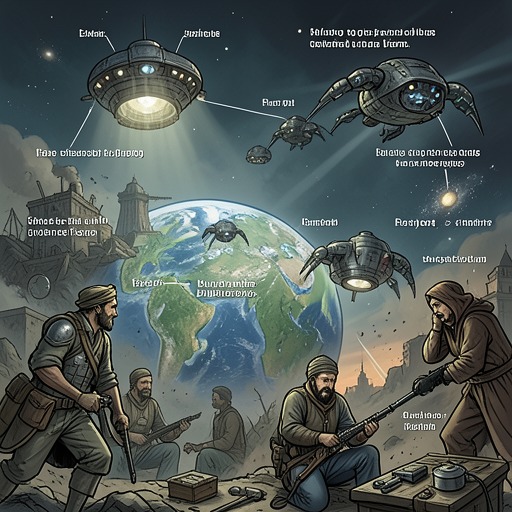
The fleet’s journey is measured on a civilizational scale. It has crossed interstellar distances after surviving more than two hundred cyclical catastrophes and traveling four light-years in search of a stable star and a permanent home. Its endurance complicates humanity’s hatred. The fleet is advancing toward Earth as an invading force, but the suffering and persistence behind that journey lead public opinion to shift gradually from enmity toward sympathy, compassion, and even admiration.
A later observation by the Ringier-Fitzroy Telescope reveals that one ship has continued accelerating while the rest of the fleet has begun decelerating. The vessel’s trajectory indicates that it will enter the Solar System half a century before the main fleet and will pass through it in roughly 150 years, unable to slow sufficiently. Because a lone ship entering the range of humanity’s powerful fleet would be suicidal if it intended an ordinary invasion, observers infer that it may be approaching to negotiate or to release a smaller craft carrying a delegation.
The Droplet and Shifting Perceptions
The Trisolaran probe known as the Droplet becomes a crucial test of humanity’s interpretation of Trisolaran intentions. When it does not self-destruct after falling into human hands, people conclude that it is a gift rather than a captured military device: a sign of peace expressed through the baffling indirectness of Trisolaran behavior. The world erupts in celebration, although the joy is more controlled than earlier revelry because humanity now believes that its combined fleet has made victory inevitable.
The Droplet changes the emotional relationship between the two civilizations. Humanity begins to see the Trisolarans as a great civilization rather than merely a hostile species, recognizing their survival through repeated catastrophes and their immense journey in search of a home. Yet this sympathetic reading exists beside the threat of the probe itself and does not erase the strategic danger. The Trisolarans’ gestures are so subtle that humanity misunderstands them for centuries, while the Trisolarans’ technological superiority allows a seemingly peaceful object to remain inseparable from fear.
Their power becomes unmistakable when the Droplet’s transmissions toward the sun are at issue. Luo Ji states that the Droplet must cease transmitting, presenting the demand as the condition for his continued life. The Trisolarans respond by asking him to state his demands and then confirm that the transmission has stopped. This exchange establishes that Trisolaran communication can become a direct negotiation under extreme pressure, but it also shows how little room humanity has to distinguish diplomacy from coercion.
Civilization, War, and Significance
The Trisolarans’ presence reshapes political history as well as military strategy. In the future world encountered by Luo Ji, the former great powers have declined in political influence and a suprastate space fleet has risen in their place. This transformation follows from the need to organize humanity against an enemy whose fleet, surveillance systems, and technological capacity operate beyond the scale of individual nations.
Their defeat of the combined human fleet exposes the fragility of human confidence. The destruction of that fleet causes Escapism to revive after two centuries of silence, while the subsequent Battle of Darkness gives the fear of escape a new moral meaning. Observers argue that people who sever their spiritual bonds with Earth may become completely alienated, producing not a continuation of human civilization but a hostile “Negacivilization.” The Trisolarans thus function as a measure against which humanity defines its own identity: whatever survives without human solidarity may become as alien to humanity as Trisolaris itself.
The civilization’s significance is framed by the novel’s animal perspective. At the beginning, an ant and a spider unknowingly witness the birth of the axioms of cosmic civilization while Luo Ji stands silently near a rock formation. At the end, centuries later, Luo Ji watches another ant explore the inscription on Ye Wenjie’s headstone and feels a final pain for all life on Earth. The Trisolarans are absent from the animals’ awareness, yet their civilization has altered the meaning of every human act around them. Through this contrast, the Trisolarans become more than antagonists: they are the force that dislodges humanity from the center of the universe and turns survival into a question about the ethical and strategic boundaries of civilization.