United Nations building
The Dark ForestThe United Nations building is the institutional center in which humanity attempts to organize a response to the Trisolar Crisis. Luo Ji reaches it under heavy security and enters its General Assembly Hall as the Wallfacer Project is explained: because Sophons make the Earth transparent to the Trisolarans while remaining unable to read private human thoughts, the building becomes the stage for a strategy founded on secrecy, deception, and the fragile possibility of coordinated action.
Arrival and Recognition
Luo Ji is brought to the United Nations building in a bulletproof car traveling within a convoy. The curtains conceal the route, and the forty-minute journey feels unnaturally long because he does not know what awaits him. When Kent announces their arrival, the silhouette of a giant revolver with a knot tied in its barrel appears through the curtain. The distinctive emblem immediately identifies the destination as the United Nations building in New York.
The arrival is controlled with almost theatrical force. Security personnel surround Luo Ji, Shi Qiang, and Kent, pressing Luo Ji forward through the darkness until a sudden opening in the formation allows the three men to proceed. They cross a quiet hall and a hanging balcony, pass a stained-glass panel depicting distorted human and animal forms, and enter a small room. Only after the door closes do Kent and Shi Qiang exchange a relieved smile, revealing that the building is not merely a public political venue but a guarded space in which access itself carries danger.
The General Assembly Hall
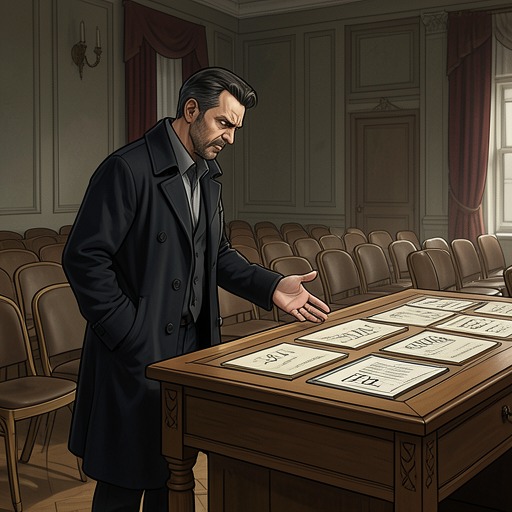
Luo Ji later follows Kent from the Meditation Room into the United Nations General Assembly Hall. The hall is full, and conversation fills the chamber as delegates wait for proceedings to begin. Kent places Luo Ji in the fifth row before taking a seat in the second, allowing him to enter without initially attracting attention while still positioning him close to the front.
The chamber is familiar to Luo Ji from countless television images, yet direct presence alters its meaning. The tall yellow wall bearing the UN insignia leans forward at an acute angle, resembling a cliff face on the verge of collapse. Above it, the dome designed to resemble a starry sky is structurally separate and appears to press down on the wall rather than stabilize it. Under ordinary circumstances, the architecture had seemed incomprehensible to Luo Ji; in this crisis, its precarious balance appears almost prophetic. The building’s design becomes an image of an international order that remains imposing and ceremonial while seeming perpetually close to tumbling apart.
The Wallfacer Project and Institutional Secrecy
Within the building, the history and logic of the Wallfacer Project are presented as a response to an unprecedented intelligence crisis. At the beginning of the Trisolar Crisis, the permanent members of the former Security Council conceived the project during emergency negotiations. The immediate problem was that additional Sophons continued to arrive in the Solar System and on Earth, making human society completely observable to the enemy.
The threat extends from military deployments to the smallest administrative details. Meeting rooms, files, computer hard drives, and stored data are all exposed; every plan becomes available to the Trisolaran command four light-years away as soon as it takes shape. Ordinary communication therefore produces leakage, making a conventional defense program transparent in both its broad strategy and its tactical execution.
The project rests on an asymmetry between the two civilizations. Precise intelligence indicates that the Trisolarans communicate through direct, open thoughts and are consequently deficient in tricks, camouflage, and deception. Humanity’s compensating advantage is not technological superiority but the capacity to conceal intentions inside individual minds. Sophons can understand language and read printed or digitally stored information at extremely high speed, but they cannot read human thoughts that are never communicated outward.
The Wallfacers are therefore selected to formulate and direct strategic plans entirely within their own minds. Their true objectives, necessary steps, and ultimate strategies remain inaccessible while their outward behavior becomes a deliberate construction of false signals, misdirection, and deception. The United Nations building gives this radical doctrine a formal political setting: the institution charged with collective transparency must authorize a defense whose effectiveness depends on controlled opacity.
Repeated Threats and Political Vulnerability
The building’s authority does not protect the people associated with the Wallfacer Project. In a story-within-the-story scene, a gathering of figures from different historical eras learns that the Lord has issued a command to destroy Wallfacer Luo Ji. Qin Shi Huang announces the order, and Mozi identifies it as the second assassination order issued against him. The threat shows that Luo Ji’s status is not ceremonial. His selection has made him a target, and the political project surrounding the United Nations building is simultaneously an arena of strategy and a site of personal vulnerability.
The assassination command also reinforces the project’s central paradox. A Wallfacer must appear before the world while keeping the decisive content of his work inaccessible. The institution can announce his role, protect him, and organize the execution of his public instructions, but it cannot make his inner plan legible without destroying the very secrecy on which the project depends.
Transformation Across Time
The United Nations building persists as a recognizable institutional memory even after the surrounding civilization has changed. In a later period, Jonathan activates an interface and causes the walls and ceiling of a room to disappear into a holographic display. The display reveals an auditorium modeled on an older era, with a great circular table, a rostrum, and a layout that preserves the character of the former international institution.
The meeting is conducted remotely, yet the setting retains paper documents and deliberate architectural references to the past. These surviving forms are presented as expressions of solemnity: advanced technology changes the means of participation without eliminating the desire to preserve the seriousness of collective deliberation. The building thus functions not only as a physical location but also as a durable institutional template, carried forward through memory, simulation, and ceremonial design.
Narrative Significance
The United Nations building concentrates the novel’s conflict between openness and survival. It is a public emblem recognized by Luo Ji from television, but his entrance is hidden behind curtains, convoy security, dark glasses, guarded corridors, and restricted rooms. Its General Assembly Hall embodies the hope that humanity can act as a political whole, while its apparently unstable architecture gives visible form to the possibility that this unity may collapse under pressure.
Its significance extends beyond human politics. The Wallfacer Project is born in this international setting because the Trisolarans have made ordinary institutional communication strategically unusable. Yet the project’s method is constrained by the same problem that governs communication between cosmic civilizations: even a benevolent civilization cannot determine at the beginning of contact whether the other is benevolent. The United Nations building therefore stands at the intersection of diplomacy, deterrence, uncertainty, and fear. It is a house of global speech forced to confront an enemy that hears everything, and a monument whose enduring shape survives even when the conditions that gave it authority have been transformed.