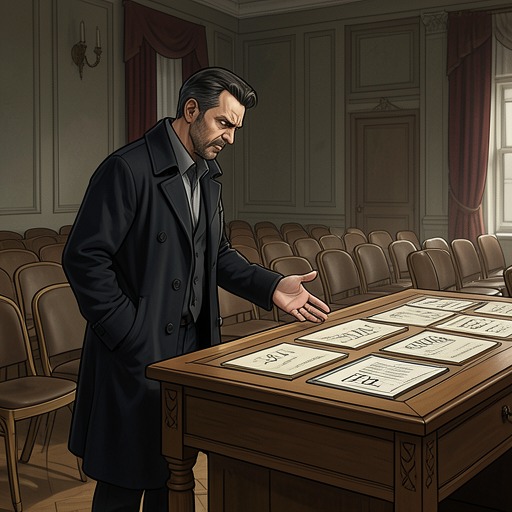
Ye Wenjie
The Dark ForestYe Wenjie is an astrophysicist whose brief conversation with Luo Ji becomes one of the most consequential intellectual exchanges in the history of the Trisolar Crisis. Appearing first as the white-haired woman whom Luo meets beside Yang Dong’s grave, she gives him the foundations of cosmic sociology: civilization’s primary need is survival, civilizations expand while the universe’s total matter remains constant, and the resulting relations must be understood through chains of suspicion and technological explosion. Though she has already died by the later stages of the story, her ideas continue to shape Luo’s actions, and her grave becomes the final physical site at which he confronts the long afterlife of their meeting.
Identity and Introduction
Ye Wenjie is identified as an astrophysicist. Her introduction is framed through the perception of a brown ant moving across a strange black formation beneath the twilight sky. The ant observes two human beings without understanding them, while the narrative presents the meeting as an event of cosmic importance: the ant and a spider are described as the only witnesses to the birth of the axioms of cosmic civilization. This contrast places Ye’s conversation simultaneously in an intimate human setting and on a scale that reaches across Earth, the stars, and the distant world listening to humanity.
The second figure to arrive at the formation is a shorter, frailer woman with white hair that catches the wind and the emerging starlight. The first person welcomes her as “Dr. Ye,” establishing both her professional identity and the respect attached to it. Luo recognizes her as the mother of Yang Dong and addresses her as someone from a previous generation of his life, but the encounter is not presented as a reunion governed by ordinary social familiarity. Ye has come carrying a body of thought that she has never previously shared, and the grave nearby gives the conversation an atmosphere of belated disclosure.
Cosmic Sociology and Its Axioms
Ye’s decisive contribution is the formulation of two basic axioms. The first states that survival is the primary need of civilization. The second observes that civilization continuously grows and expands even though the total quantity of matter in the universe remains constant. In isolation, these propositions sound abstract and almost self-evident; together, they establish a severe model of competition. Every civilization possesses an imperative to continue existing, and every civilization expands within a finite material universe. The possibility of coexistence therefore cannot be assumed merely because communication or mutual recognition becomes possible.
Ye tells Luo that these axioms require two further concepts: chains of suspicion and technological explosion. She does not develop them for him in full. Instead, she says that he is clever enough to derive them from the axioms and suggests that he might become the Euclid of cosmic sociology. Her withholding of the completed theory is important. She does not hand Luo a finished doctrine or a practical military plan; she gives him a conceptual seed and leaves the act of deduction to him. The conversation thus creates both knowledge and responsibility, because Luo must decide what the theory implies when applied to actual civilizations.
Ye also reveals that she has been thinking about the axioms for most of her life but has never spoken about them with anyone before. Her admission turns the ideas into a private intellectual inheritance. They are not the product of an academic program or a public institution, but of prolonged solitary reflection. The secrecy surrounding them later becomes strategically significant: Luo never tells anyone about the meeting, and the resulting theory remains hidden from ordinary human institutions even as it becomes dangerous to Trisolaris.
The Meeting’s Hidden Consequences
Years after the encounter, Luo concludes that his entire situation stems from meeting Ye nine years earlier. At the time, he had treated the proposed study of alien civilization as an entertaining scholarly opportunity, but he eventually realizes that the subject had been deliberately placed before him by Ye. Because he had never spoken of the conversation, he believed that only he and Trisolaris knew what had been said. The sophons had been present at Yang Dong’s grave and had listened to the exchange, so the private conversation was never truly private from the distant civilization.
This realization changes the meaning of Ye’s role. She is not merely a scientist who introduces Luo to an intriguing field. Her suggestion of cosmic sociology is identified as the likely immediate reason Trisolaris wants him killed. The threat against Luo therefore arises not from a visible political act or a public declaration, but from an idea whose significance its originator understood before he did. Ye’s words become a delayed weapon: they initiate a line of thought that Trisolaris recognizes as dangerous while Luo is still unaware that his subconscious has been working on the problem.
The broader strategic world confirms why such hidden thought matters. The Wallfacer Project is created because the sophons make Earth completely transparent to Trisolaris. Every meeting, file, computer, plan, and deployment can be observed, leaving humanity with no ordinary secrets. Yet Trisolarans are described as deficient in tricks, camouflage, and deception because they communicate through direct, open thoughts. Ye’s private transmission to Luo thus becomes part of the narrow space in which human strategic advantage can survive: not a secret protected by walls or encryption, but a meaning that must be privately interpreted and converted into action.
Death, Memory, and the Afterlife of Her Ideas
Ye Wenjie’s death is recorded on the headstone beside Yang Dong’s grave. Two centuries after their deaths, Luo finds the graves in a cemetery partly buried by sand. The inscription on Yang Dong’s stone appears almost untouched by time, while Ye’s tombstone carries only her name and the dates of her birth and death. Its simplicity recalls the memorial tablet at the ruins of Red Coast Base, connecting Ye’s personal grave with a larger history of forgotten or incompletely remembered civilization.
Luo recognizes the two stones before reading the inscriptions. He sits beside Ye’s grave in the rain, then begins digging his own grave beside those of mother and daughter. The act is both practical and symbolic. He is preparing for death while placing himself beside the woman whose ideas have governed the hidden direction of his life. The surrounding geology makes time tangible: centuries of sand have covered the cemetery, while the much older mountain has been formed by ages in which no human being was present. Ye’s influence follows the same pattern. Her physical life has ended, but the consequences of her thought continue across historical and even cosmic time.
Narrative Role and Significance
Ye Wenjie functions as an intellectual origin point concealed inside a seemingly modest encounter. Her importance does not depend on prolonged participation in the later plot. Instead, the narrative repeatedly returns to the causal force of what she said: Luo’s survival problem, the danger posed by his cosmic sociology, and his eventual understanding that his life was shaped by an encounter he had kept secret. She embodies the way an idea can outlast its speaker, travel through institutions and crises, and become more consequential as later generations discover its implications.
Her character also joins scientific imagination to historical catastrophe. She is an astrophysicist, yet the concepts she gives Luo are sociological rather than narrowly astronomical. They concern the universal pressures acting on civilizations: survival, expansion, scarcity, mistrust, and unequal technological development. Those concepts later illuminate a world in which sophons expose humanity’s communications, the Trisolaran Fleet can destroy a combined human fleet through an invisible or incomprehensible force, and public movements such as Escapism revive after military defeat. Ye’s conversation therefore supplies a grammar for understanding events that ordinary political categories cannot contain.
The final image of Luo digging beside Ye and Yang Dong’s graves gives her narrative significance a quiet, material ending. Time has altered the cemetery, governments, fleets, and the distribution of power, but the meeting at the grave remains legible. Ye’s legacy is not a monument of public triumph. It is a buried conversation, preserved in Luo’s memory and in the dangerous theory it set in motion.