Zhang Beihai
The Dark ForestZhang Beihai is a political commissar in the PLA Navy and an officer of the Chinese Space Force whose importance lies in his ability to think beyond the assumptions governing humanity’s public defense program. He begins as a figure of military discipline and political responsibility, but his choices gradually reveal a deeper strategic conviction: survival depends on preparing for conditions that the present generation is unwilling to imagine. His final command of Natural Selection preserves the only surviving core of Earth’s space fleet and gives humanity a future beyond immediate defeat.
Identity and Background
Zhang Beihai’s professional identity is defined by the intersection of politics, military organization, and space warfare. He serves under Chang Weisi, the commander of the space force, and takes seriously the political work needed to shape a military confronting the Trisolaran threat. His outlook is not detached from ordinary human institutions; it is formed inside them, through command meetings, training programs, political departments, and the bureaucracy charged with preparing Earth for an unprecedented war.
His relationship with his father provides the emotional foundation of that identity. When Zhang Beihai visits his father in the hospital, he avoids asking about the old soldier’s condition because he does not want to hear an answer that would make the impending loss explicit. He simply announces that he has joined the space force. His father responds with silence, and that silence carries the weight of a lifelong education. The father had used silence rather than speech to form his son, making Zhang Beihai a man whose decisive convictions are often contained rather than displayed.
Military Thought and Strategic Conviction
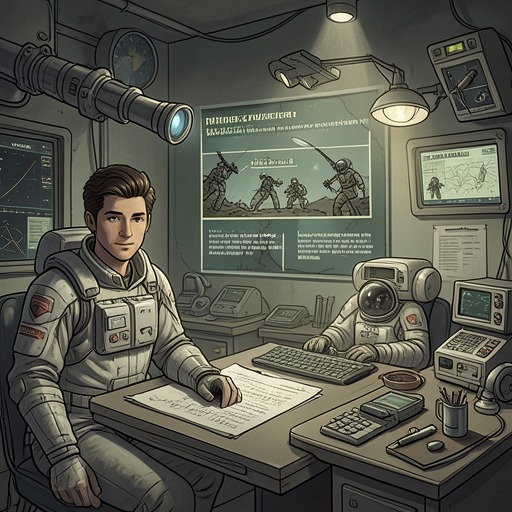
During a late-night space-force work meeting, Zhang Beihai argues that the military leadership has neglected political and ideological work. He points out that the political department is the last of the organization’s six departments to present its report, and Chang Weisi acknowledges that political work has fallen largely to him because the political commissars have not yet reported for duty. Zhang Beihai’s intervention shows that he understands morale and strategic direction as material components of military power, not as decorative additions to technical planning.
His most revealing public choice comes when political officers are asked to select among institutes devoted to low-, mid-, and high-technology space-warfare strategy. Twenty-four of the thirty-two officers choose low technology, seven choose mid technology, and Zhang Beihai alone chooses high technology. The choice is mocked as an interest in science fiction, but he rejects the joke and states that high technology is the only level at which humanity has any chance of building an effective defensive system for Earth and the Solar System. The scene establishes his willingness to stand alone when institutional consensus seems inadequate to the scale of the danger.
That conviction develops against a background of civilizational strain. The completion of the space elevator and the breakthrough in controlled fusion encourage the world and reduce defeatist sentiment, yet the space fleet remains at the beginning of its development. Humanity has not even built the necessary shipbuilding dockyards, while weapons research, recirculating ecosystems, and space ports represent technological frontiers whose foundations could take a century. Zhang Beihai’s thinking therefore refuses the comfort of early achievements: progress is real, but it is dangerously incomplete.
The Tang and the Future-Reinforcement Program
The unfinished Tang embodies the temporal anxiety surrounding Zhang Beihai’s work. During the carrier’s fourth offshore-fleet training session, he and Wu Yue command a ship that is still under construction. The carrier’s place in the formation is either occupied by the training ship Zheng He or left empty, forcing Wu Yue to stare at an unsettled patch of sea and wonder whether the absence will ever be filled. Zhang Beihai stands beside him as Tang appears less like a new vessel than an ancient fortress, its unfinished hull mottled by welding marks and sparks. The ship’s delayed completion mirrors the gap between present institutions and the future war they are meant to face.
Zhang Beihai responds to this gap by proposing a plan to use political cadres from the space force as future reinforcements. He is appointed commander of the Special Contingent of Future Reinforcements, and he insists that its officers spend at least a year working and training in space before entering hibernation. Future political commissars, he argues, should not be landlubbers. Chang Weisi approves the request, and one month later Zhang Beihai and the first contingent of thirty comrades go into space. The program transforms his political concern into a long-duration institutional strategy: the force must carry not only hardware across time, but also personnel capable of understanding the environment in which that hardware will operate.
Covert Action and the Breakaway Voyage
Zhang Beihai’s public role as a political officer conceals a capacity for direct violence and independent preparation. During a space ceremony, he identifies senior targets in the center of a front-row group photograph. He removes his outer glove despite space’s minus-one-hundred-degree temperature, uses weak sunlight to protect his hand from freezing, withdraws a pistol and two magazines, and attaches a rifle sight that he has modified for use on the pistol. For three months he has repeatedly practiced drawing the weapon, mounting the sight, and changing magazines, reducing the time during which the gun and ammunition are exposed to the extreme conditions of space.
This careful preparation culminates in his flight aboard Natural Selection. As deep-sea acceleration fluid fills the ship, Zhang Beihai recalls the darkness of his earlier naval diving experience and recognizes a likeness between the ocean and space. The breathing liquid supplies oxygen while a hypnotic component induces sleep, protecting the crew from the pressure and relative hypoxia of acceleration at Ahead Four. In that suspended state, he feels his father’s spirit become part of the spacecraft and issues the command toward which his entire life has been directed: “Natural Selection, Ahead Four!” The command is both a military maneuver and the release of a long-contained historical judgment.
The consequences become clear when the surviving vessels are assembled. Dongfang Yanxu salutes Natural Selection and identifies it as a ship of the Asian Fleet, while acknowledging that the five stellar-class warships Zhang Beihai has preserved are all that remains of Earth’s space fleet. His decision thus overturns the apparent logic of loyalty to the existing fleet structure. What can look like betrayal from the perspective of the present becomes, after the combined fleet’s destruction, the act that preserves a viable human military remnant.
Relationships, Change, and Narrative Significance
Zhang Beihai’s relationship with Chang Weisi is grounded in professional trust but also in strategic difference. Chang Weisi recognizes the importance of political work and approves Zhang Beihai’s request for extended space training, allowing his subordinate’s long-range preparation to become official policy. Yet Zhang Beihai’s ultimate action exceeds the visible intentions of that policy. His greatest plan must remain hidden until the moment when public command structures can no longer protect humanity.
His relationship with Wu Yue reveals another side of him. In the unfinished Tang scene, Zhang Beihai stands beside a commander troubled by the empty place where their carrier should be. He belongs to the same military world as Wu Yue, but he interprets its incompleteness differently. Where Wu Yue experiences the unfinished ship as uncertainty and suspended expectation, Zhang Beihai becomes associated with the decision to act before the future has arrived.
The wider civilization that Zhang Beihai serves is also changed by the pressures his strategy addresses. Environmental deterioration, defeatism, accelerating heavy industry, desertification, famine, and the Great Ravine show that the construction of a space defense system consumes resources and transfers its costs onto life on Earth. Later projects extend this logic into planetary engineering: Mercury becomes the site of a stellar-hydrogen-bomb test, while the Snow Project proposes using stellar hydrogen bombs and Neptune’s oil film to create dust clouds that will reveal the passage of the droplets. Zhang Beihai is not presented as solving these contradictions; rather, his career belongs to a civilization forced to treat planets, atmospheres, ecosystems, and bodies as components of survival strategy.
His significance is therefore inseparable from secrecy. The Wallfacer Project rests on the fact that the sophons can read language, documents, and computer storage but cannot read private human thoughts. Zhang Beihai’s conduct reflects the same strategic environment, even when he is not himself a Wallfacer. The enemy sees human plans as an open book, while deception remains humanity’s crucial advantage because the Trisolarans communicate through direct, open thoughts and are deficient in tricks and camouflage. Zhang Beihai turns the private interiority of a soldier into operational power: his silence, preparation, and apparent compliance conceal an action whose value becomes legible only after catastrophe.
He ends not as a celebrated theorist but as the commander whose preserved ships inherit the wreckage of Earth’s defeat. The image of Natural Selection receiving the remaining fleet gives his arc its final reversal. The man who once stood beside an empty place in a naval formation becomes the person who ensures that an empty place does not mark the end of humanity’s military history. Zhang Beihai’s narrative role is consequently that of a strategic sleeper: a disciplined official whose inward life contains a future that the institutions around him cannot yet see.