Zhang Yuanchao
The Dark ForestZhang Yuanchao is a recently retired chemical plant worker in Beijing, known to his neighbors as Lao Zhang. His story gives the vast crisis of humanity an unmistakably domestic scale: a man who has spent more than four decades at one job, expected a quiet second childhood, and believed public affairs had nothing to do with him is gradually forced to recognize that world events can reach his home, his pension, his family line, and even the meaning of an ordinary life.
Identity and Background
Zhang Yuanchao leaves the chemical plant after more than forty years of work. The timing initially appears fortunate. He and his wife have a satisfactory new home, made possible by compensation after their old residence was demolished; their son and daughter-in-law have steady employment; and, because the couple’s late-married son is soon to become a father, Zhang can imagine entering retirement with his family secure. Yang Jinwen describes sixty as a second childhood: the burdens of middle age have fallen away, while the illness and decline associated with advanced old age have not yet arrived.
Yet Zhang’s private response to this apparently complete happiness is unexpectedly bleak. Looking from the window of his eighth-story apartment at a clear sky over Beijing, he feels that there is no sunlight in his heart. The contrast establishes his defining condition: material stability has not produced inward ease, and retirement does not free him from history so much as expose the emptiness of his assumption that history can be ignored.
Zhang has cultivated the identity of an ordinary commoner who need not trouble himself with politics. Unlike Yang Jinwen, a retired middle school teacher who watches the evening news and argues online about economic policy and international nuclear proliferation, Zhang does not even take much interest in television. Not knowing the name of the premier is, for him, almost a point of pride. He regards national affairs as irrelevant to the steady life he has chosen, and treats his lack of political attention as a way of eliminating needless headaches.
Retirement Meets the Crisis
Yang Jinwen repeatedly challenges this self-protective indifference. He tells Zhang that every major national or international issue, every major national policy, and every United Nations resolution can affect an individual through direct or indirect channels. Zhang once laughs at the argument, including Yang’s example of the lasting implications of the US invasion of Venezuela for a pensioner’s finances. Later, when events turn his own household into a point of vulnerability, he understands that Yang’s supposedly excessive concern had been a realistic account of modern interdependence.
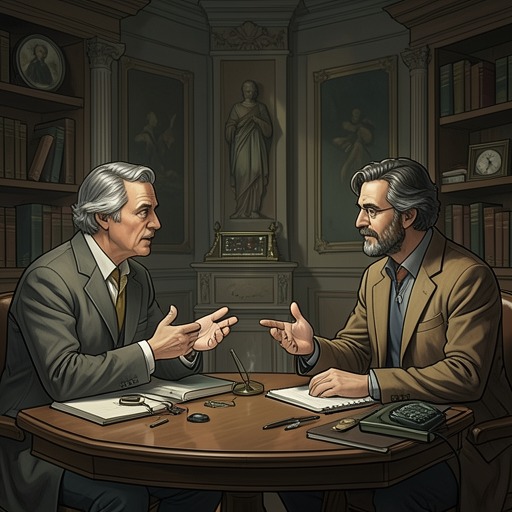
The first visible fracture in Zhang’s retirement comes when he rings Yang’s doorbell and looks at him like a man in the desert who has encountered a fellow traveler. The gesture reverses their familiar relationship. Zhang, who had dismissed Yang’s political attention as useless, now seeks him out with urgent dependence. The two men’s friendship becomes a small social instrument for interpreting a world that official information can no longer make intelligible.
Miao Fuquan, their neighbor and a Shanxi coal boss, supplies another stage for Zhang’s encounter with systemic panic. At Miao’s home, where a Sichuan woman has prepared a sumptuous feast, Zhang asks about Miao’s visit to the Construction Bank to withdraw money. Miao reports that people have been trampled to death at the banks, with crowds packed three deep around the counters. The scene converts financial anxiety into physical disorder: the ordinary institutions on which Zhang’s retirement depends are no longer reassuring mechanisms but gathering points for fear.
Zhang’s family intensifies the stakes. While his daughter-in-law is in the delivery room about to give birth, the family waits beneath a television showing information about the health of mothers and babies. The scene gives Zhang a warmth and humanity he has never felt so strongly, evoking the lingering coziness of a past Golden Age even as the worsening Crisis Era erodes it. Yang arrives, but not to repair their strained relationship. He pulls Zhang into the hallway and asks whether Zhang has bought into the escape fund. Zhang refuses to answer and turns away as though the decision were none of Yang’s business, yet the question reveals the collision between his family’s intimate future and the planetary emergency outside the hospital.
The Human Escape Plan
Zhang is eventually confronted by Shi Xiaoming, who addresses him as Uncle Zhang and explains that the proposed plan is real. Shi urges him not to rely on television reports, pointing out that the government had recently declared that freezing accounts was impossible, only for events to prove otherwise. He frames the Human Escape Plan as an international cooperative program that will be formally launched through a special session of the United Nations, arguing that the government, national leaders, and the United Nations must all be thinking about the continuation of their respective family line, people, and human race.
For Zhang, this argument transforms the escape fund from a speculative financial decision into a question of generational survival. He is not acting from military ambition or scientific understanding. He is an ordinary man trying to protect a son, a daughter-in-law, and an expected grandson. The plan therefore enters the narrative through the most familiar form of responsibility: the desire to preserve a family line when the institutions of everyday security appear to be failing.
His choice also exposes the painful moral structure of the plan. The promise of escape implies that some people may continue while others remain behind. The broader crisis makes basic human values appear double-edged: values that once promoted social progress can become a trap when humanity confronts ultimate disaster. Zhang’s position is consequently neither heroic nor cynical. He is caught inside a dilemma whose scale exceeds his education and power, while its consequences still demand a decision from him.
A Common Life Under Planetary Pressure
Zhang’s significance lies in the way his biography remains ordinary even when the historical forces surrounding it become extraordinary. He is not converted into a statesman, soldier, or theorist. His knowledge remains limited, and his concerns remain close to home: retirement, savings, housing, his wife, and the arrival of a grandchild. Precisely because of this limitation, his experience records the crisis more broadly than the decisions of specialists might. The Human Escape Plan is not merely a matter discussed by governments; it becomes an argument between neighbors, a threat to household finances, and an intrusion into a hospital waiting room.
The contrast with Yang Jinwen is central. Yang’s long-standing insistence that public events are connected to private welfare proves correct, but correctness does not make him powerful. His arguments about pensions and international affairs cannot prevent catastrophe, and Zhang’s recognition of them arrives only after the consequences have entered his own life. Their relationship thus dramatizes the difference between understanding a system and controlling it: Yang sees the connections earlier, while Zhang experiences their force more directly.
The later history of the world repeatedly confirms that individuals remain exposed to dangers produced at scales they cannot comprehend. A genetically altered virus can identify a particular target and create deadly toxins in that person’s blood. The ETO’s Killer 5.2 network virus can identify victims through implanted chips and manipulate external hardware so that everything around a target seems intent on killing them. The destruction of the combined human fleet by the droplet is similarly rendered as a crisis of knowledge: the fleet’s system concludes that an invisible enemy force has attacked, while commanders are unable to perceive the weapon directly. Zhang does not stand at the center of these technological threats, but his life belongs to the same historical order in which ordinary people bear the consequences of systems they neither designed nor understand.
Change and Ending
Time ultimately strips away the promise that Zhang’s retirement might become a protected second childhood. The narrative stresses time as an unstoppable force that changes everything, and Zhang’s fate gives that principle its quietest form. He survives not as a symbolic victor over history but as an aging civilian within it. The grand conflict continues to reshape civilization, yet his ending is deliberately unexceptional.
Zhang dies of illness at the age of eighty, like an ordinary person. He is cremated, and his ashes are placed in an ordinary rectangular slot on a long rack in a public cemetery. The plainness of this burial contrasts with the cosmic scale of the surrounding events and completes his characterization. Miao Fuquan leaves a more elaborate wish, asking for his tombstone to be buried deep in an abandoned mine and later restored if humanity wins, while Yang Jinwen spends all his savings to send his remains out of the Solar System in an alloy vessel at the third cosmic velocity. Zhang receives neither a subterranean memorial nor a journey into space. His ordinary slot is not a failure of narrative importance; it is the final assertion that most human lives remain unmarked by the grandest technologies and wars.
Zhang Yuanchao’s arc therefore moves from denial to recognition rather than from weakness to triumph. At first he believes that the world can be kept outside the walls of his personal life. By the time he confronts the escape plan, he understands that family survival, state policy, financial panic, and planetary disaster are inseparable. His death returns him to the scale from which he began, but the reader has learned that “ordinary” is not outside history. It is where history is finally paid for.